


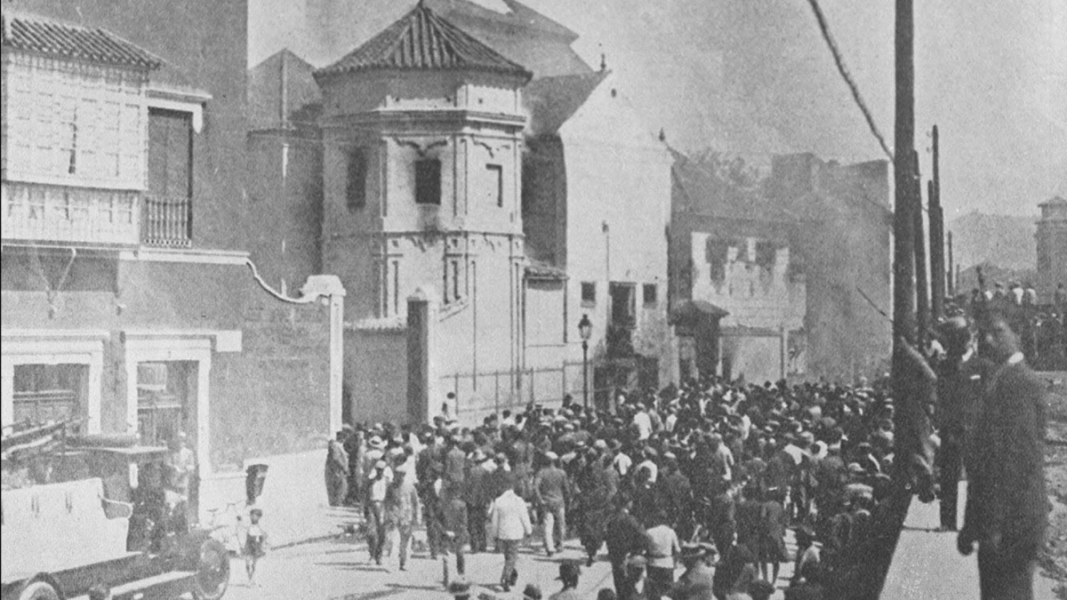
The chapter opens in a climate where the Second Republic, newly established, declared itself secular, modern, and bearer of a new political horizon. However, barely a few weeks had passed when an old demon surfaced: violent anticlericalism. On May 10, a simple rumor—the supposed murder of a taxi driver by Catholics—was enough for the mobs to set fire to religious buildings, centuries-old libraries, and entire convents, including that of the Jesuits, losing treasures from the Golden Age and works by Zurbarán or Van Dyck.
The image of a country that aspired to be “new” was tarnished by photographs of agitators posing with mummified bodies extracted from crypts. More than a hundred religious buildings burned in a few hours. And the Government, far from quelling the violence, merely watched it: Azaña declared that no temple was worth the life of a worker. The message was as clear as it was unsettling: public order was subordinated to ideology.
Franco’s silence in the face of chaos: discipline against vendetta
The young Franco witnessed these events with deep disappointment, not out of piety—Roa recalls that he was not “a devout Catholic” and in Dar Riffien he forbade “women and priests”—but because he intuited what was at stake: Spain was violating its own historical spirit. While intellectual elites declared themselves equidistant, Franco remained silent, true to his style: observe, evaluate, do not expose oneself prematurely.
That silence was his form of inner resistance. Discipline, always discipline. The same principle he would teach his cadets in the famous address after the abrupt closure of the Military Academy of Zaragoza: obedience even when “the heart struggles to launch itself in intimate rebellion”.
Azaña against the Army: the fracture that ignited a country
In Roa’s account, one sees an Azaña intent on reconfiguring the Army from resentment. His memoirs leave brushstrokes of contempt toward his own commanders: he reduced staffs, demoted officers, ignored promotions, and closed the General Military Academy without technical justification. Franco was one of the main victims: from first in his class, he was relegated to last; his career was put on hold; his discipline was called into question; his service record stained by a negative note that would pursue him for years.
The clash between them was not ideological, but one of character. Azaña expected submission; Franco delivered discipline. They are different things.
Spain judges its dead
The Republic, in its thirst for moral exemplarity, went to the extreme of trying in absentia Alfonso XIII… and also the deceased Primo de Rivera. The trials, grotesque in their theatricality, revealed a politics turned into a circus: death sentences commuted, massive confiscations, and inflammatory speeches against the monarchy. For Franco, a monarchist by historical conviction more than sentiment, that spectacle was unbearable: it was not errors being judged, but symbols.
The atmosphere grew tense. The streets pointed fingers at monarchists and Catholics; wearing a crucifix became a risk. Even Franco’s demeanor—usually serene, even jovial in African times—darkened.
Sanjurjo, Azaña, and a country on the brink of the abyss
In this climate of military humiliation and social disorder, the famous “Sanjurjada” of August 10, 1932, erupts. Sanjurjo, former chief of the Civil Guard, sought to capitalize on the discontent and rebelled. But the uprising failed in hours. Franco, far from joining, remained watchful in La Coruña, loyal to the Government but aware that the country was heading toward a point of no return.
And then he let slip a phrase that Niko Roa records as a portent:
“The day they dissolve the Civil Guard, or when the hour of communism arrives… I will take to the countryside.”
It was not a threat: it was a reading of historical time.
In The Young Franco, Niko Roa reconstructs with surgical precision the years in which the Republic went from promise to disillusionment, and in which Franco—still far from any political prominence—forged himself in silence, reading, observing, and understanding that Spain was entering a spiral that would soon demand extreme decisions. A book that invites us to reread a decisive period without clichés, without simplifications, and with the sobriety that history demands.