


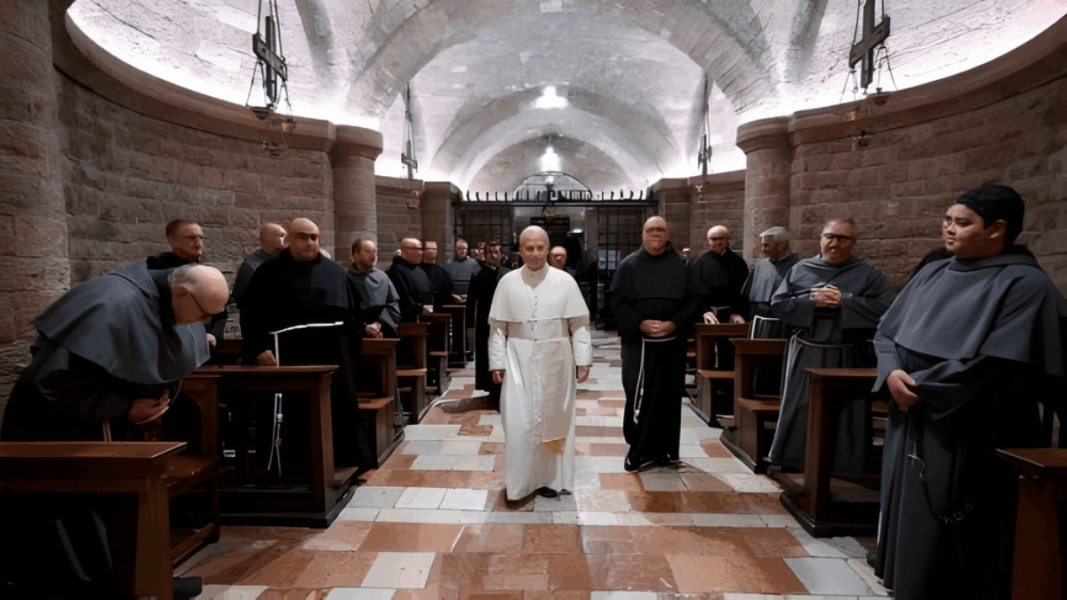
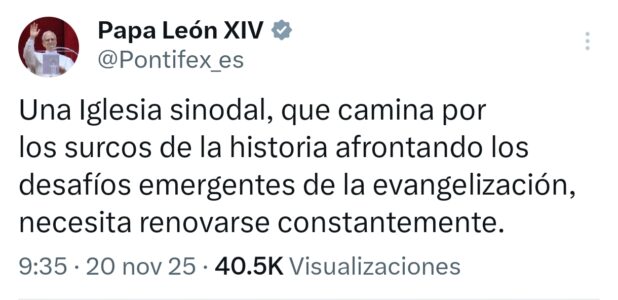
The recent speech of Pope Leo XIV delivered in Assisi left several highlighted phrases, one of them, published on the social network X—«A synodal Church, which walks through the furrows of history facing the emerging challenges of evangelization, needs to renew itself constantly»— brings back to the table a debate that we have not yet overcome: where should the true focus of ecclesial renewal be placed? The insistence on the «synodal», the «assembly-like» or the «adaptive» runs the risk of becoming a mental framework from which everything is interpreted, even that which by its very nature exceeds the transitory. And at the bottom of this tension beats a crucial question: why insist so much on the contingent when precisely the young people—the great pastoral concern of the 21st century—seek the permanent?
The contemporary thirst for what does not perish
One of the greatest cultural paradoxes of our time is that, even living in a liquid society that has renounced permanence, the new generations show a growing need for stable meanings, roots, and ontological certainties. Modern culture has renounced perennial categories, replacing them with a functional relativism in which the true, the good, and the beautiful cease to exist as objective realities. This anthropological emptying has generated disoriented, fragmented, and existentially vulnerable individuals.
It is no coincidence that crises of meaning proliferate or the inability to project life toward the future. When the permanent is suppressed, the human being is left suspended in a present that offers no support. And precisely here the decisive question arises: the human soul does not live on the ephemeral. The thirst for transcendence is not quenched with structural adaptations or administrative processes.
Renewal is not permanent aggiornamento
The word «renewal» has undergone a semantic drift since the late 20th century. It has been confused with unlimited plasticity, as if the Church had to reinvent itself constantly to «keep up» with each new cultural climate. But this idea responds more to a mindset typical of the 1990s—dominated by fashionable sociological theories, institutional modernization urges, and fascination with participatory language—than to the true spirit of Tradition.
The Pope and many of the communication advisors around him seem to be installed in that mentality very frequently, without realizing that the current culture has radically shifted toward other searches. Today, more than ever, the Church has the historical opportunity to rediscover that its strength does not lie in updating its structure, but in safeguarding what does not pass away.
The eternal as the foundation of the mission
The Church has survived empires, revolutions, and paradigm shifts not because it has mimicked each era, but because it has preserved truths that transcend all times. When the Church focuses exclusively on the temporal—processes, structures, synods, participatory methodologies—it runs the risk of diluting its identity until it becomes a spiritual NGO, incapable of offering what only it can transmit: the revelation of an eternal, personal truth embodied in Christ.
True Christian renewal has always arisen from a return to the perennial: the Desert Fathers, the Benedictine reform, the spiritual revolution of Francis of Assisi, Trent, the evangelizing impulse of the 19th and 20th centuries. None of these great transformations was born from an administrative assembly. All sprang from turning one’s gaze to the Eternal.
The risk of confusing the means with the end
Synodal language may have its function, yet to be demonstrated, but it becomes a problem when it is absolutized. At times, it seems that synodality has gone from being a means to being an end, overshadowing what truly sustains the Church: truth, grace, and the spiritual deposit that does not change.
The obsession with the structural can end up displacing the essential: conversion, doctrine, sacraments, holiness as a real goal, truths that shape human existence. If the permanent is lost, everything else is left hanging in the air.
Returning to what does not pass: the true response to the crisis
The new generation is not waiting for assemblies. It is not waiting for technical documents. And certainly not waiting for the Church to function like just another institution in the social ecosystem. Youth seeks solid truth, stable identity, moral authority, a horizon that transcends death, a life proposal that does not depend on the latest sociological consensus.
The future of the Church—and authentic renewal—does not lie in multiplying processes, but in returning to what has never ceased to be its treasure: the eternal, the absolute, what is not negotiable.