


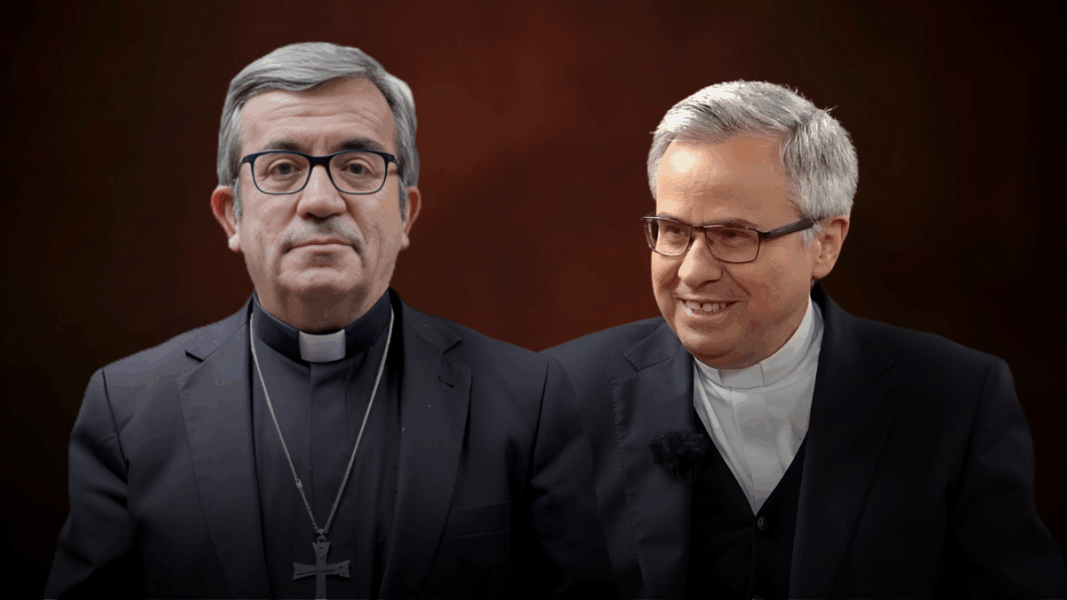
A few days ago, Msgr. Planellas, Archbishop of Tarragona, stated in an interview granted to the newspaper Público that «praying the rosary at the door of an abortion clinic is to ideologize and banalize prayer», a statement that leaves us breathless coming from a bishop—although today nothing surprises us anymore—.
Read also: Planellas gives an interview and once again embarrasses the suffering faithful people
Planellas appealed to the plurality of the Church to justify his response. «What do you gain with this?» he finally asked before presenting the accompaniment plans that his archdiocese has to help «disoriented» women who have decided for life.
«I believe that this is working for life and not going to an abortorio [to an abortion center], holding a demonstration and praying a rosary».
The spiritual battle and the power of the rosary
Perhaps Planellas missed more catechism classes on prayer, or no one ever taught him what the rosary was; maybe reading a few lives of saints and reviewing the messages of Fatima and Lourdes would have helped. Throughout the centuries, the saints have repeated with unmistakable clarity that prayer—and in particular the rosary—is not a devotional ornament, but a real weapon in the spiritual battle.
St. Pio of Pietrelcina called it “the weapon for these times”, convinced that each Hail Mary opens a crack in the darkness that surrounds the world. For St. John Paul II, the rosary was “Mary’s school”, where the heart learns to look at reality with the eyes of faith, even in the midst of pain. St. Teresa of Calcutta assured that there is no situation so broken that it cannot begin to be put back together with a rosary in hand. And saints like Dominic de Guzmán, Louis Mary Grignion de Montfort, or Maximilian Kolbe saw in it a chain that does not bind, but liberates, capable of changing souls, families, and entire nations.
For Catholics, prayer is not a passive gesture: it is a direct intervention by God in the midst of history. That is why, when Christians pray before evil, they do not “banalize” anything; they do exactly what the Church has always done to confront what the world does not want to look at.
Argüello’s response
Days later, in the opening speech of the Plenary Assembly of the Spanish Episcopal Conference (CEE), Msgr. Argüello, president of the CEE and Archbishop of Valladolid, dedicated extensive words to reflect on abortion and the reality that Spain is going through in this time.
Publicly affirming that abortion is objectively immoral, since it means putting an end to the life of a person distinct from his mother and father, is to risk hearing strong personal, social, and political disqualifications: “Question this conquest? Doubt this right? It is the paroxysm of fascist and authoritarian thought that deserves the immediate label of far right.” Even worse, affirming that there are non-religious arguments against abortion is unimaginable.
The response to Planellas came strong and clear:
Offering information to pregnant women is considered an abuse and praying in front of an abortorio a threat. Why this rejection of reasoning and letting science—DNA, genome, ultrasound, etc.—speak, inform, and allow the truth to be known?
Putting faith in effort and not trusting in prayer
In the end, it all comes down to this: when a shepherd distrusts the power of prayer and places his hope solely in structures, programs, or strategies, he is unwittingly saying that man can do more than God. It is exactly the opposite of what Christ taught and what every saint who has sustained the Church in turbulent times lived.
Planellas talks about “projects”—and blessed be they—, but he forgets that without prayer all human effort remains on the surface. Because when the Church begins to trust more in its own hands than in those of God, the enemy does not need to do much more: the battle is already lost before it begins.