


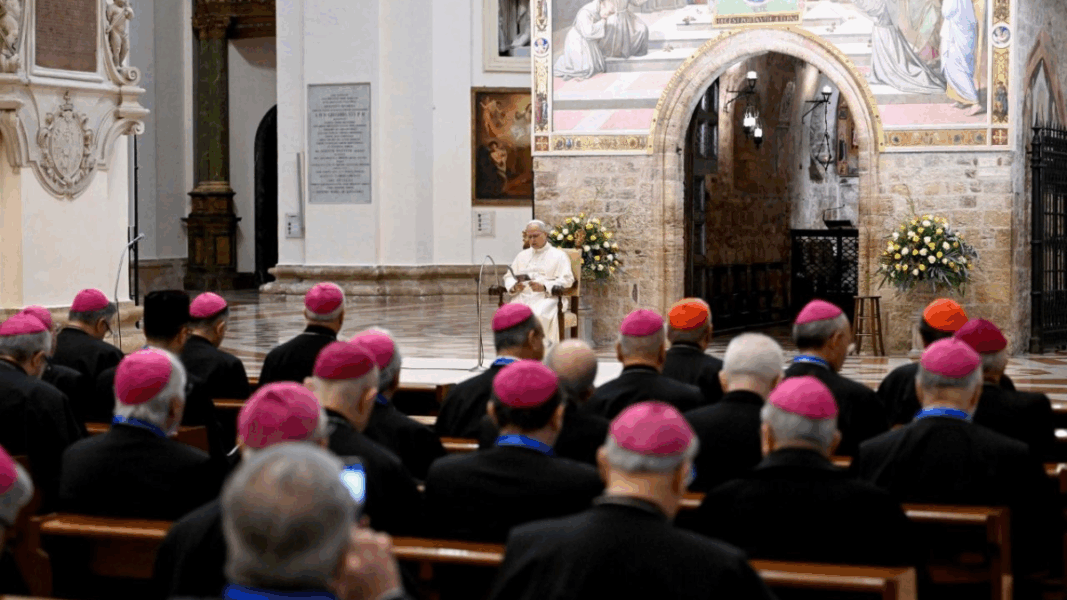
During his visit to Assisi to close the 81st General Assembly of the Italian Episcopal Conference, Pope Leo XIV asked the bishops to “put Jesus Christ at the center” and rebuild ecclesial life from the kerygma. In a context marked by social tensions, loneliness, violence, and cultural fragmentation, the Pontiff insisted that the Church must become an “artisan of peace, fraternity, and authentic relationships” capable of sustaining a wounded world.
«Keeping our gaze on the Face of Jesus makes us capable of looking at the faces of our brothers.»
A synodal church
The Pope emphasized that synodality is not an administrative exercise, but a “walking together with Christ and toward the Kingdom,” which demands real communion, shared decisions, and courage to face necessary reforms.
«To you, bishops, it now falls to outline the pastoral lines for the coming years; for this reason, I wish to offer you some reflections so that a truly synodal spirit may grow and mature in the Churches and among the Churches of our country.»
Among them, he asked not to back down in the process of reorganizing the dioceses and to strengthen the participation of the People of God in the consultation for new bishops.
«What matters is that, in this synodal style, we learn to work together and that in the particular Churches we all commit ourselves to building open, hospitable, and welcoming Christian communities, in which relationships translate into mutual co-responsibility for the proclamation of the Gospel.»
He also stressed the importance of respecting the norm of 75 years to leave pastoral government, except in exceptional cases.
Integral humanism
Leo XIV called for keeping alive the memory of the post-conciliar journey, promoting an integral humanism that defends life, legality, and solidarity, and educating a responsible Christian presence in the digital realm.
«Pastoral care cannot be limited to ‘using’ the media, but must educate to inhabit the digital world in a human way, so that truth is not lost behind the multiplication of connections, so that the network can truly be a space of freedom, responsibility, and fraternity.»
Finally, he urged the bishops to remain close to families, young people, the elderly, the poor, and victims of abuse, reminding them that where pain is deepest “the hope born of communion must be even stronger.”
The synodal style of St. Francis of Assisi
Finally, Leo XIV urged the bishops and cardinals to follow as an example St. Francis of Assisi and his religious brothers:
«In this place, St. Francis and the first friars fully lived what, in today’s language, we call ‘synodal style.’ Together, in fact, they shared the various stages of their journey.»
He thus concluded his speech by asking «that the example of St. Francis give us also the strength to make choices inspired by an authentic faith and to be, as Church, a sign and witness of the Kingdom of God in the world.»
We leave below the full speech delivered by Leo XIV:
Dearest brothers in the episcopate, good morning!
I sincerely thank the Cardinal President for the words of greeting he addressed to me and for the invitation to be with you today to conclude the 81st General Assembly. And I am glad for this first stop of mine, though very brief, in Assisi, a place of the highest significance for the message of faith, fraternity, and peace it conveys, of which the world has urgent need.
Here St. Francis received from the Lord the revelation that he was to «live according to the form of the holy Gospel» (2Test 14: FF 116). Christ, in fact, «who was rich above all things, chose in this world, together with the most blessed Virgin, his mother, poverty» (2Lf 5: FF 182).
Looking at Jesus is the first thing to which we too are called. The reason for our presence here, in fact, is faith in Him, crucified and risen. As I told you in June: in this time we have more than ever need «to put Jesus Christ at the center and, on the path indicated by Evangelii gaudium, help people to live a personal relationship with Him, to discover the joy of the Gospel. In a time of great fragmentation, it is necessary to return to the foundations of our faith, to the kerygma» (Address to the Bishops of the Italian Episcopal Conference, June 17, 2025). And this applies above all to us: to start again from the act of faith that makes us recognize Christ as Savior and that unfolds in all areas of daily life.
Keeping our gaze on the Face of Jesus makes us capable of looking at the faces of our brothers. It is His love that impels us toward them (cf. 2 Cor 5,14). And faith in Him, our peace (cf. Ef 2,14), asks us to offer everyone the gift of His peace. We live in a time marked by fractures, both in national and international contexts: messages and languages tinged with hostility and violence are often spread; the race for efficiency leaves the most fragile behind; technological omnipotence compresses freedom; loneliness consumes hope, while numerous uncertainties weigh like unknowns on our future. And yet, the Word and the Spirit still exhort us to be artisans of friendship, of fraternity, of authentic relationships in our communities, where, without reservations or fears, we must listen and harmonize tensions, developing a culture of encounter and thus becoming a prophecy of peace for the world. When the Risen One appears to the disciples, His first words are: «Peace be with you» (Jn 20,19.21). And He immediately sends them, as the Father has sent Him (v. 21): the paschal gift is for them, but so that it may be for all!
Dearest ones, in our previous meeting I pointed out some coordinates to be a Church that embodies the Gospel and is a sign of the Kingdom of God: the proclamation of the message of salvation, the building of peace, the promotion of human dignity, the culture of dialogue, the Christian anthropological vision. Today I would like to emphasize that these instances correspond to the perspectives that emerged in the Synodal Journey of the Church in Italy. To you, bishops, it now falls to outline the pastoral lines for the coming years; for this reason, I wish to offer you some reflections so that a truly synodal spirit may grow and mature in the Churches and among the Churches of our country.
First of all, let us not forget that synodality indicates the «walking together of Christians with Christ and toward the Kingdom of God, in union with all humanity» (Final Document of the Second Session of the XVI Ordinary General Assembly of the Synod of Bishops, 28). From the Lord we receive the grace of communion, which animates and shapes our human and ecclesial relationships.
On the challenge of an effective communion, I desire that there be the commitment of all, so that the face of a collegial Church may take shape, which shares steps and common decisions. In this sense, the challenges of evangelization and the changes of the last decades, which affect the demographic, cultural, and ecclesial spheres, ask us not to back down on the issue of diocesan groupings, especially where the demands of Christian proclamation invite us to overcome certain territorial boundaries and to make our religious and ecclesial identities more open, learning to work together and to rethink pastoral action by uniting forces. At the same time, looking at the physiognomy of the Church in Italy, embodied in the various territories, and considering the fatigue and sometimes disorientation that such decisions can provoke, I desire that the bishops of each Region carry out an attentive discernment and, perhaps, manage to suggest realistic proposals on some of the small dioceses that have few human resources, to evaluate whether and how they could continue to offer their service.
What matters is that, in this synodal style, we learn to work together and that in the particular Churches we all commit ourselves to building open, hospitable, and welcoming Christian communities, in which relationships translate into mutual co-responsibility for the proclamation of the Gospel.
Synodality, which implies an effective exercise of collegiality, requires not only communion between you and me, but also an attentive listening and serious discernment of the instances that come from the people of God. In this sense, the coordination between the Dicastery for Bishops and the Apostolic Nunciature, with a view to a common co-responsibility, must be able to promote greater participation of people in the consultation for the appointment of new bishops, in addition to the listening of the Ordinaries in office in the local Churches and of those who are about to conclude their service.
Also on this last aspect, allow me to offer you some indication. A synodal Church, which walks in the furrows of history facing the emerging challenges of evangelization, needs to renew itself constantly. It is necessary to avoid that, even with good intentions, inertia slows down the necessary changes. In this regard, we all must cultivate the inner attitude that Pope Francis defined as “learning to say goodbye,” a precious attitude when one must prepare to leave one’s position. It is good to respect the norm of 75 years for the conclusion of the service of Ordinaries in the dioceses and, only in the case of cardinals, a continuation of the ministry may be evaluated, possibly for another two years.
Dear brothers, returning to the horizon of the mission of the Church in Italy, I exhort you to remember the path traveled after the Second Vatican Council, marked by the national ecclesial congresses. And I exhort you to ensure that your diocesan and parish communities do not lose the memory, but keep it alive, because this is essential in the Church: to remember the path that the Lord makes us travel through time in the desert (cf. Dt 8).
In this perspective, the Church in Italy can and must continue to promote an integral humanism, which helps and sustains the existential itineraries of people and society; a sense of the human that exalts the value of life and the care of every creature, that intervenes prophetically in the public debate to spread a culture of legality and solidarity.
In this context, the challenge posed by the digital universe must not be forgotten. Pastoral care cannot be limited to “using” the media, but must educate to inhabit the digital world in a human way, so that truth is not lost behind the multiplication of connections, so that the network can truly be a space of freedom, responsibility, and fraternity.
Walking together, walking with everyone, also means being a Church that lives among the people, welcomes their questions, alleviates their sufferings, and shares their hopes. Continue to be close to families, to young people, to the elderly, to those who live in loneliness. Continue to devote yourselves to the care of the poor: Christian communities rooted in a capillary way in the territory, the many pastoral agents and volunteers, the diocesan and parish Caritas already do great work in this sense, and I thank you for it.
In this line of care, I would also like to recommend attention to the smallest and most vulnerable, so that a culture of prevention of every form of abuse may also develop. The welcome and listening to victims are the authentic seal of a Church that, in community conversion, knows how to recognize wounds and commits itself to alleviating them, because «where pain is deep, the hope born of communion must be even stronger» (Vigil of the Jubilee of Consolation, September 15, 2025). I thank you for what you have already done and encourage you to continue in your commitment to the protection of minors and vulnerable adults.
Dearest brothers, in this place St. Francis and the first friars fully lived what, in today’s language, we call “synodal style.” Together, in fact, they shared the various stages of their journey; together they went to Pope Innocent III; together, year after year, they perfected and enriched the initial text that had been presented to the Pontiff, composed, says Thomas of Celano, «above all of expressions from the Gospel» (1Cel 32: FF 372), until transforming it into what we know today as the first Rule. This decisive choice for fraternity, which is the heart of the Franciscan charism together with minority, was inspired by an intrepid and persevering faith.
May the example of St. Francis give us also the strength to make choices inspired by an authentic faith and to be, as Church, a sign and witness of the Kingdom of God in the world. Thank you!