


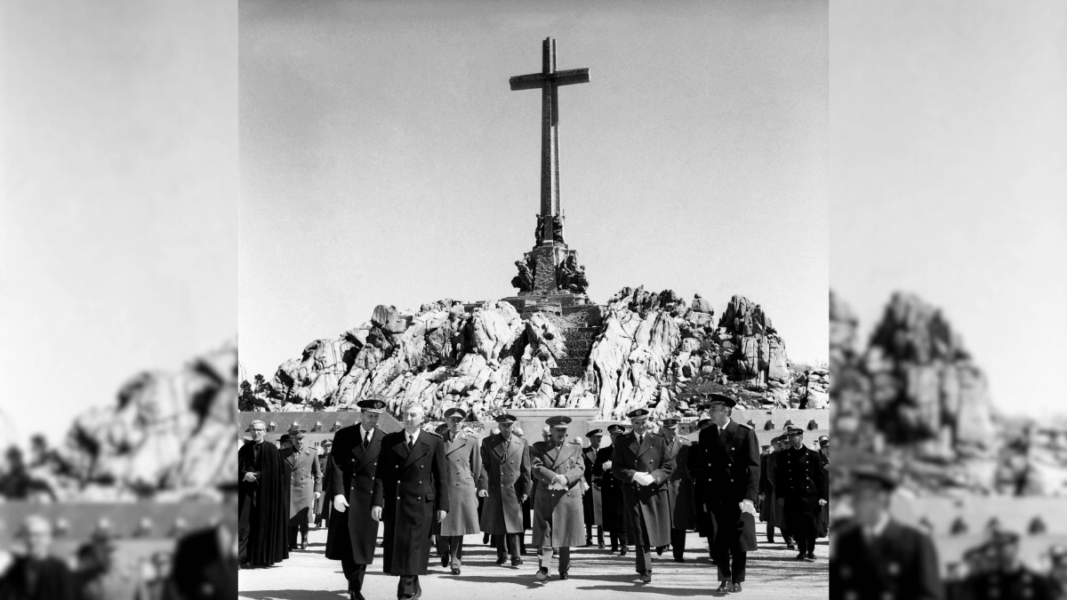
The dominant narrative repeats that Franco, like a proud pharaoh, designed his own mausoleum and rested in it surrounded by the suffering of thousands of slaves. However, historical documentation disproves this ideological construction. In the book Eternamente Franco, Pedro Fernández Barbadillo recalls, relying on the records of the doctor Ángel Lausín, that the deaths during the work amount to fifteen, between prisoners and free workers, in almost a decade of labor —a figure very different from the one that feeds the progressive imagination— and that the prisoners went voluntarily to the Valley to redeem their sentences faster, earn a salary, and live with their families.
In Cuelgamuros there was a school, marriages, baptisms, communions. They resemble very little —if anything— the extermination camps with which forced parallels are now attempted to be drawn. But in the official narrative, nuances are superfluous: what matters is not the truth, but the symbol.
Franco did not think he would be buried there
Perhaps the revelation is simpler: Franco had no intention of being buried in the Valley. The proof is so evident that it surprises how silently it has been buried: the Franco family bought a pantheon in the El Pardo cemetery, where Carmen Polo rests today.
The general left no instructions in his political testament about his tomb, nor did he express any preference. It was the State that decided his final destination.
Operation Lucero: the State planned the burial
The details are revealing. In the months prior to Franco’s death, the SECED prepared the so-called Operation Lucero, a roadmap to ensure political stability after the death of the Head of State: protocol, proclamation of the king… and yes, also the choice of the burial place. As General Peñaranda explains, the Valley was, simply, the “practical” option: outside the city, monumental, secure, and equipped with conditions to accommodate crowds.
The family was not consulted. It was not debated in the Council of Ministers. There was no parliamentary deliberation.
It was a technical decision. And it was the State —not Franco— who chose Cuelgamuros.
One of the new king’s first orders
The scene is disconcerting today: once proclaimed, Juan Carlos ordered within hours to hand over the body to the abbot of the Valley for burial. Without endorsement from the President of the Government or any minister, a gesture that demonstrates to what extent the decision had already been agreed upon long before.
The chosen place was so improvised that the grave had to be excavated in a hurry behind the main altar. An eloquent fact: if Franco had planned that detail, the work would have been prepared years in advance.
The new narrative: desecrate to rewrite
Decades later, the left and nationalist parties promoted the exhumation as part of a broader strategy: to present the Transition as a capitulation to Francoism and legitimize “historical memory” as an instrument of power. In 2018, the Government approved a decree-law ordering the desecration, without ever explaining why Franco was buried there, as if he had spontaneously appeared under the basilica.
The omission is not innocent: if it were accepted that it was the State —and not the family or the dictator— who decided the burial, the moral narrative that justifies the exhumation would collapse.
The repetition of the old ritual: defeat the dead
Barbadillo collects Jiménez Losantos’s analysis on the deep meaning of the desecration: when a dead adversary cannot be defeated politically, his tomb is destroyed to reaffirm moral superiority. The French revolutionaries did it with the royal sepulchers. The communists did it with the “whites.” The anticlerical mobs of 1936 did it posing with nuns’ corpses. And they repeat it today, those who display Franco’s symbolic skull to satiate their hunger for ideological legitimacy.
The next step: attack the Cross
The exhumation was only the first act. Already in 2018, left-wing sectors shamelessly proposed dismantling the Valley’s Cross stone by stone, to turn Cuelgamuros into a “memory center.” The world’s largest cross, erected to honor all the dead, has become an obsession for those who conceive history not as a legacy, but as a symbolic battlefield.
That time has already come, we are living it, the “resignification” plan is underway: The crack in the Valley: a Taliban project against faith and art
Tertsch himself, quoted in the chapter, sums it up like this: the Valley must be a dike against the tsunami of lies. And thousands of Spaniards who go every week to hear Mass or see the monument demonstrate it: there is a memory that cannot be rewritten.
In Eternamente Franco, Pedro Fernández Barbadillo reconstructs with surgical precision an episode manipulated for decades. His narrative restores the context, the facts, and the voices silenced by propaganda. A chapter that invites you to keep reading a book that dismantles myths with a rigor that today —perhaps precisely because of that— is uncomfortable.