


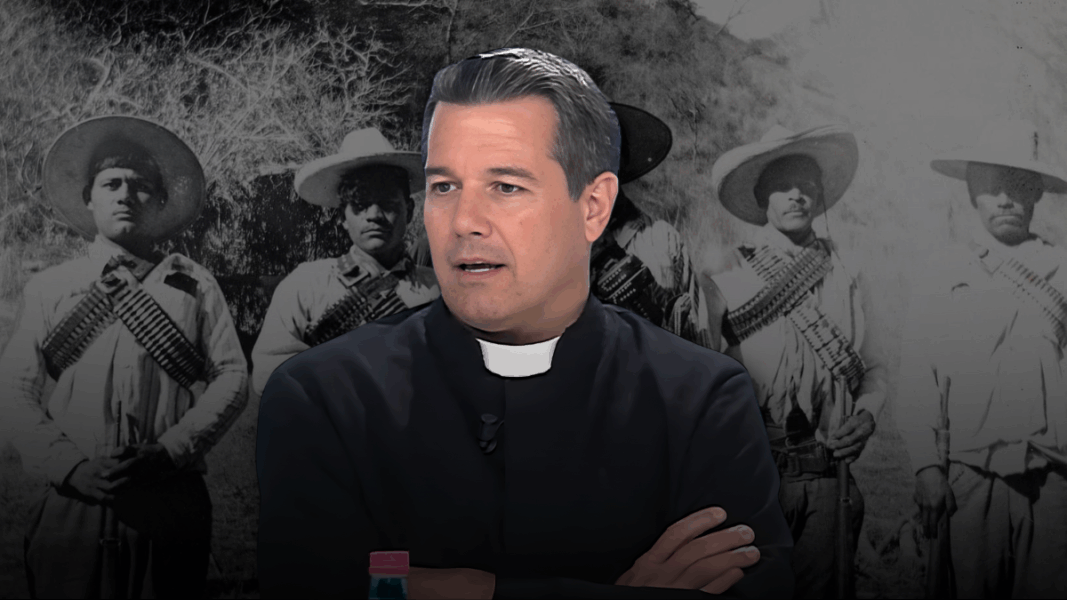
The Argentine priest Javier Olivera Ravasi, known for his apologetic work and for the channel Que no te la cuenten, visited Madrid to present his book La Contrarrevolución Cristera, a work that rescues the religious persecution in Mexico between 1926 and 1929 and the uprising of the Catholic people against the Calles Law. During his interview on Dando Caña (El Toro TV), he offered a historical analysis and a direct critique of the current situation of the Church, marked by doctrinal confusion and cultural capitulation.
The Cristero War: fidelity in the face of anti-Catholic power
The priest emphasized that his book seeks to show that the Cristero resistance was not merely a political uprising, but an act of faith that arose from the people in the face of the lukewarmness of part of the hierarchy. «The Cristeros did not rise up for ideology, but because they took away the Mass, the sacraments, the temples. They took away Christ from them», he affirmed.
For Olivera, that contrast has current resonance: «If one looks at history, it is not the first time that simple people sustain the faith when some pastors waver». That phrase serves as a bridge to his critical analysis of the contemporary Church.
Lack of doctrinal and disciplinary clarity in today’s Church
During the conversation, Olivera addressed the moral and disciplinary crisis within the clergy, exemplified by various recent scandals in Spain, such as that of «Josete» or the priest from El Álamo—topics widely disseminated by Infovaticana—and denounced the initial lack of reaction from some bishops to serious cases, recalling Benedict XVI’s instruction on the risk of admitting seminary candidates with deeply rooted homosexual tendencies.
When speaking of the current doctrinal confusion, Olivera used an example: «Today you ask in a Catholic university what the hypostatic union is and they tell you: ‘How do you eat that?’». He contrasted this superficiality with the great doctrinal debates of the past: «In the times of Arianism, in the baths they discussed whether the Son was begotten or created. Today we discuss whether Jesus Christ is true God… because many no longer know how to explain it».
The priest denounced that part of the clergy has replaced doctrinal clarity with an “ecclesial hippism” that seeks to please everyone, but abandons Christian truth: «I cannot be asking people for orthodoxy if from above they are sending me a kind of sweetened doctrine».
The debate on praying in front of abortion clinics: “The delirious thing is to condemn prayer”
The panelists, along with Olivera, reviewed the video of Planellas and his statements about praying the rosary in front of abortion centers, which he described as “banalization of prayer”. Olivera responded firmly:
«Praying in front of an abortion clinic saves lives. The delirious thing is to label it as ideological and to remain silent before confusing liturgies or syncretistic celebrations.»
He also recounted that in the United States he himself goes with his community to pray in front of abortion clinics and has seen direct testimonies from women who abandoned the idea of aborting upon seeing people praying in silence: «Many times a look, a word, or simply the presence are what stop a death».
The mariological controversy: “Problems are created where there were none”
The priest also addressed the controversies generated around the document from the Dicastery for the Doctrine of the Faith on the Marian title of “Co-Redemptrix”. He questioned the timeliness and ecumenical motivation of the text and recalled that numerous popes and saints used that title in a clear and orthodox sense.
«Many popes and saints used that title with clarity. There was no theological problem. The problem was created now, perhaps due to an excess of misunderstood ecumenism.»
In his view, the problem is not the theological discussion, but the general climate of disorientation and the tendency to create non-existent theological problems.
A horizon of hope amid the confusion
Despite the critical panorama he described, Olivera emphasized that the Church is not defeated. He highlighted the vocational growth in places like Madrid and the emergence of new priests with doctrinal firmness and a desire for authenticity. According to him, “the more rot is seen, the more beauty emerges”, recalling that the current confusion is pushing many young people to seek a more solid and uncomplexed faith.
The priest concluded by encouraging overcoming self-censorship and speaking clearly: “Only the truth makes us free. There is only one life: it makes no sense to remain silent until it is too late”. His message, between denunciation and hope, made clear the background that also runs through his work on the Cristero War: faith is not negotiated, and when the world becomes hostile, Christians are called to give full witness, without fear and without duplicity.