


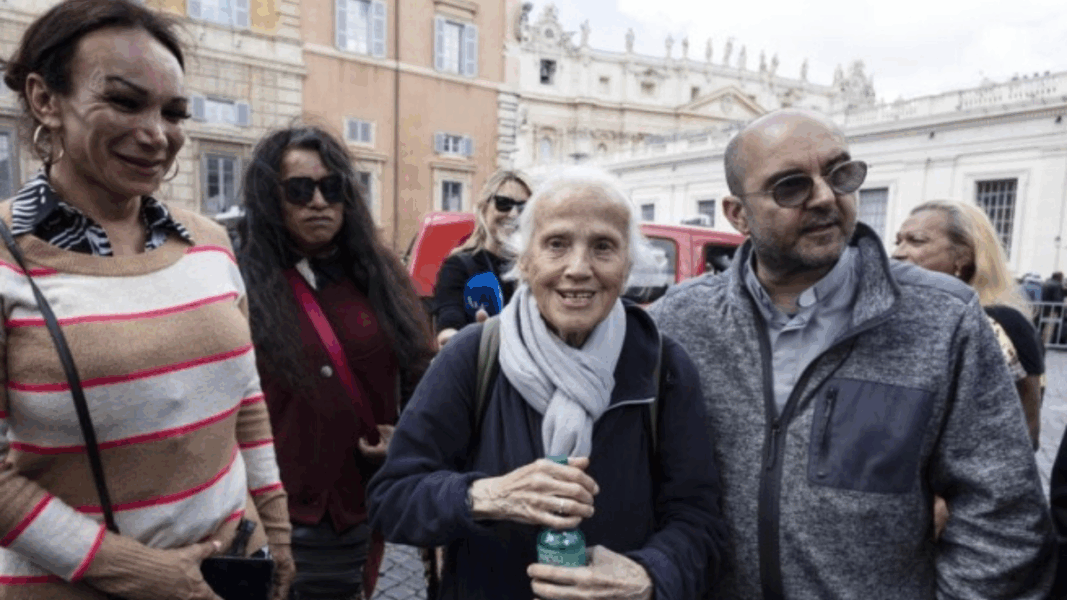
The lunch of the Jubilee of the Poor on November 16th, presided over by Pope Leo XIV in the Paul VI Hall, gathered —according to official figures— more than 1,300 people in situations of poverty or social exclusion: homeless, migrants, elderly, and usual recipients of Vatican charity.
But among the guests there was also a very visible group: around 40–50 people who identify as “trans women”, several of them turned into media referents and activists, with a long history of contact with the Vatican during Francis’s pontificate.
The question is inevitable: what exactly were those trans activists doing at a lunch “for the poor”?
A selected group: not just “random guests”
Media outlets like LifeSiteNews and other portals had already reported that, among the guests, was the Italian trans activist Alessia Nobile, accompanied by four other activists, in what was described as an “official” lunch with the Pope, as part of the Jubilee of the Poor.
The Italian agency LaPresse confirmed that the event would be attended by “more than 40 trans people”, invited as a group, accompanied by the priest Andrea Conocchia, parish priest of Torvaianica, known for his steady work with the trans community on the outskirts of Rome.
Vatican sources emphasize that tickets for the lunch are distributed through parishes and charitable organizations, without public lists. However, in this specific case, it was not a matter of individuals arriving on their own, but of an organized group, with leaders, companions, and prior coverage in international media.
Who is Alessia Nobile?
The most well-known face of the group is Alessia Nobile (pseudonym of Alessia Vessia), born in Bari in 1979, author, sex worker, and activist for “trans rights” in Italy.
Nobile has published an autobiographical book, La bambina invisibile. Diario di una transizione, in which she recounts her transition process and personal journey. She is a regular figure in Italian media, conferences, and public events, where she combines LGBT militancy, media exposure, and constant presence in the cultural debate.
In 2022, she had already been received by Pope Francis in an audience with other trans people, and the then pontiff even responded to her with a personal letter, addressing her as “dear sister”, as reported by various media.
In other words: we are not dealing with an anonymous guest picked up off the street, but with a professional activist, well-known, with a literary background and media network, who returns to the Vatican now with Leo XIV as the visible face of “trans inclusion”.
And who is Marcella Di Marco?
Another of the people mentioned by the press is Marcella Di Marco, presented in some reports as a “52-year-old trans woman”, who expressed some disappointment at not having been seated at the Pope’s table, but interpreted the event as a sign that “the Church is not going to close the door that Francis opened”.
Far from being a marginal person without resources, Di Marco appears on her own professional profile as a communications consultant and “coach”, with experience in agencies and companies in various sectors, including fashion, and president of a youth association (Ad Astra) dedicated to educational projects.
Her presence, therefore, fits the profile of a high-profile activist and communications professional rather than that of a simple “poor” person assisted by Vatican charity.
The network behind the group: Conocchia, Sister Geneviève, and the “trans community” of Rome
The group does not appear out of nowhere. Behind it is a network known for years: the parish of Torvaianica (Roman outskirts), where Father Andrea Conocchia has been welcoming trans people for some time, many of them migrants and sex workers, to whom material help (food, medicines, hygiene products) was offered during the pandemic.
Alongside him moves the nun Sister Geneviève Jeanningros, 81 years old, a nun who lives in carnival trailers in Ostia and who has been assisting trans women and carnival workers on the Lazio coast for decades. Francis called her the “enfant terrible” and allowed her to regularly bring groups of homosexuals and transsexuals to the Wednesday general audiences.
This established and organized network —priest, nun, group of Roman “trans women”, media activists— has been the constant gateway between the trans community and the Vatican, first with Francis and now with Leo XIV.
Are they “poor” or are they “political signs”?
The Jubilee lunch is officially presented as a gesture of closeness to the “poor” and “excluded”, and certainly several of the trans attendees come from contexts of real marginality: migration, prostitution, economic precariousness.
However, the composition of the group shows something more: media activists like Nobile, with a book, constant presence on TV, and direct ties to two popes; qualified professionals like Di Marco, with a background in consulting and educational projects; a very consolidated pro-LGBT pastoral structure, with Conocchia and Sister Geneviève as visible faces, who do not hide their intention to consolidate a stable presence of the trans agenda at the heart of the Vatican.
More than a casual group of guests, we are faced with a carefully articulated collective, which functions as a political and pastoral symbol within the framework of the so-called “outgoing Church” toward LGBT groups.
The reading of the protagonists themselves
Both Nobile and other attendees interpret the lunch as a sign of continuity with Francis’s line. Before the meeting, Nobile told Italian media that she hoped to ask Leo XIV not to “backtrack on” LGBT “rights”.
Read also: Leo XIV will share an official lunch with trans activists during the Jubilee of the Poor
After the event, several participants noted that, although Leo XIV is “different” from his predecessor and the gesture was less visible than with Francis, they perceive that “the door has not been closed” and that the new Pope’s heart “is open” toward them.
In that sense, the initial question answers itself: they were not there “as poor”, but as privileged interlocutors of a strategy of presence and visibility, which has been building for years on the margins of Rome and now sits —literally— at the Pope’s table.