


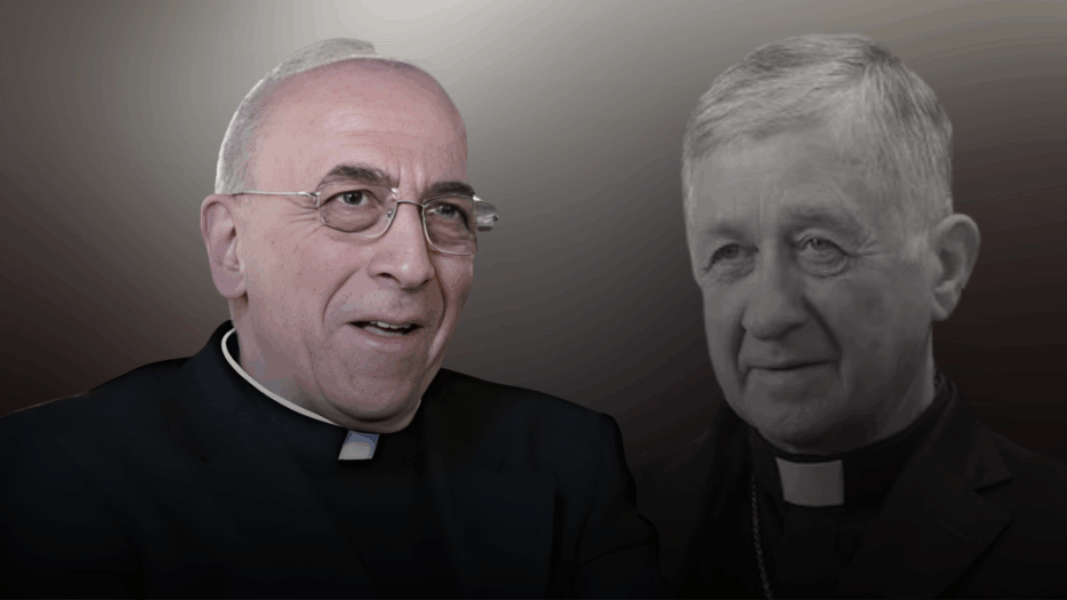
The Italian priest and theologian Nicola Bux, consultant on liturgical matters during the pontificates of Benedict XVI and Francis, has made public an open letter addressed to Cardinal Blase Cupich, Archbishop of Chicago, in which he rebuts his recent criticisms of the Traditional Mass. The letter, published on November 18 by Edward Pentin, defends the validity and importance of the usus antiquior as an expression of the Church’s deep identity.
To provide some context, the letter is a response to Cupich’s reflection on the apostolic exhortation Dilexit te, by Leo XIV, in which the cardinal reduces the solemnity of the Mass to a fraternal assembly that can be shared with the poorest. For Cupich, the Traditional Mass turns out to be a spectacle influenced by elements of imperial and royal courts:
«The liturgical reform benefited from academic research on liturgical resources, identifying those adaptations introduced over time that incorporated elements from imperial and royal courts. That research made it clear that many of these adaptations had transformed the aesthetics and meaning of the liturgy, making the liturgy more of a spectacle than the active participation of all the baptized to form themselves to join in the saving action of the crucified Christ. By purifying the liturgy of these adaptations, the goal was to allow the liturgy to sustain the renewed sense of the Church of itself.»
Read also: Cupich turns the Mass into a social project with the help of Vatican News
This is how Msgr. Bux places his reflection in a theological key: the liturgy, he states, is not an aesthetic exercise or community animation, but the public manifestation of the worship due to God, a reality that Christians have upheld even in the face of persecutions. Therefore, he rejects that the Second Vatican Council called for a «poor» or banalized liturgy, and recalls that the «noble simplicity» requested by Sacrosanctum Concilium refers to ritual clarity, not the impoverishment of worship.
The beauty of worship as a sign of divine majesty
Bux recalls that both East and West have understood since ancient times that the liturgy possesses a «regal» quality, because it expresses that only God deserves worship. He even cites St. Francis of Assisi, who, far from advocating a stripped-down worship, asked that the best ornaments and sacred vessels be used in the Mass.
Active participation: entering the mystery, not copying the world
In the letter, the theologian revisits the conciliar notion of «active participation,» which he describes as a entry into the Mystery through prayers and rites, in continuity with St. Thomas Aquinas. He criticizes, on the other hand, the tendency to confuse participation with spectacle or animation.
He quotes a reflection by the then-priest Robert Prevost —today Pope Leo XIV— delivered in 2012, where he stated that evangelizing today involves reorienting the public’s attention from spectacle to mystery. According to Bux, this is precisely what the traditional liturgy achieves.
Warning about the «deformations» of the novus ordo
The priest invites Cupich to remember what Benedict XVI described as «deformations on the edge of the tolerable» present in some post-Conciliar liturgical contexts: applause, dances, and improper elements of worship, already denounced by St. Cyprian. Therefore, he maintains that the liturgy must preserve its solemn and apologetic character, capable of moving to conversion.
We leave below the full letter from Msgr. Bux:
To His Eminence Cardinal Blase Cupich
Your Eminence,
«Because I think that God has exhibited us apostles as last of all, like men condemned to death; because we have become a spectacle to the world, to angels, and to men» (1 Cor 4:9). This statement of the Apostle describes the identity of Christianity, both as proclamation of the Gospel and as public worship of the Church. Focusing on the latter, it can rightly be said that the liturgy is the spectacle offered to the world by those who worship Christ, the only Lord of the cosmos and history, to whom they belong and not to the world. This is recalled by the expression «liturgical service,» which is truly appropriate —unlike the term «animation,» now in vogue—, as if worship were not already animated by Jesus Christ and by the Holy Spirit.
After the persecutions, this became evident, because Christians did not burn incense to the Roman emperor, but to Jesus, the Son of God. Therefore, Catholic liturgy has royal and imperial characteristics —the Eastern liturgies teach us this— because worship of God opposes any worship of the worldly rulers of the moment.
It is not true that the Second Vatican Council desired a poor liturgy, since it asks that «the rites shine with noble simplicity» (Constitution on the Liturgy, 34), because they must speak of the majesty of God, which is the nobility of beauty itself, and not of worldly banalities. The Church understood this from the beginning, both in the East and in the West. Even St. Francis prescribed that the most precious linens and vessels be used in worship.
What then is the «participation» of the faithful, if not being part of and taking part in the «spectacle» of a faith that affirms God and therefore challenges the world and its profane spectacles, which are truly spectacular: think of megaconferences and rock concerts? The liturgy expresses the sacred, that is, the presence of God; it is not a theatrical performance. The participation desired by the last Council must be full, conscious, active, and fruitful (ibid. 11 and 14), that is, a «mystagogy,» an entry into the Mystery that takes place per preces et ritus [through prayers and rites], which, as St. Thomas reminds us, must elevate us as much as possible to the divine truth and beauty (quantum potes tantum aude); or, in the words of the then Father Robert F. Prevost: «Our mission is to introduce people to the nature of the mystery as an antidote to spectacle. Consequently, evangelization in the modern world must find the appropriate means to reorient the public’s attention, shifting it from spectacle to mystery» (May 11, 2012). The usus antiquior of the Roman rite fulfills this function; otherwise, it would not have been able to resist the secularization of the sacred that entered the Roman liturgy, to the point of making people believe that the Council itself wanted it that way. This is the identity and mission of the Church.
Finally, Eminence, I invite you to consider that the liturgy, from antiquity, was solemn in order to convert many to the faith, and for this reason it must also have an apologetic value and not imitate the fashions of the world, as St. Cyprian reminds us (applause, dances, etc.), up to the «deformations on the edge of the tolerable» that entered the novus ordo, as Benedict XVI observed. This is the authenticity of the «sacred liturgy»; this is the ars celebrandi, as demonstrated by the offertory of the Mass, which is performed for the needs of worship and for the poor.
Therefore, Eminence, I ask you to engage in a synodal dialogue for the good of ecclesial unity!
In the Lord Jesus,
Fr. Nicola Bux