


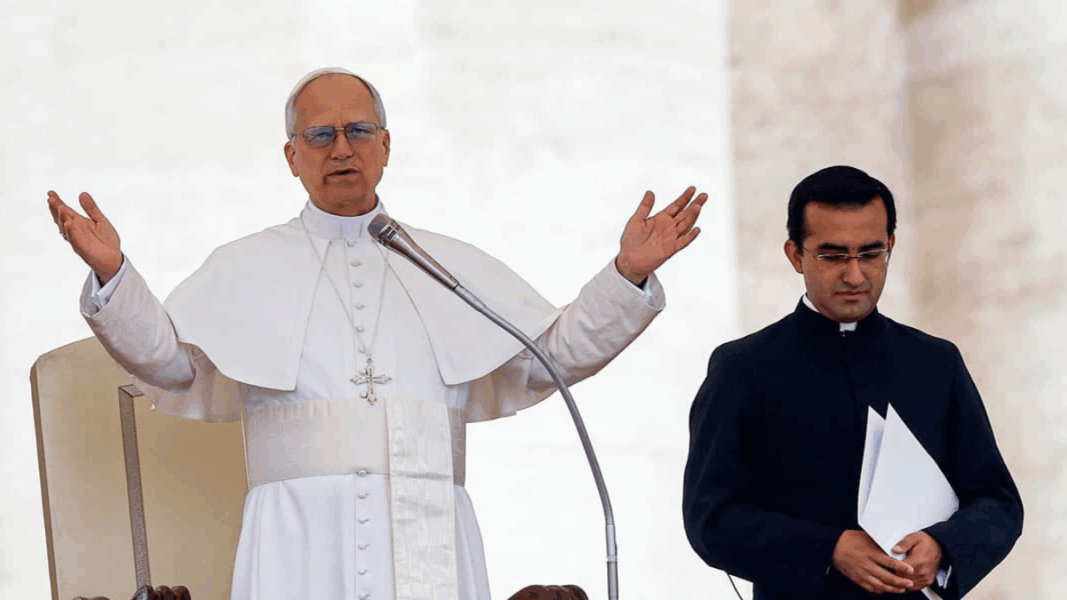
In today’s General Audience, Wednesday, November 19, held in St. Peter’s Square, Pope Leo XIV continued the cycle of catecheses for the 2025 Jubilee, dedicated to Christian hope. On this occasion, the Pontiff centered his reflection on the relationship between Christ’s Resurrection and contemporary challenges, dwelling especially on what he defined as an “Easter spirituality and integral ecology”.
In a discourse on the foundation of ecological conversion—the same one we have been hearing since Laudato si’—the Pope started from the encounter of Mary Magdalene with the Risen Christ to emphasize that the Christian’s mission—“to cultivate and care for the garden”—is not secondary, but a task that springs directly from the Paschal mystery. In this line, he took up the teaching of Francis to recall that, without a contemplative gaze, the human being can become a “devastator” of creation.
The message proposes an ecological conversion inseparable from the conversion of the heart, and affirms that from Easter springs a mission capable of activating solidarity, repairing bonds, and rediscovering the original harmony between God, the human being, and creation.
We leave below the full message from Leo XIV:
Dear brothers and sisters, good morning and welcome!
We are reflecting, in this Jubilee Year dedicated to hope, on the relationship between Christ’s Resurrection and the challenges of the present world, that is, our challenges. Sometimes Jesus, the Living One, also wants to ask us: “Why are you weeping? Whom are you seeking?”. Indeed, challenges cannot be faced alone, and tears are a gift of life when they purify our eyes and free our gaze.
The evangelist John draws our attention to a detail that we do not find in the other Gospels: weeping beside the empty tomb, Magdalene did not immediately recognize the Risen Jesus, but thought he was the gardener. Indeed, already in narrating Jesus’ burial, at dusk on Good Friday, the text was very precise: “In the place where he had been crucified there was a garden, and in the garden a new tomb in which no one had yet been laid. There, therefore, because it was the day of Preparation for the Jews and the tomb was nearby, they laid Jesus” (Jn 19:40-41).
Thus ends, in the peace of the Sabbath and the beauty of a garden, the dramatic struggle between darkness and light unleashed by the betrayal, the arrest, the abandonment, the condemnation, the humiliation, and the death of the Son, who “having loved his own who were in the world, loved them to the end” (Jn 13:1). To cultivate and care for the garden is the original task (cf. Gn 2:15) that Jesus has fulfilled. His last word on the cross—“It is finished” (Jn 19:30)—invites each one to rediscover that same task, his task. For this reason, “he bowed his head and gave up his spirit” (v. 30).
Dear brothers and sisters, Mary Magdalene, then, was not entirely wrong in believing she had encountered the gardener. Indeed, she had to hear her own name again and understand her own mission from the New Man, the one who in another Johannine text says: “Behold, I make all things new” (Rev 21:5). Pope Francis, with the Encyclical Laudato si’, has pointed out to us the extreme need for a contemplative gaze: if he is not the guardian of the garden, the human being becomes its devastator. Christian hope, therefore, responds to the challenges to which all humanity is exposed today by remaining in the garden where the Crucified was laid like a seed, to rise and bear much fruit.
Paradise is not lost, but rediscovered. The death and resurrection of Jesus are thus the foundation of a spirituality of integral ecology, without which the words of faith remain without impact on reality and the words of the sciences remain outside the heart. “Ecological culture cannot be reduced to a series of urgent and partial responses to the problems that arise regarding environmental deterioration, the depletion of natural resources, and pollution. It should be a different gaze, a thought, a policy, an educational program, a lifestyle, and a spirituality that give shape to a resistance” (Laudato si’, 111).
For this reason, we speak of an ecological conversion, which Christians cannot separate from that change of course that following Jesus demands of them. It is a sign of this the turning around of Mary on that Easter morning: only from conversion to conversion do we pass from this valley of tears to the new Jerusalem. That step, which begins in the heart and is spiritual, modifies history, commits us publicly, activates solidarities that from now on protect people and creatures from the greed of wolves, in the name and in the strength of the Lamb Shepherd.
Thus, the sons and daughters of the Church can today encounter millions of young people and other men and women of good will who have heard the cry of the poor and of the earth, allowing it to touch their hearts. There are also many people who desire, through a more direct relationship with creation, a new harmony that leads them beyond so many wounds. On the other hand, even “the heavens declare the glory of God, the firmament proclaims the work of his hands. Day to day pours forth speech, and night to night declares knowledge. There is no speech, nor are there words; their voice is not heard; yet their voice goes out through all the earth, and their words to the end of the world” (Ps 19:1-4).
May the Spirit grant us the capacity to listen to the voice of those who have no voice. We will then see what the eyes do not yet see: that garden, or Paradise, toward which we are heading only by welcoming and carrying out each one our own task.