


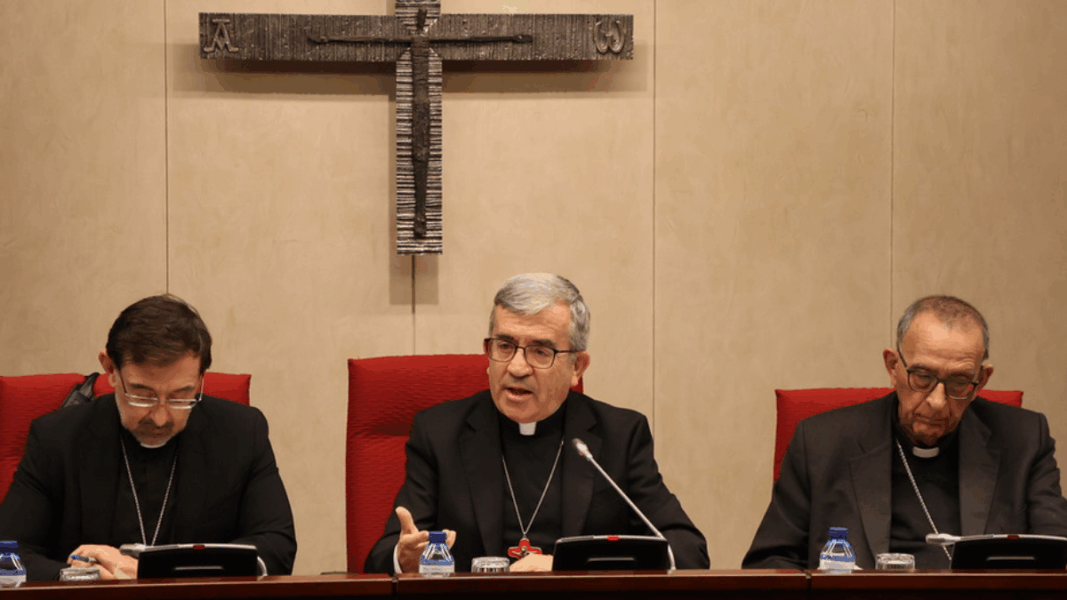
The Spanish Episcopal Conference opened on Tuesday, November 18, its CXXVIII Plenary Assembly in Madrid, the first under the pontificate of Leo XIV. The president of the CEE, Mons. Luis Argüello, delivered a broad inaugural speech loaded with cultural, philosophical, and social references. But between the lines, it left three axes that define the current moment of the Church in Spain: the so-called “Catholic turn”, the defense of life against the advance of abortion, and a review of the last 50 years of history in which not a single time did it appear the Valley of the Fallen, despite dedicating more than ten minutes to recalling Franco’s death and the democratic transition.
A “Catholic turn” that awakens enthusiasm… and reservations
Mons. Argüello addressed head-on the media phenomenon that several commentators have labeled as the “Catholic moment” or “Catholic turn”. He explicitly cited recent articles and, relying on them, spoke of a renewed attention toward the religious in certain sectors of Spanish society, especially among young people.
And he added a reflection from Juan Manuel de Prada, warning against confusing fashion with faith:
“A Church that is always called to be out of fashion, because it is sensible, because it seems backward, but in reality it is ahead of its time.”
His conclusion was clear: the renewed interest in Catholicism exists, but it will only be fruitful if it is accompanied by truth, goodness, and spiritual depth. Otherwise —he warned— it runs the risk of becoming a mere emotional aesthetic of the moment.
The defense of life: a harsh diagnosis on abortion
Mons. Argüello denounced the social banalization of abortion, the pretension to elevate it to constitutional rank, and the manipulation of the public debate, “public authorities cannot look the other way and although they regulate abortion and make it possible, they cannot decline their inexcusable duty to care for the weakest.”
And he added a phrase that resonated strongly in the room:
“The shortcut of abortion to solve problems that require public policies in favor of the family and life is a symptom of the moral weakening of our democracy.”
Argüello also denounced that it has become taboo to speak publicly about abortion and that any rational criticism is labeled as extremism. The defense of life occupied one of the longest segments of the speech, with scientific, philosophical, and sociopolitical references, emphasizing that “nothing justifies ending the life of a human being in gestation” and that the Church wants to accompany both the mother and the child.
Fifty years since Franco’s death… and an eloquent silence about the Valley of the Fallen
It is to be hoped that the same energy and impetus had been employed at the moment of speaking about memory and the defense of one of the spaces that today is at risk of being «resignified» precisely because of not speaking clearly and determinedly.
One of the longest moments of the speech was the reflection on the fifty years since the death of Francisco Franco and the proclamation of King Juan Carlos I. Argüello reviewed the historical context, the political evolution, and the Church’s position in those years: the end of national Catholicism, the figure of Cardinal Tarancón, the democratic awakening and social changes, finally, looking to the future and the celebration of the 50 years of the Constitution in 2028, he stated:
“These next three years should be ones of ‘purification of memory’ contaminated by the ideological biases of the historical and democratic memory laws that, precisely, seek to rehabilitate and honor victims of the dictatorship and to bury with dignity those who remain in graves and ditches, but are, mainly, an instrument of ideological polarization at the service of the political interests of the present rather than a channel to deepen the reconciliation that the years of the Transition achieved, to a great extent.”
In a speech of more than ten minutes on historical memory that omits the Valley, the silence is not accidental. It is a decision, and it conveys a message: the CEE prefers not to enter into a conflict that directly involves the defense of sacred spaces and religious freedom because they themselves have negotiated the Valley.
An Assembly that arrives amid a climate of redefinition
Already concluding, Argüello mentioned the usual topics —pastoral lines, education, abuses, public life—, but the inaugural speech makes clear the framework in which the bishops wish to place the Church: an institution culturally present but that, on sensitive issues like the Valley of the Fallen, opts for silence.