


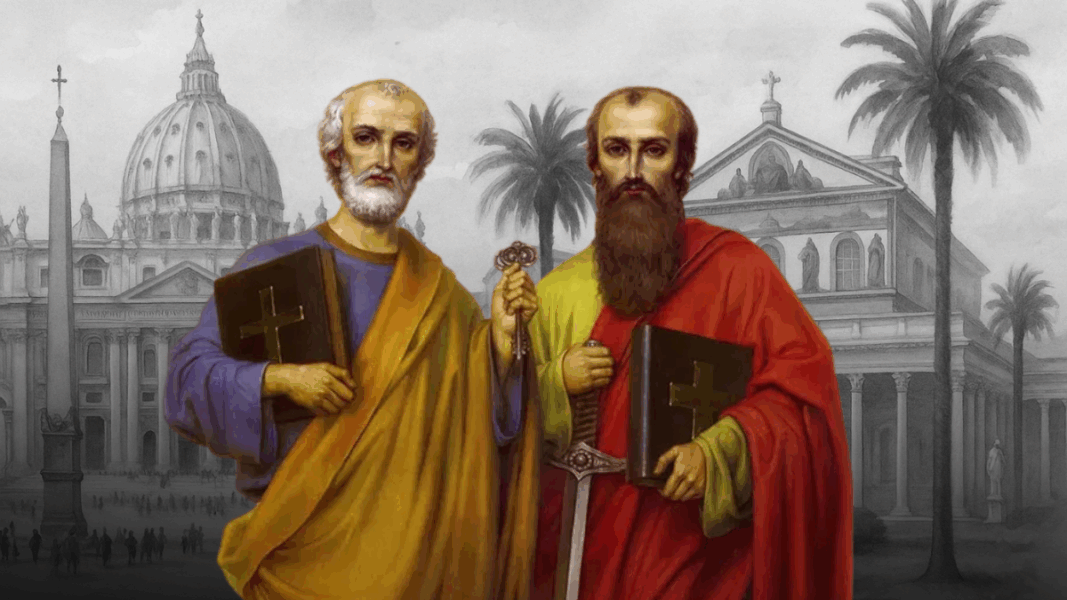
Basilicas built over tombs, not over symbols
The particularity of these two basilicas does not lie solely in their artistic dimension or in their role as centers of pilgrimage. Their relevance arises from the fact that they were built directly over the tombs of the apostles Peter and Paul. The Christian tradition, confirmed by historical testimonies and archaeological findings, identifies these places with certainty from the 2nd century.
In the Vatican, the necropolis under the current basilica preserves the memory of Peter’s burial, already identified in the 2nd century by the first pilgrims. On the Via Ostiense, the basilica of St. Paul Outside the Walls was built over the place where the Apostle of the Gentiles was buried after his martyrdom. In both cases, the construction of the temples was not a symbolic homage, but the protection and dignification of the place where the remains of the apostles rested.
Constantine and the public recognition of Christian memory
After the Constantinian peace, the emperor understood the importance of these places for Christians. At the beginning of the 4th century, he ordered the construction of two great basilicas that would allow public worship next to the apostolic tombs. The construction signified, in historical terms, the transition from a persecuted Christianity to a recognized Christianity, without altering the essence of the original memory.
For centuries, these basilicas were expanded, restored, or rebuilt—as happened with St. Paul after the 1823 fire or with St. Peter during the Renaissance—but always preserving their centrality: the physical presence of the apostolic testimony.
Martyrial memory: the Church is born from the blood of the apostles
The dedication of these basilicas reminds us that the Church did not arise from theories or cultural formulations, but from the concrete testimony of those who gave their lives for the faith. Peter died crucified; Paul, beheaded. Both sealed with their blood the preaching of the Gospel in Rome, turning the imperial city into a point of reference for all Christendom.
Read also: The blood of the martyrs that prepared the conversion of an Empire
This martyrial dimension is not an accessory element, but constitutive. Christian faith was transmitted through a legacy that cost lives, and the Church, by preserving these places, affirms that its origin cannot be reinterpreted without disfiguring historical reality.
Apostolic continuity: foundation of Catholic identity
The solemnity of November 18 also underscores the importance of apostolic succession as a principle of doctrinal unity. The tomb of Peter under the altar of the Vatican basilica points to the link between the Petrine primacy and the continuity of the Pope’s ministry. Rome is not the seat of authority for political reasons, but because there rest the apostles to whom Christ entrusted the mission of confirming the brethren and announcing the Gospel.
In the same way, St. Paul Outside the Walls recalls the missionary and universal dimension of the Church. In Paul converge doctrinal rigor, openness to cultures, and the mandate to carry the Gospel to the ends of the world. The joint celebration of both temples thus expresses the unity between authority and mission, between stability and proclamation.
A liturgical act that unites past and present
The commemoration of the dedication is not reduced to an architectural anniversary. Liturgically, it expresses that the current Church continues to be built upon the apostolic testimony. Each generation of Catholics celebrates this date as an act of communion with the roots of the faith, remembering that what is lived today is supported by the continuity of twenty centuries of history.
In this sense, the liturgy of November 18 is a reminder that there is no authentic renewal that can break with the apostolic past, nor a valid reform that ignores the martyrial foundation of the Church.