


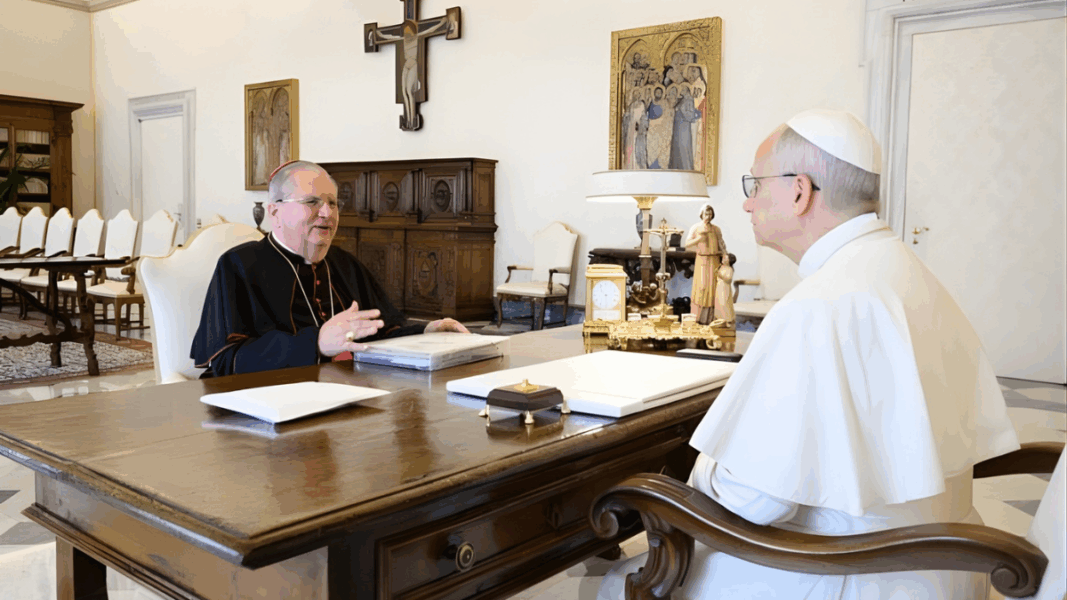
Bishop Fernando Rifan—responsible for the only ecclesiastical jurisdiction in the world dedicated entirely to the Traditional Latin Mass—has revealed the details of his meeting with Pope Leo XIV, held on November 15 in the Library of the Apostolic Palace. The half-hour meeting comes at a decisive moment for the future of the Personal Apostolic Administration of Saint John Mary Vianney, created by Saint John Paul II in 2002 as a stable canonical solution to ensure the continuity of the usus antiquior in Brazil.
The audience was not a mere protocol greeting: Rifan went to personally explain to the Pope the origin, mission, and reason for being of this structure, and to defend the need for it to continue existing after his resignation due to age.
A Jurisdiction Created to Preserve the Traditional Mass
Rifan reminded the Pontiff that the Apostolic Administration was born with a clear objective: to ensure a stable and fully canonical home for priests and faithful deeply linked to the traditional liturgy. He presented documents from Rome and from the Administration itself that show how, after years of separation, full communion with the Holy See was achieved without renouncing the liturgical heritage received.
The bishop emphasized that the identity of Campos (Brazil) is not an aesthetic option or a “liturgical taste,” but a consolidated pastoral reality for decades. He also explained that his seminary trains priests entirely in the Mass of all time, with solid vocational discernment and a growing number of faithful in eleven dioceses who regularly request their assistance for the celebration of the traditional rite.
Leo XIV Recognizes that Campos Is Not a Radical Group
According to Rifan’s account, the Pope asked specific questions about the doctrinal position of the Apostolic Administration and was satisfied with the answers. The bishop states that Leo XIV “realized that we are very different from other radical and schismatic groups,” a key point in the current ecclesial climate surrounding the traditional liturgy.
This distinction is not minor: at a time of tensions over the place of the usus antiquior in the Church, the Pope’s recognition of the doctrinal and disciplinary normality of Campos constitutes a significant gesture.
Episcopal Continuity, a Key Issue for the Traditional Mass in Brazil
Rifan informed the Pope that he has already submitted his resignation upon turning 75, and that the continuity of a bishop at the head of the Apostolic Administration is essential to preserve the stability of the traditional rite in the region.
Without its own bishop—and depending entirely on papal appointment—the Administration could be weakened or even diluted. Rifan did not ask for concessions or privileges, but he did make it clear that the existence of this structure has been, for more than twenty years, an effective way to integrate the Traditional Mass into the ordinary life of the Church.
In his words: “I spoke of the need to continue with our Apostolic Administration for the good of the Church.”
A Cordial Meeting in Uncertain Times for the usus antiquior
The bishop recounts that the audience concluded by praying together with the Pope the prayer Dominus conservet eum… and expressing his confidence that the Holy Spirit will guide future decisions. However, the concern among the faithful of the Traditional Mass remains palpable: the continuity of Campos’ own charism depends directly on the next episcopal appointment.