


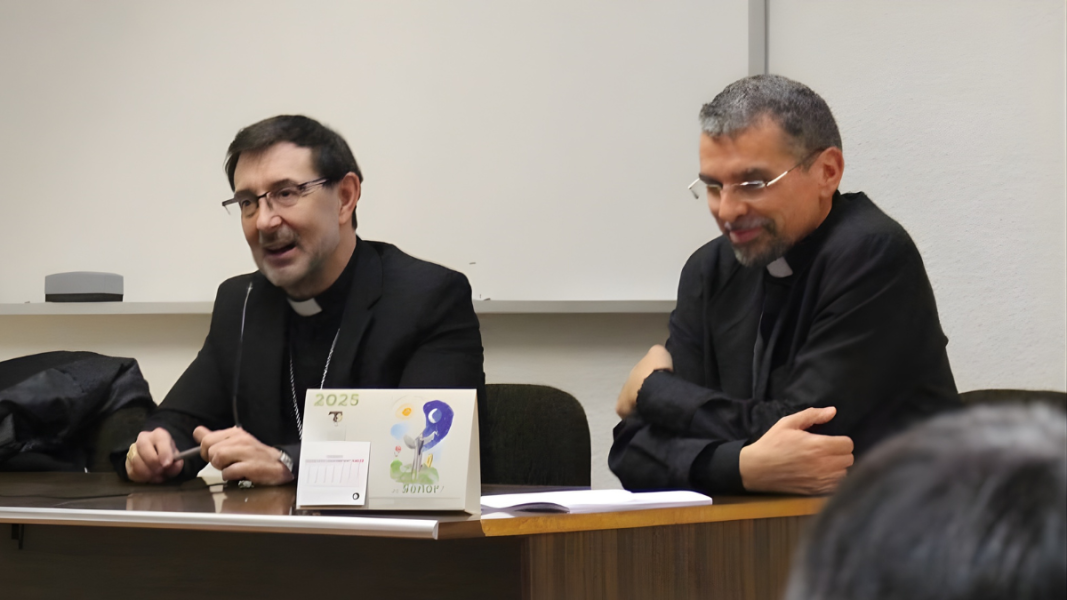
The Ukrainian Greco-Catholic community in Madrid is going through a deep internal crisis that, according to complaints from its own members, has a direct responsible: Fr. Andrés Martínez Esteban, Vicar General of the Catholic Oriental Ordinariate of Madrid and figure with full authority over the Eastern communities within the archdiocese.
According to the testimony gathered by El Wanderer, the vicar general’s decisions have led to a limit situation that the faithful describe as a process of “emptying” of their community. Martínez Esteban would have imposed drastic changes in the use of temples, schedules, and parish life that, far from favoring their stability, would be leading to the progressive dissolution of a community that had been settled and functioning normally for years.
A community that feels pushed towards dissolution
The Ukrainian Greco-Catholics affirm that the transfer imposed by the diocese has already caused the loss of nearly 60% of their faithful, due to the new assigned places being hardly accessible or insufficient to develop a real parish life.
According to the community, the options offered by the diocese are, in fact, two paths to disappearance:
a peripheral parish where many could not attend, or a central temple with such severe restrictions —without the possibility of celebrating baptisms, weddings, funerals, vigils, or major feasts of the Byzantine calendar— that it would turn the faithful into “temporary guests,” without authentic community life.
Several members point out that, in response to their requests for dialogue, the vicar would have replied with the phrase “either acceptance or seek life on your own”, words that have been perceived as a direct threat and a denial of the pastoral accompaniment that any Catholic community should receive.
A wound for a people already bearing the weight of persecution
The Ukrainian Greco-Catholics, many of them descendants of families persecuted by the Soviet regime, consider that their rite and liturgical tradition are not a whim, but a spiritual heritage that they have preserved with sacrifice and fidelity. Therefore, the feeling of abandonment by the archdiocese hurts especially.
The community emphasizes that it does not ask for privileges, but respect, a dignified place to celebrate their worship and the possibility of keeping alive a tradition that is part of the richness of the universal Church.
What they denounce is that, while other groups are facilitated temples, schedules, and institutional support, they receive obstacles, forced displacements, and a climate of hostility.
A case that reopens the debate on the treatment of Eastern rites in Spain
What happened in Madrid brings to the table a broader issue: how does the Church in Spain manage the presence of Eastern Catholic communities?
These communities are fully in communion with Rome, possess their own liturgical rights, and, according to the magisterium, must be treated with equal dignity and respect as any Latin rite parish.
However, the testimony gathered by El Wanderer shows a worrying reality: lack of listening, unilateral decisions, inadequate spaces, and an attitude that many faithful perceive as a form of internal marginalization.
An urgent call for justice and pastoral care
The public denunciation raises a problem that cannot be left in silence. A Catholic community —especially an Eastern community that has historically suffered persecution— deserves welcome, stability, and fair treatment.
What is at stake is not just a building or a schedule: it is the continuity of a rite, the future of a living community, and the pastoral credibility of the Archdiocese of Madrid.