


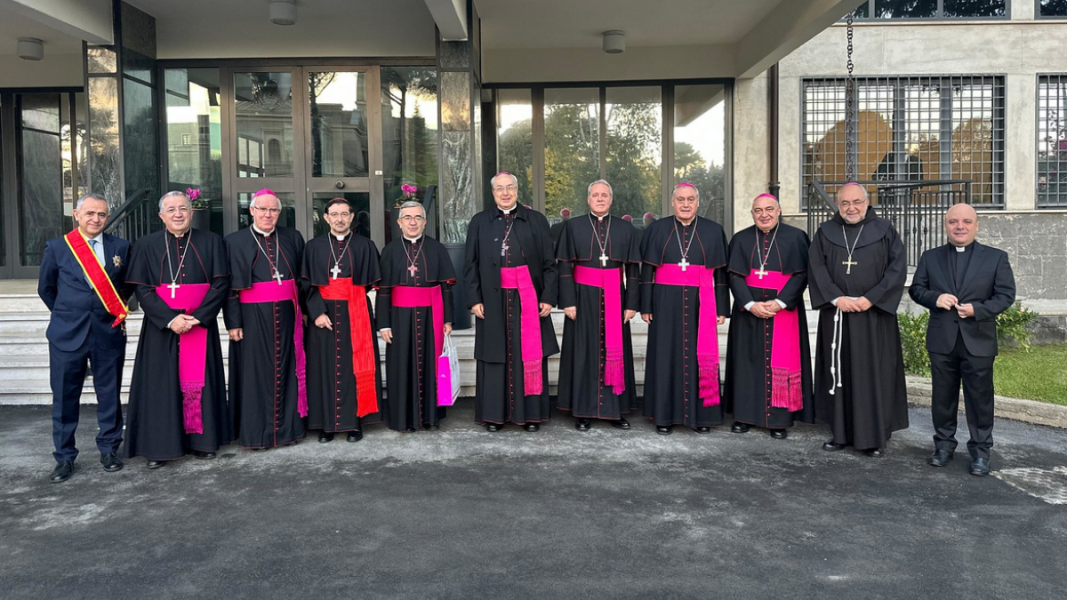
The Executive Commission of the Spanish Episcopal Conference was received this morning, November 17, by Pope Leo XIV in a meeting that lasted nearly an hour. According to Mons. Luis Argüello, Archbishop of Valladolid and president of the CEE, the meeting took place in a climate of “joy and gratitude”, after the audience request was made following his appointment in May and confirmed at the beginning of the current course 2025/2026.
During the visit, the bishops delivered to the Holy Father a special edition of the Bible, two recent issues of the magazine Ecclesia —those dedicated to the exhortation Dilexi te and to the election of Leo XIV—, as well as a donation “for the Pope’s charity”.
The Spanish Church presents its challenges and advances
Mons. Argüello pointed out that the meeting allowed them to review “the various moments that the Church in Spain is experiencing”: the need to proclaim the Gospel in a secularized society; the challenges of Christian initiation; the situation of consecrated life and the clergy; the growing diversity in parishes due to the arrival of immigrants; and the work in prevention, training, and reparation for victims of abuse.
We were also able to discuss everything that the Spanish Church has been doing since the impetus from the Holy See in relation to prevention, training, and reparation for victims of abuse in that plan that we call PRIVA and which has also given rise to the existence of a reparation commission, which, thank God, we believe is satisfactorily attending to the victims that they approach, declared Argüello.
On this last point, the president of the CEE also assured that the Spanish approach has recently received a positive assessment from the Holy See during the October meeting with diocesan offices for the protection of minors.
Possible trip of Pope Leo XIV to Spain
One of the most anticipated topics was the eventual visit of the Pope. Argüello confirmed that the CEE left “hopeful”, although he recalled that the confirmation of a trip corresponds exclusively to the Holy See. Leo XIV, he added, “knows Spain well” and showed interest in the signs of spiritual renewal among young people, such as the rise of “impact retreats”, the increase in adult baptisms, and the growth in the number of seminarians.
The bishops proposed several possible motivations for a papal trip: the migration issue in the Canary Islands; the centenary of the canonization of St. John of the Cross; the culmination of the Sagrada Família and the eventual beatification of Gaudí; as well as local jubilees, such as that of St. Toribio de Mogrovejo in the diocese of Valladolid.
The issue of abuse and the case of the bishop of Cádiz
The CEE reiterated to the Pope its commitment to the reparation of victims of abuse in prescribed cases or when the accused has died. Argüello affirmed that this “path is working” and that it has been “confirmed” by the Holy See.
Regarding the situation of Mons. Rafael Zornoza, Bishop of Cádiz, he explained that an investigation has been open for fifteen days to verify the veracity of the complaints. He recalled that the Church must simultaneously respect “the right of any victim to be heard and the right to the presumption of innocence”, especially when in the civil sphere the case is prescribed.
Read also: Last day of Zornoza as bishop of Cádiz
Regarding the possible resignation of Mons. Zornoza, Argüello indicated that it could be accepted “soon”, although the Holy See has not communicated either the date or the modality.
Previous meeting with Cardinal Parolin
Before the audience with Leo XIV, the Spanish delegation held a meeting with the Secretary of State, Cardinal Pietro Parolin. Mons. Argüello highlighted this gesture especially, as the cardinal had arrived in Rome at four-thirty in the morning from Benin and, even so, wanted to receive them.
In the meeting, Parolin recalled his recent conversations with the Spanish Minister of Justice and conveyed to the bishops the topics discussed in his brief meeting with President Pedro Sánchez during the COP30 in Brazil. Based on this conversation, the CEE presented to the Secretary of State the issues that remain open in Church-State relations and that require follow-up in the coming months.
But beyond diplomatic courtesy, the underlying issue remains the same: what exactly is the Holy See negotiating with the Spanish Government and why is it not being reported clearly?
One of the most sensitive issues is, precisely, the process of “resignification” of the Valley of the Fallen. The Government has been pressuring for some time to deprive the Benedictine community of its presence and redefine the religious meaning of the place. Recent movements —including the replacement of prior Santiago Cantera and the approval of the plans for the new project— have generated suspicions among the faithful, who see signs of continuous concessions without public explanations.
In this context, the meeting with Parolin and with Leo XIV reopens the question that many of us ask without receiving an answer: when are we going to know the real contents of the agreements between the Government, the Spanish Church, and the Holy See regarding the Valley of the Fallen?