


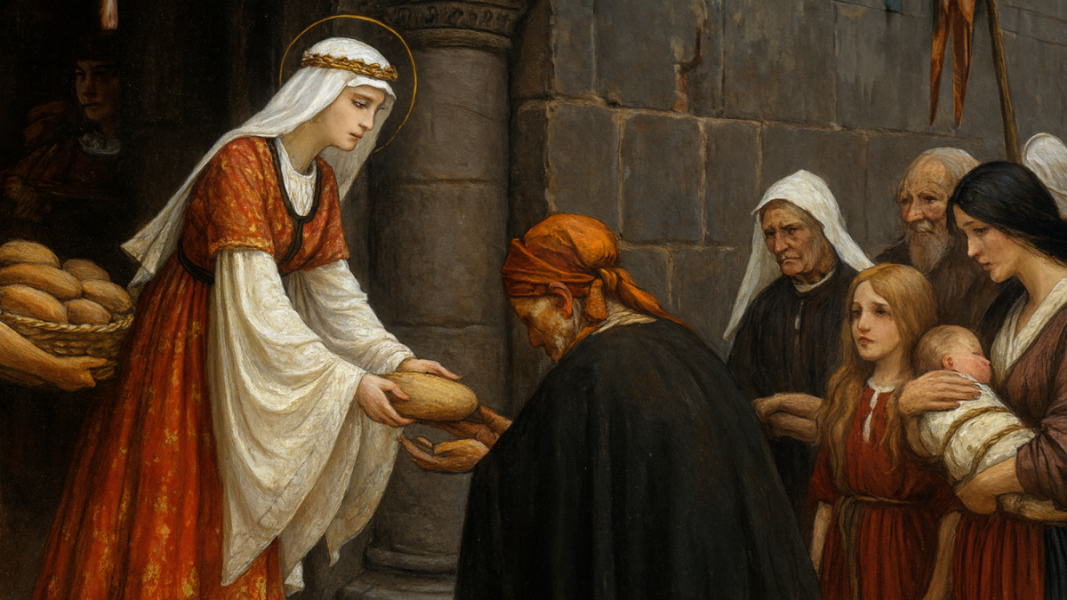
Power Understood as Service
Unlike other members of the nobility of her time, Elizabeth did not consider the position as a privilege, but as a moral obligation. She personally supervised the distribution of aid in times of need, financed hospitals, and attended to people marginalized by society. She did so not as a gesture of philanthropy, but as a direct consequence of her faith.
Her intervention in social matters did not translate into paternalism or political activism. Elizabeth acted with sobriety, without exhibitionism and without seeking recognition. She understood that politics, to be Christian, must be exercised with moral clarity and without instrumentalizing others' suffering.
The Trials that Consolidated Her Sanctity
The premature death of her husband in 1227 radically changed her situation. The young queen, barely twenty years old, found herself subjected to internal tensions within the court and disputes over the control of assets and the regency. She was removed from the castle and forced to leave the environment she had governed with balance and firmness.
These difficulties did not break her spirit. On the contrary, they strengthened her vocation of service. Without the resources proper to a queen and subjected to the instability of the political situation, Elizabeth maintained her commitment to the poor and continued to trust in Providence. This stage marked her transition from ruler to a reference spiritual figure.
An Influence that Transcended Political Borders
In the last years of her life, Elizabeth linked herself more closely to the Franciscan spirit, adopting a simple way of life but without abandoning her public responsibility. She founded hospital institutions that offered stable and orderly care, in an era when assistance depended almost exclusively on private or religious initiatives.
This work had a lasting consequence: it demonstrated that the action of the ruler should not be limited to the administration of resources, but must promote structures that sustain the common good in a permanent way. Her legacy anticipated principles that centuries later would be articulated in the Church's social doctrine.
A Model of Public Life for the Present
The figure of Saint Elizabeth of Hungary is especially pertinent for the present day. Her life reminds us that authority without moral sense degenerates into abuse, and that service without a Christian vision is reduced to mere management. Elizabeth conceived government as a vocation that demands coherence, discipline, and orientation toward the common good.
In a political context frequently marked by polarization, personal ambition, and lack of principles, her figure shows that the exercise of power can be a space for virtues if it is sustained on firm foundations. Her example contradicts the idea that sanctity belongs only to private life: it demonstrates that it can also take root in institutional life.
Canonized 4 Years After Her Death
Saint Elizabeth of Hungary died on November 17, 1231, at only twenty-four years old, but left a legacy of extraordinary importance. Her canonization, just four years later, confirmed the impact of her life on the Church and society. Over the centuries, she has been remembered not only as the patroness of charity, but as a model of public responsibility exercised from faith.
In times of moral crisis and institutional wear, her example invites us to recover a Christian understanding of power: a power that does not seek to impose itself, but to serve; that is not sustained by force, but by justice; that is not fed by ideologies, but by the truth of the Gospel.