


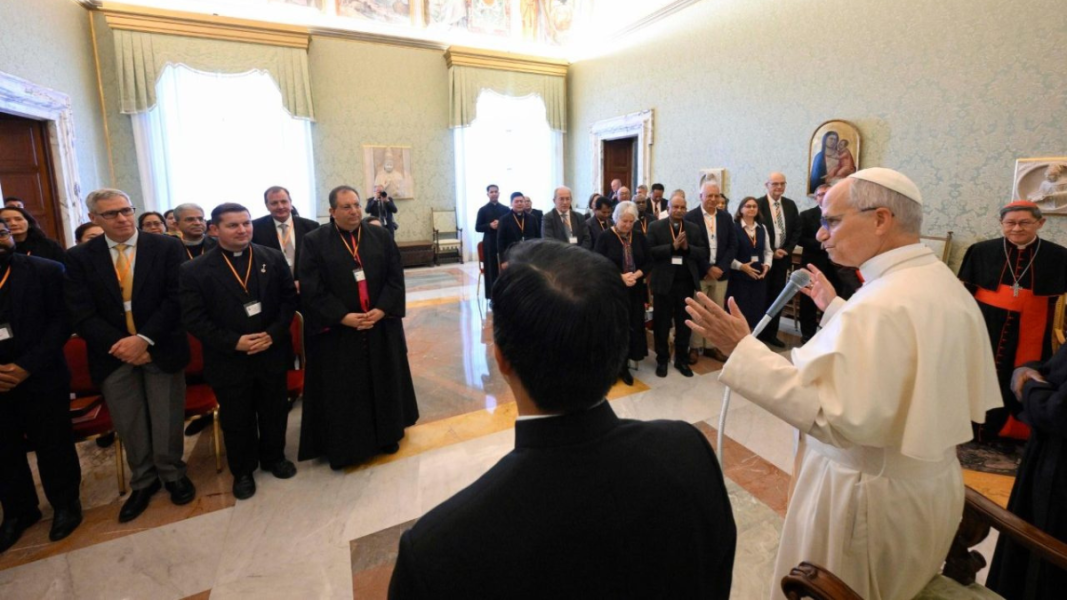
Pope Leo XIV received this morning, in the Apostolic Palace, the members of the Catholic Biblical Federation on the occasion of their assembly, coinciding with the 60th anniversary of the constitution Dei Verbum. In his speech, the Holy Father insisted on the essential mission of the Church: to listen reverently to the Word of God and proclaim it faithfully, especially in a time when, he warned, cultural and digital noise tends to obscure it.
Accompanied by Cardinal Kurt Koch, prefect of the Dicastery for the Unity of Christians, and by Cardinal Luis Antonio Tagle, president of the Biblical Federation, the Pontiff expressed his gratitude for the work of those dedicated to the biblical apostolate: “The Church does not live from itself, but from the Gospel”, he recalled.
The Word of God as a source of life and mission
Leo XIV emphasized that the doctrine of Dei Verbum remains fully valid: the Church is called to offer “easy access to the Sacred Scripture” for all the faithful, not as an academic resource, but as the living source that guides their path. Thus, he pointed out that the proclamation of the kerygma remains the core of the mission: “The Church rediscovers its course by listening to the Spirit, who reminds us of everything the Son has said”.
The Pope recalled that the reading of Scripture is not an isolated act, but deeply ecclesial: the Church listens to the voice of the Bridegroom and, from that listening, proclaims the Gospel. He also thanked the initiatives of lectio divina and the biblical translations, fundamental for the Word to reach all peoples.
The challenge of digital culture
Leo XIV warned of a growing risk: although the Church has insisted for decades on the importance of facilitating Bible reading, new generations live in digital environments where the Word of God is relegated or presented in a distorted way.
The Pope posed two central questions for today’s mission:
“What does ‘easy access to Scripture’ mean in our time? How to facilitate the encounter with the Word for those who have never heard of the Gospel or live in cultures where Christ is unknown?”
He urged the Biblical Federation to seek new ways of evangelizing presence, capable of opening paths to Scripture in contexts where faith has become marginal or unknown.
Being ‘living letters’ in a world saturated with voices
The Pontiff concluded by inviting the biblical agents to become “living letters written by the Spirit of the living God”, witnesses to the primacy of the Word over media noise and the multiple narratives that shape contemporary life. He entrusted this mission to the intercession of the Virgin Mary, “womb where the Word became flesh”, model of listening and obedience.
We leave below the complete message of Leo XIV:
In the name of the Father, and of the Son, and of the Holy Spirit.
Peace be with you.
Eminences,
Reverend fathers, reverend sisters,
Dear brothers and sisters:
I would like to thank Cardinal Koch, prefect of the Dicastery for Promoting Christian Unity, for his presence this morning, and also Cardinal Luis Tagle, pro-prefect of the Dicastery for Evangelization and president of the Catholic Biblical Federation. I also extend a cordial greeting to the members of the Executive Committee, to the regional coordinators, to the General Secretariat, and to the Friends of the Catholic Biblical Federation. To each of you and to all those you represent, I express my sincere gratitude for your service to the Word of God.
The Dogmatic Constitution on Divine Revelation, Dei Verbum, whose sixtieth anniversary we celebrate this year, concludes with these words: “Pray for us, that the word of the Lord may speed on and triumph, as it did among you” (2 Thess 3:1). This petition of the Apostle Paul to the Thessalonians expresses a strong desire, a firm conviction, and a pastoral approach that can guide our joint reflection.
The teaching of Dei Verbum is clear: we are called “to listen to the word of God with reverence and to proclaim it with faith” (cf. DV 1), and “easy access to Sacred Scripture should be provided for all the Christian faithful” (DV 22). This same vision is reflected in your Constitution, which states that the Catholic Biblical Federation “promotes and develops the pastoral ministry of the Bible in such a way that the Word of God, present in Sacred Scripture, becomes a dynamic source of inspiration for all areas of the life and mission of the Church in the current world” (Constitution of the Catholic Biblical Federation, art. 9).
In these days of deliberation, I encourage you to examine once again your personal and ecclesial fidelity to this mandate, which is nothing other than the proclamation of the kerygma, the saving mystery of our Lord Jesus Christ. Your mission and vision must always be inspired by the conviction that the Church does not receive life from itself, but from the Gospel. From the Gospel it constantly rediscovers the direction for its path, under the guidance of the Holy Spirit, who teaches all things and reminds us of everything the Son has said (cf. Jn 14:26). Therefore, listening to the Word of God and proclaiming it are properly ecclesial acts: it is the Bride who listens with loving attention to the voice of the Bridegroom (cf. Song 2:8-10).
At the same time, ensuring easy access to Sacred Scripture for all the faithful is essential, so that all may encounter the God who speaks, who shares his love, and who draws us to the fullness of life (cf. Jn 10:10). In this sense, translations of Scripture remain indispensable, and I thank you for your commitment to promoting lectio divina and all initiatives that encourage frequent reading of the Bible.
However, today new generations inhabit digital environments where the Word of God is easily overshadowed. New communities are often found in cultural contexts where the Gospel is unknown or distorted by particular interests. Therefore, we must ask ourselves: what does “easy access to Sacred Scripture” mean in our time? How to facilitate this encounter for those who have never heard the Word of God or come from cultures not yet touched by the Gospel? I hope these questions encourage you to seek new forms of biblical presence capable of opening paths to Scripture, so that the Word of God may take root in hearts and lead all to live in his grace.
In short, your mission is to become “living letters… written not with ink but with the Spirit of the living God” (2 Cor 3:1-6), witnesses to the primacy of the Word of God over the multiple voices that fill our world. May the Most Holy Virgin Mary, Mother of God and womb in which the Word became flesh, teach us the art of listening, strengthen us in obedience to his Word, and guide us to magnify the Lord (cf. Lk 1:46). With these sentiments, I impart my apostolic blessing to all of you and to your loved ones.
Thank you.