


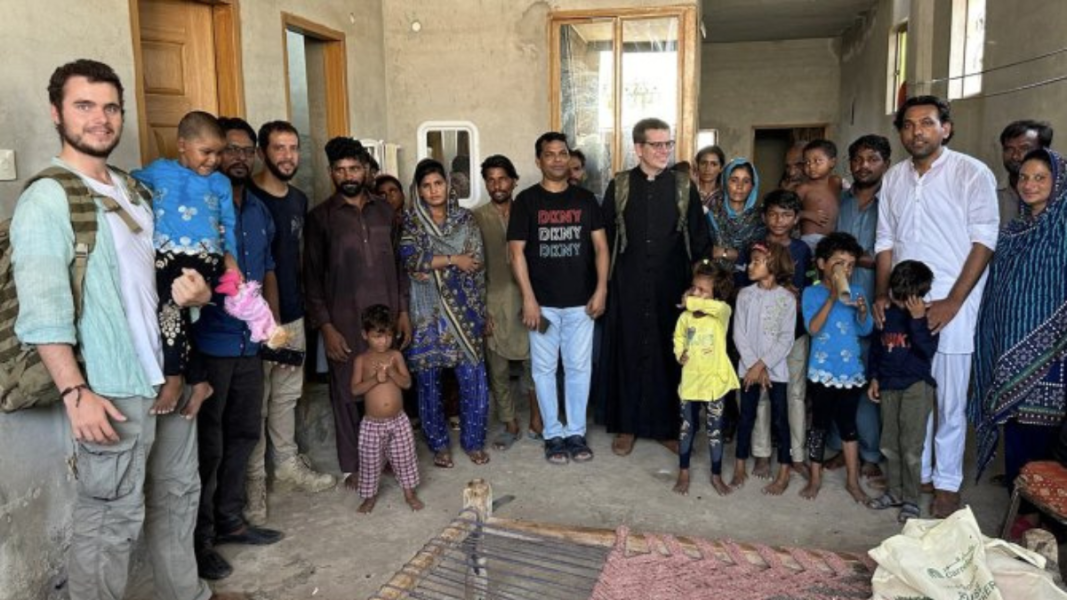
Three Christian families have been freed from slavery in Pakistan thanks to the mission of the Argentine priest Fr. Federico Highton and the young Spanish layman Diego, who recently returned from this Muslim-majority country after a new rescue operation. The initiative adds to the efforts that both have been carrying out in recent years, in which they have managed to free more than 300 Christians subjected to generational servitude in brick kilns.
As the priest recounted to Catholic News Agency, he paid the equivalent of 1,700 dollars to Pakistani businessmen to settle the fictitious debts that kept these families trapped in forced labor. Men, women, and children have been victims for decades of a widespread practice in Pakistan: debt bondage, which is often accompanied by abuses, rapes, forced conversions, and religious restrictions.
A mission born from apostolic zeal
Fr. Federico explained that he traveled to Pakistan “with the sole purpose of freeing enslaved Christians who suffer in servitude.” He brought with him 3,000 dollars intended exclusively to pay for the freedom of these families. As on previous occasions, he was accompanied by Diego, a young Spaniard who returned to the Catholic faith in 2024 and who since then has joined the apostolic mission with determination.
In their first joint trip last year, they managed to free 200 people; and in 2025, 110 more. This latest expedition allowed the liberation of 11 people belonging to three families who had never known freedom. They could not attend Mass or receive the sacraments. “The same day they were freed, I was able to give them the sacraments, including baptism. It was a day of double liberation,” the priest recalled.
The cross lived with hope
After the mission, Fr. Federico received a letter from Dominic, a recent Pakistani convert who suffered aggression from his own family after embracing Christianity. They broke the crucifix he had received as a gift. However, Dominic responded with prayer and forgiveness: “Now I deeply understand what it means to carry the Lord’s cross. I am proud of this cross. The blows, the insults, and the destruction of crucifixes cannot stop the growth of the Church, because the true cross lives in our hearts”.
His testimony reflects the reality of many converts and persecuted Christians in Pakistan, a country where blasphemy legislation continues to be used disproportionately against non-Muslims, and where mob violence against Christians has left victims in recent years.
PaX: a project for the future for freed Christians
To offer a lasting response to the situation of the most vulnerable Christians, Fr. Federico has launched the project PaX, whose name means “peace” and also “Pakistan Christendom.” Diego acts as the project director, in collaboration with the Order of St. Elias and with the Pakistani Catholic activist Joseph Janssen, a member of the Neocatechumenal Way.
During a visit in June, Diego and Janssen sought land to build the first PaX community, intended to accommodate between 300 and 400 people. The goal is to provide the freed with a safe environment where they can rebuild their Christian life and learn to live with dignity through work: construction, agriculture, livestock, and material production.
“After a life eating garbage, being treated like garbage, and suffering constant violence, some do not know what it is to be human. We have to take them to a place where they can live in peace, practice Christianity, and educate their children,” Diego noted. For security reasons, the exact location of these communities has not been revealed.
Catholic charity in action
The young man highlighted the enormous generosity received from Catholics from different parts of the world: “It has been impressive to see the charity of so many: prayers, donations, and offers to travel to Pakistan.” Currently, the first PaX community is in the initial phase and they have already begun building the perimeter wall. “There is still a long way to go, but this is the first step toward the foundations of Pakistani Christianity,” he affirmed.
The mission of Fr. Federico and Diego is a living example of the Church’s missionary spirit and a hopeful sign in one of the countries where Christians suffer the greatest persecution.