


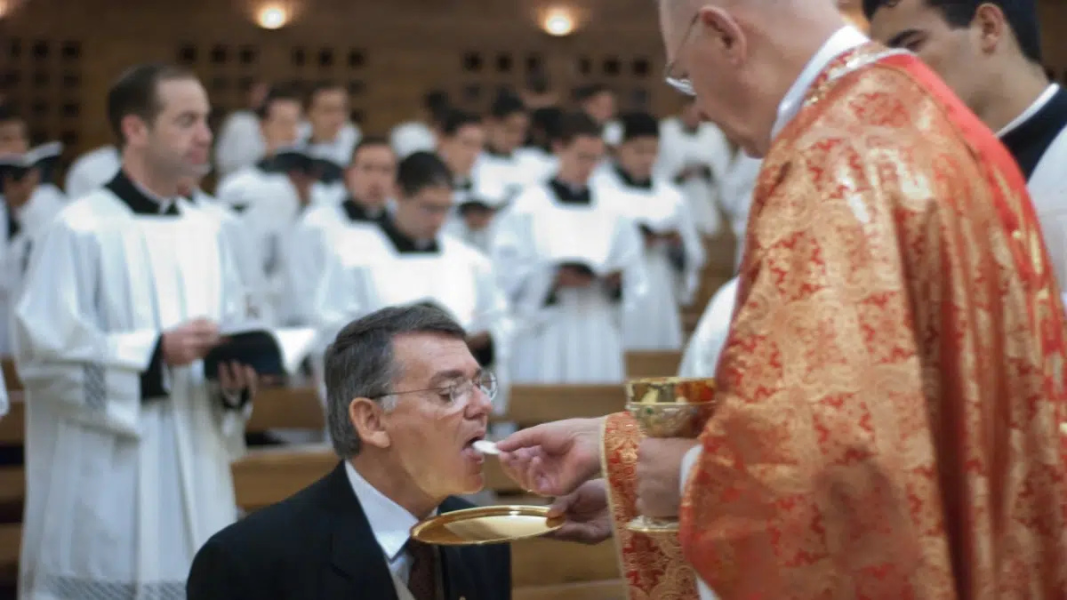
The Diocese of Austin (Texas) has issued a memorandum, signed by the Vicar General, Fr. James A. Misko, which orders pastors to discontinue the use of prie-dieux (prie-dieu) during the distribution of Holy Communion. The document, dated November 12, 2025 and addressed to all pastors, has generated concern among the faithful and priests who see in this measure an attempt to discourage kneeling for Communion, a legitimate practice in the universal Church.
According to the memorandum, some priests had placed a prie-dieu to facilitate the faithful who wish to receive Communion kneeling, especially those who have difficulty getting up after receiving the Eucharist. However, the vicar general states that, in these cases, the priest should rather “have a pastoral conversation” and recommend to the person to receive Communion standing, assuring that “it does not offend God” to do so.
An instruction that contradicts the freedom of the faithful and generates undue pressure
The document attributes the decision to Bishop Daniel E. Garcia, who explicitly requests that the practice of placing a prie-dieu be discontinued. The text argues three reasons:
First, it cites GIRM 160, recalling that in the United States the norm is to receive standing, although it recognizes—as universal law indicates—that any faithful may receive kneeling if they wish.
Second, it holds that the prie-dieu “could confuse the faithful” about what is normative.
Third, it states that its presence “could pressure” some to receive kneeling against their will.
This line of argument has been criticized in various ecclesial circles for starting from a problematic premise: suppressing a pastoral means to avoid others feeling “pressured” by the example of those who want to adore Christ kneeling, when the Church has repeatedly insisted that no faithful can be reproved, much less prevented, from receiving kneeling.
It insists on kneeling “if desired”, but without facilitating it
Although the memorandum recognizes the reverence of the faithful who wish to kneel and states that it is “permitted” to do so, at the same time it insists that catechesis must be given so that the faithful understand that it is received with the same reverence standing, and adds that priests, deacons, and lay leaders must not emphasize kneeling for Communion.
The practical result is evident: it is stated that one can receive kneeling, but the means that facilitates it is removed, it is recommended not to promote it, and the faithful are encouraged to stand.
