


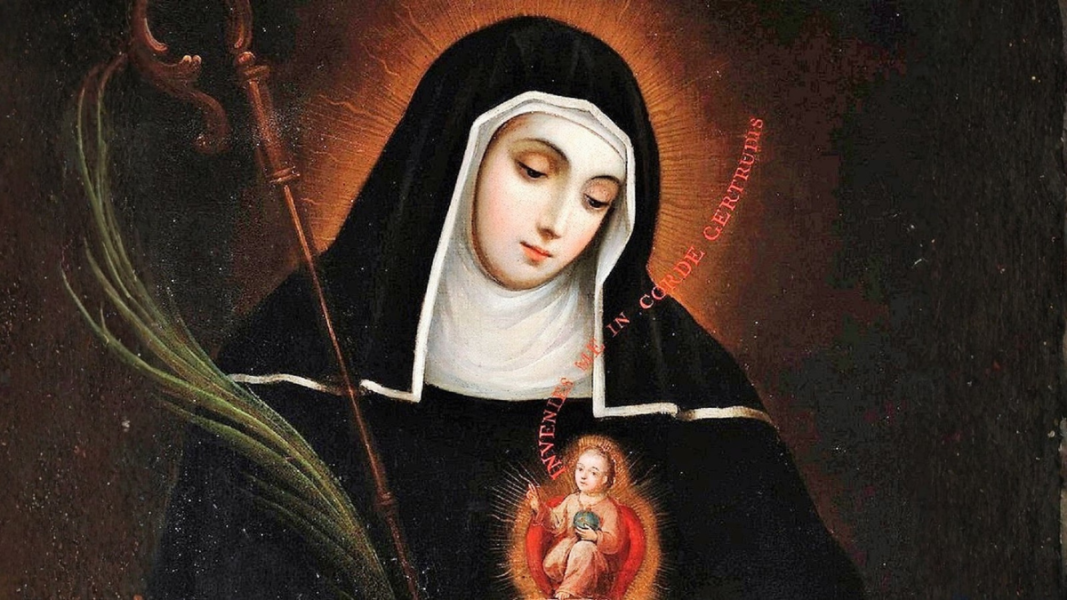
At the age of twenty-four, in the midst of a profound crisis that she herself described as one of “spiritual emptiness,” Gertrude experienced an apparition of Christ that would definitively change her existence. From that moment on, she abandoned all concern for intellectual prestige and devoted herself unreservedly to the contemplative life, to prayer, and to love for God.
A Mystic of Truth, Not of Sentimentalism
In a context like ours, where spirituality is often confused with emotion, Saint Gertrude stands out for the sobriety and theological precision of her writings. Her visions are not sensory evasions or pious imaginations, but authentic teachings of high doctrinal content, centered on the greatness of divine love and the smallness of the creature.
Her most well-known work, the Book of Revelations or Herald of Divine Love, is a synthesis of how grace configures the soul and introduces it into the mystery of Trinitarian life. Gertrude does not present an extraordinary path, but a deeply ecclesial one: living from the sacraments, obeying the Word, loving the liturgy, and allowing oneself to be transformed by charity.
The Heart of Jesus, Center of All Spiritual Life
One of the highest contributions of Saint Gertrude was her intimate relationship with the Heart of Christ. Two centuries before this devotion spread in the Church thanks to Saint Margaret Mary Alacoque, Gertrude had already received revelations that showed the Heart of Jesus as the source of mercy, sanctification, and consolation.
For her, the Heart of Jesus was not a sentimental metaphor, but the theological symbol of divine love that pours out upon humanity. In it she found: truth, humility, reparation for sins, and the strength to persevere. Her spirituality of the Heart did not annul reason or monastic discipline; on the contrary, it gave them fullness. Prayer was a dialogue of love, but rooted in obedience, in the rule, and in tradition.
A Prophetic Voice for the Church of Today
The figure of Saint Gertrude is especially relevant today. In an era when many seek alternative spiritualities or emotional experiences detached from doctrine, she teaches that true mysticism is inseparable from the Church. She also teaches that interior life is not improvised: it is built with patience, humility, study, and sacrifice.
In the face of a culture that lives accelerated, scattered, and without rest, Gertrude invites us to recover interior silence. In the face of a spirituality empty of content, she restores our love for the liturgy. In the face of a world that reduces Christ to a moral symbol, she proclaims the living reality of the Heart of Jesus as a source of grace. And in the face of a Church that sometimes looks too much at itself, she reminds us of the absolute primacy of God’s love.
The Doctor of Divine Love
Saint Gertrude remains one of the purest and most demanding voices in the Catholic mystical tradition. Her life demonstrates that greatness does not consist in accumulating knowledge, but in allowing Christ to transform the soul from within. The clarity of her doctrine, the depth of her love, and the sobriety of her spiritual style make her a powerful antidote against the superficiality that suffocates faith in our days.