


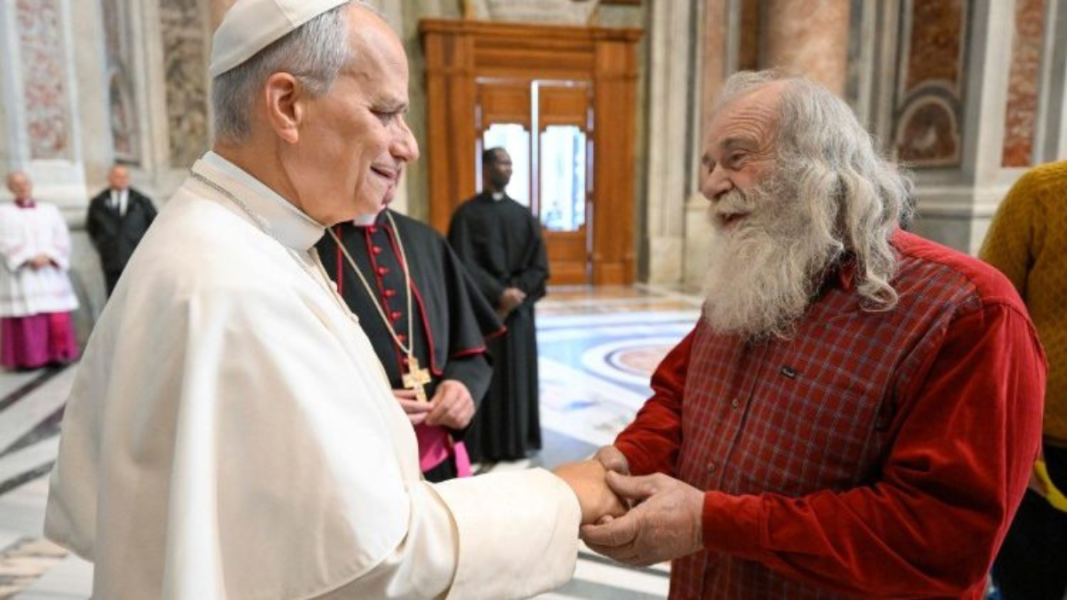
In the IX World Day of the Poor, Pope Leo XIV presided over the Mass of the Jubilee of the Poor in St. Peter’s Basilica, dedicating his homily to Christian hope amid the world’s crises and to the central place that the poor occupy in the Church. The Pontiff invited us to contemplate history in the light of the Kingdom of God, to renew the culture of care in the face of contemporary loneliness, and to listen to the cry of those who suffer the most. He recalled that poverty challenges not only believers but all those responsible for public life, and exhorted to build “bridges” where others raise walls.
The Pope situated loneliness as the great transversal poverty of our time, insisting that it is not enough to respond to material needs, but that it is necessary to promote an authentic “culture of care.” The reflection connects with real concerns, although the homily tended toward a sociological analysis of poverty, leaving the spiritual aspect and the call to personal conversion less developed, which are traditionally central in Catholic preaching.
Leo XIV concluded by invoking the Virgin Mary and proposing as a model St. Benedict Joseph Labre, a symbol of evangelical humility. His final message appealed to live like Mary when she exclaims the Magnificat, where God exalts the humble and brings down the proud.
We leave below the complete homily:
Dear brothers and sisters:
The last Sundays of the liturgical year invite us to contemplate history in its final outcome. In the first reading, the prophet Malachi glimpses the arrival of the “day of the Lord” as the beginning of a new time. This time is described as the time of God, in which, like a dawn that gives way to the sun of justice, the hopes of the poor and humble will receive a definitive response from the Lord, and the works of the wicked and their injustice will be eradicated, burned like straw, especially to the detriment of the defenseless and the poor.
This rising sun of justice, as we know, is Jesus himself. The day of the Lord, in reality, is not only the final day of history, but it is the Kingdom that approaches each person in the coming of the Son of God. In the Gospel, using the apocalyptic language proper to his time, Jesus announces and inaugurates this Kingdom. He himself is, in fact, the lordship of God that becomes present and makes its way through the dramatic events of history. Therefore, they should not frighten the disciple but make him even more persevering in his witness and aware that the promise of Jesus is always alive and faithful: “not a hair on their heads will perish” (Lk 21:18).
This, brothers and sisters, is the hope to which we anchor ourselves, even amid the not always joyful events of life. Even today, “the Church ‘journeys on between the persecutions of the world and the consolations of God’ announcing the cross of the Lord until he comes” (Lumen gentium, 8). And where all human hopes seem to run out, the one certainty becomes even firmer, more stable than heaven and earth, that the Lord will not allow a single hair on our heads to perish.
Amid persecutions, sufferings, difficulties, and oppressions of life and society, God does not abandon us. He presents himself as the One who advocates for us. This guiding thread runs through all of Scripture, narrating the story of a God who is always on the side of the smallest, the orphan, the stranger, and the widow (cf. Dt 10:17-19). And in Jesus, his Son, God’s closeness reaches the maximum expression of love. Therefore, the presence and word of Christ become a joy and a jubilee for the poorest, since he came to announce the Good News to them and to proclaim the year of grace of the Lord (cf. Lk 4:18-19).
We too participate in a special way in this year of grace, precisely today as we celebrate, with this world day, the Jubilee of the Poor. The whole Church rejoices and is glad, and above all to you, dear brothers and sisters, I wish to convey with strength the irrevocable words of the Lord Jesus: “Dilexi te – I have loved you” (Rev 3:9). Yes, despite our smallness and poverty, God looks at us like no one else and loves us with an eternal love. And his Church, even today, perhaps especially in our time, still wounded by poverties—old and new—desires to be “mother of the poor, place of welcome and justice” (Exhort. ap. Dilexi te, 39).
How many poverties oppress our world! First of all, they are material poverties, but there are also many moral and spiritual situations, which often affect above all the youngest. And the drama that crosses them all transversally is loneliness. It challenges us to look at poverty in an integral way, because certainly sometimes it is necessary to respond to urgent needs, but in general what we must develop is a culture of care, precisely to break down the wall of loneliness. Therefore, we want to be attentive to the other, to each person, where we are, where we live, transmitting this attitude already from the family, to live it concretely in places of work and study, in diverse communities, in the digital world, everywhere, pushing us to the margins and becoming witnesses of God’s tenderness.
Today, above all the war scenarios, present unfortunately in various regions of the world, seem to confirm us in a state of impotence. But the globalization of impotence arises from a lie, from believing that this history has always been this way and cannot change. The Gospel, on the other hand, tells us that precisely in the upheavals of history, the Lord comes to save us. And we, the Christian community, must be today, amid the poor, a living sign of this salvation.
Poverty challenges Christians, but it also challenges all those who in society have roles of responsibility. I therefore exhort Heads of State and those Responsible for Nations to listen to the cry of the poorest. There can be no peace without justice, and the poor remind us of this in many ways, with their migration, as well as with their cry so often stifled by the myth of well-being and progress that does not take everyone into account, and that even forgets many creatures abandoning them to their own fate.
To the agents of charity, to the numerous volunteers, to those who work to alleviate the conditions of the poorest, I express my gratitude and at the same time my encouragement to be ever more a critical conscience in society. You know well that the question of the poor leads back to the essential of our faith, that for us they are the very flesh of Christ and not just a sociological category (cf. Dilexi te, 110). It is for this reason that “the Church, as a mother, walks with those who walk. Where the world sees a threat, she sees children; where walls are raised, she builds bridges” (ibid., 75).
Let us all commit ourselves. As the apostle Paul writes to the Christians of Thessalonica (cf. 2 Thess 3:6-13), in the expectation of the glorious return of the Lord we must not live a life withdrawn into ourselves nor in a religious intimism that translates into disregarding others and history. On the contrary, seeking the Kingdom of God implies the desire to transform human coexistence into a space of fraternity and dignity for all, excluding no one. There is always around the corner the danger of living like distracted travelers, inattentive to the final destiny and indifferent toward those who share the journey with us.
In this Jubilee of the Poor let us be inspired by the witness of the saints and blesseds who have served Christ in the most needy and followed him on the path of smallness and self-giving. In a special way, I would like to propose the figure of St. Benedict Joseph Labre, who with his life as a “vagabond of God” could be considered the patron of all the homeless poor.
May the Virgin Mary, who in the Magnificat continues to remind us of God’s choices and becomes the voice of those who have no voice, help us to enter into the new logic of the Kingdom, so that in our life as Christians the love of God may be present, which welcomes, forgives, binds up wounds, consoles, and heals.