


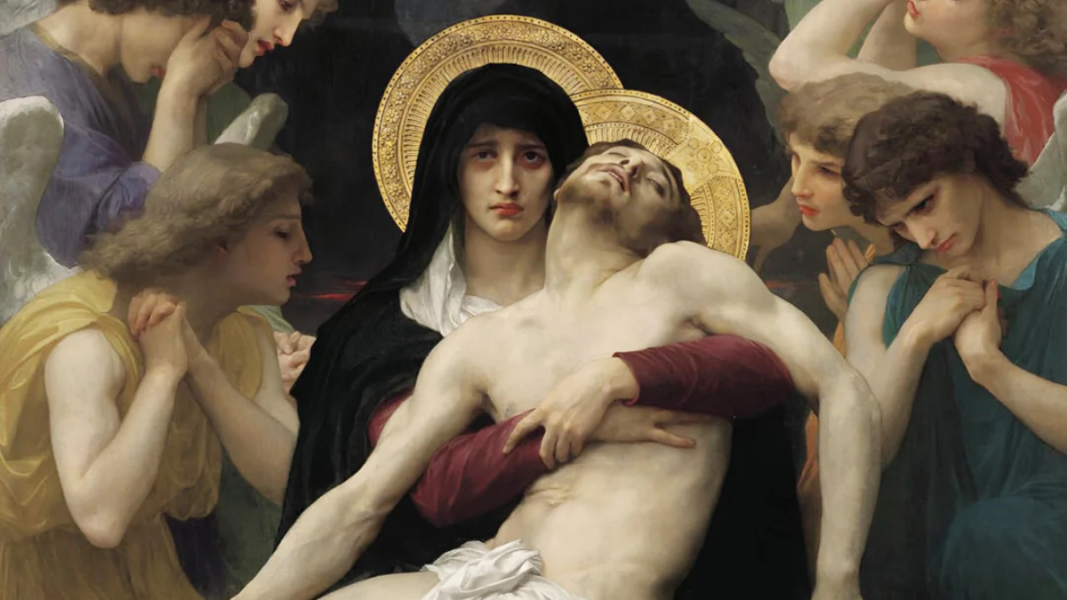
In his article María “Co-Redemptrix” in St. Alphonsus Maria de Liguori, published in volume 5 of the journal Ecce Mater Tua, the Argentine bishop Antonio Baseotto, C.Ss.R. (R.I.P.), rescues the thought of the Redemptorist Doctor of the Church on the unique cooperation of the Virgin Mary in the work of salvation.
The study recalls that St. Alphonsus—author of The Glories of Mary—clearly defended the maternal participation of the Virgin in Christ’s sacrifice, to the point of affirming that Mary voluntarily offered her Son for the redemption of the world, uniting herself to his Passion as an “instrument united” to divine grace.
The Redemptive Love of the Mother
Baseotto quotes the introduction to The Glories of Mary, in which St. Alphonsus addresses Christ and his Mother directly in a tone of prayer:
“Sweetest Lady and my Mother, you well know that in you, after Jesus, I have placed all my hope of eternal salvation, for all my good […] I recognize as having received through your mediation.”
The bishop emphasizes that this conviction is not devotional but theological: Mary appears as advocate, mediator, and co-redemptrix, functions inseparable from her spiritual motherhood.
The Neapolitan saint—Baseotto affirms—wrote his work after sixteen years of research and study, relying on Sacred Scripture, the Church Fathers, and the great Marian theologians.
A Doctrine Founded on Union with Christ
St. Alphonsus teaches that Mary began her co-redemptive mission explicitly by presenting her Son in the temple:
“Eternal Father, let my Son die […] I consent to him losing his life for your glory and the salvation of the world.”
And he adds—following St. Bonaventure—that there were two altars at Calvary: one in the body of Jesus and another in the heart of Mary. Both, Mother and Son, offered a single sacrifice: Christ making satisfaction for sins, and Mary meriting that this satisfaction be applied to humanity.
Baseotto also recalls that St. Alphonsus gathers ancient titles—from St. Epiphanius, St. Ildefonsus, St. Germanus, and St. Ambrose—that describe the Virgin as “Redeemer of the Captives” and “Repairer of the Lost World,” thus confirming an uninterrupted tradition on her singular role in the economy of grace.
Mary, United to the Cross
In the deepest part of his analysis, the Argentine bishop quotes St. Bonaventure and Richard of St. Lawrence:
“It was not enough for our ransom that a God be crucified; he also wanted his Mother to be crucified, who out of love for us cooperated in our salvation, offering her sorrows as merit before God.”
Thus, Marian co-redemption takes nothing away from Christ’s sacrifice, but rather manifests it in its fullness of love. Mary is not a parallel cause but a subordinate collaborator, as traditional theology affirms: she participates “not by necessity, but by grace and by love.”
Theological Relevance Today
Baseotto’s text, written years ago but of enormous relevance today, contrasts with the ambiguous tone of the recent Doctrinal Note “Mater Populi Fidelis”, which avoids the titles of Co-Redemptrix and Mediatrix.
In contrast to that caution, the study in Ecce Mater Tua shows how the great doctors—especially St. Alphonsus—taught with certainty that Mary cooperated in a singular and real way in the redemption, in perfect union with the Redeemer.
In the words of Pius XII, who proclaimed St. Alphonsus patron of moralists and confessors, the saint’s doctrine “shines for its balance between dogmatic rigor and filial tenderness toward the Mother of the Savior.”