


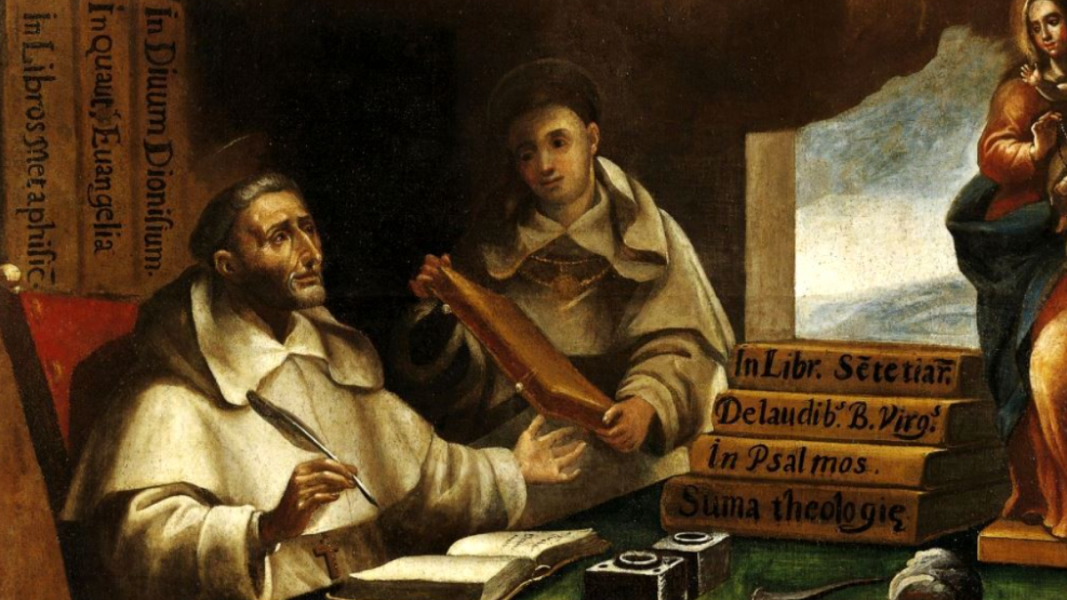
Today, when contemporary culture has broken the bond between truth and reality, reducing reason to opinion and feelings, Albert the Great becomes a beacon that illuminates the Christian foundation of Western civilization. His conviction—that all truth comes from the Holy Spirit, no matter where it comes from—is a declaration of war on the fragmented and superficial thinking that dominates modern society.
The synthesis between faith and reason that the West has forgotten
Saint Albert the Great played a decisive role in the integration of Aristotelian philosophy into Christian thought. In an era when Aristotle was viewed with suspicion, Albert understood that pagan philosophy was not an enemy, but a tool that, properly purified, could serve the revealed truth. He had no fear of studying, analyzing, and commenting on the works of the Stagirite, because he knew that faith is not weakened by dialoguing with reason, but is ennobled.
Albert’s genius consisted in avoiding two opposite errors: on the one hand, the disdain for reason by certain spiritualist currents; on the other, the idolatry of reason that would later characterize modernity. For him, human reason operates in the natural realm, while faith opens man to the supernatural. Both complement each other because both come from God. Separating them leads to confusion; confusing them, to heresy.
Faith illuminates reason, and reason leads to faith
Unlike modern rationalism, which seeks to explain the world solely through the visible, Albert understood that reason needs a higher light. Revelation does not destroy intelligence, but elevates it. For him, the contemplation of the natural order was a legitimate path to God. Nature was not chaos, but an open book, intelligible, that spoke clearly of its Creator to those who know how to listen.
This vision contrasts radically with the contemporary mentality, which has reduced the search for truth to a mere question of utility. The thought of Albert the Great reminds us that man can only understand himself when he recognizes that he is made for truth. And that truth is not reached through emotion or the will to power, but through a humble, ordered reason open to grace.
The master of Saint Thomas: the root of Catholic thought
If the figure of Albert the Great is great, it is even greater when considering his role as the master of Saint Thomas Aquinas. It was he who discovered Thomas’s genius and defended him when others despised him. Under Albert’s guidance, Thomas developed the method that would later give rise to the Summa Theologica and the most influential Christian philosophy in history.
Albert formed Thomas not only in academic rigor, but in intellectual humility. He taught his disciple that truth does not belong to those who express it, but to God, and that the mission of the theologian is to serve it with obedience. This deeply Christian attitude is what Leo XIII sought to restore in the Church with the encyclical Aeterni Patris, in which he proposes Scholasticism—and especially Thomism—as a sure guide against modern errors. Without Albert, that legacy might not have existed.
A true scientist: when investigating is an act of faith
Unlike some contemporary intellectuals, Albert did not consider science as an end in itself. His research in botany, zoology, chemistry, and mineralogy had a clearly Christian purpose: to admire and understand the order of creation. He was a scientist because he was a believer, and he was a believer because he knew that human reason, left to itself, could never explain the totality of being.
His figure contradicts the modern myth that the Church was an enemy of science. Albert is proof that true science is the daughter of faith. For him, investigating was a form of praise. His scientific work never detached itself from his conviction that the world has a rational structure and meaning. In the face of today’s fragmented and technocratic science, Albert reminds us that science without ethics becomes destructive, and that ethics without metaphysics is incapable of defending man against the new cultural totalitarisms.
Catholic intelligence needs to return to Albert the Great
The intellectual crisis that the world—and, to a large extent, the Church—is going through has its root in the abandonment of the Christian philosophical tradition. Today, weak theologies, relativist philosophies, and Catholic universities that have lost their identity proliferate. The thought of Albert the Great is an urgent call to rebuild the edifice of Catholic intelligence.
Recovering him means returning to affirming the objectivity of truth, defending the natural order, and rejecting the modern idea that faith is a feeling without rational content. It also means demanding solid formation in philosophy for those preparing for the priesthood, and remembering that evangelization needs clear minds, not just well-intentioned hearts.