


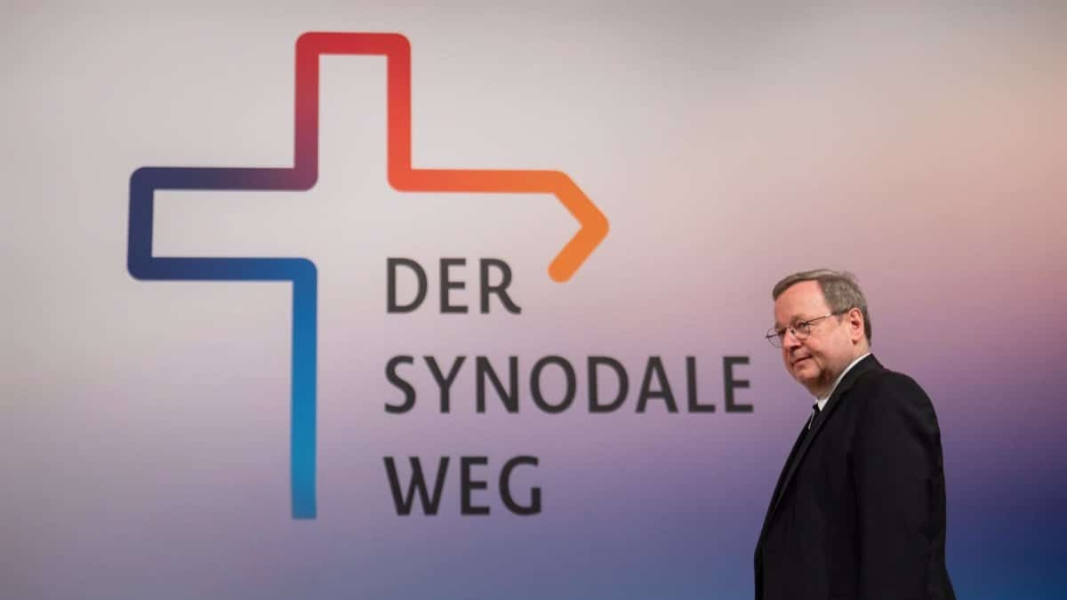
The president of the German Episcopal Conference (DBK), Georg Bätzing, acknowledged at an event in Mainz that the Church in Germany “often falls short of its own demands,” especially regarding the management of abuse cases. In his view, the loss of trust is “massive” when the public impression is that reparation to victims and investigations continue to progress in a “slow and half-hearted” manner.
However, the bishop of Limburg did not delve into examining the deep roots of this credibility crisis, which not a few analysts also associate with the doctrinal and pastoral drift of the so-called Camino Sinodal German. Bätzing insisted that transparency is the “decisive criterion” for regaining social trust, but overlooked the fact that doctrinal disorientation and the questioning of Catholic teaching have also contributed to eroding the credibility of the German Church.
A crisis diagnosis that points outward
In his speech during the traditional Martinsempfang of the Church in Rhineland-Palatinate, Bätzing expanded his analysis to politics and society, warning of a climate of “distrust, aggression, and division” that affects the entire country. He even expressed concern for the future of democracy and the stability of the values that sustain coexistence.
The general tone pointed to a structural problem shared by civil and religious institutions, which, in practice, dilutes the specific responsibility of the German Church in its own process of public erosion.
Bet on political and social alliances
Before state authorities, including the minister-president Alexander Schweitzer (SPD), Bätzing defended the need to create “cooperations” between actors who work for hope and social cohesion. Again, the message remained anchored in generalist proposals, closer to political discourse than to a self-critical examination of the ecclesiastical institution.
Schweitzer, for his part, called for abandoning the “toxic nostalgia” of the past and urged offering citizens “an emotional proposal for the future.” He pointed to the dedication of millions of volunteers as an example of social commitment and demanded support for those who actively contribute to the common good.
A speech that avoids the root of the problem
Although Bätzing emphasized the importance of transparency in the management of abuses, he did not mention the impact that the Camino Sinodal —with proposals contrary to Catholic doctrine on sexuality, morals, and sacramental structure— is having on the loss of faithful, the massive closure of parishes, and the rapid secularization of German Catholicism.
The appeal to social alliances and a more constructive political climate may sound right, but it leaves the central question unanswered: the Church in Germany not only suffers a crisis of trust; it suffers a identity crisis. And as long as its leaders insist on reformulating the doctrine instead of proclaiming it, they will hardly be able to recover the lost credibility.