


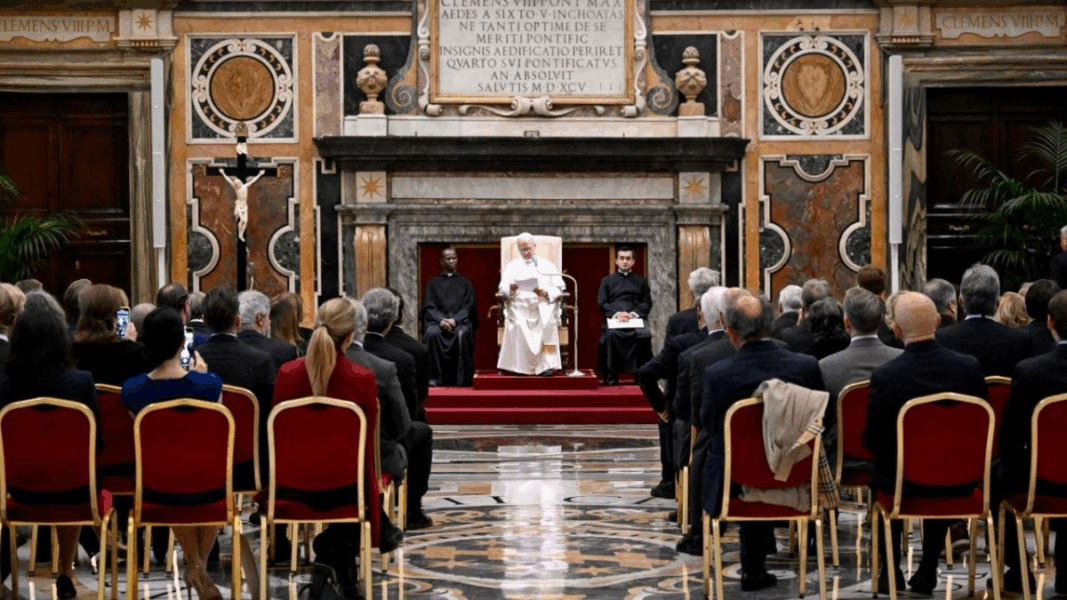
On November 13, 2025, in the Clementine Hall of the Apostolic Palace, Pope Leo XIV addressed the participants of the conference “The Dignity of Children and Adolescents in the Age of Artificial Intelligence”. Before experts, educators, and institutional representatives, the Holy Father reflected on the ethical challenges posed by the rapid advancement of artificial intelligence, especially regarding the protection of minors.
In his message, Leo XIV emphasized the vulnerability of children and adolescents to algorithms capable of influencing their behaviors and decisions, and recalled the responsibility of parents, educators, governments, and international organizations. He pointed out that safeguarding the dignity of minors cannot be reduced to technical policies, but requires a deep educational commitment on the part of adults. The Pope insisted that artificial intelligence must be oriented toward serving the integral development of young people, never to the detriment of their freedom or human growth.
Below, we provide the complete message of the Holy Father:
In the name of the Father, and of the Son, and of the Holy Spirit.
Peace be with you!
Good morning to all and welcome.
I extend my greetings to all of you participating in this meeting on the dignity of children and adolescents in the age of artificial intelligence. I thank you for your presence and your valuable contributions.
Artificial intelligence is transforming many aspects of our daily life, including education, entertainment, and the safety of minors. Its use raises important ethical questions, especially regarding the protection of the dignity and well-being of minors.
Children and adolescents are particularly vulnerable to manipulation through AI algorithms that can influence their decisions and preferences. It is essential that parents and educators be aware of these dynamics and that tools be developed to monitor and guide young people’s interactions with technology.
Governments and international organizations have the responsibility to design and implement policies that protect the dignity of minors in this age of AI. This includes updating existing data protection laws to address the new challenges posed by emerging technologies and promoting ethical standards for the development and use of artificial intelligence.
However, safeguarding the dignity of minors cannot be reduced solely to policies; it also requires digital education. As my predecessor once noted regarding a child protection project promoted by three major Catholic associations in Italy, adults must rediscover their vocation as “artisans of education” and strive to be faithful to it. [1]
It is certainly important to draft and apply ethical guidelines, but that is not enough. What is needed are everyday and ongoing educational efforts, carried out by adults who in turn are trained and supported by networks of collaboration. This process involves understanding the risks that both the use of AI and premature, unlimited, and unsupervised digital access can pose to relationships and the development of young people. Only by participating in the discovery of those risks and their effects on personal and social life can minors be accompanied in their approach to the digital world as a means to strengthen their capacity to make responsible decisions for themselves and for others.
This is, in itself, a vital exercise in safeguarding human originality and the capacity for relationship, which must always be guided by respect for human dignity as a fundamental value. Only by adopting an educational, ethical, and responsible approach can we ensure that artificial intelligence is an ally, and not a threat, in the growth and development of children and adolescents.
Dear friends, I wish you a fruitful conference that helps to lay solid foundations for our ongoing service to children, youth, and the entire ecclesial and civil community. Upon you and your work, I invoke the blessing of the Lord.
[1] Cf. Francis, Message to the Participants in the Conference “Promoting Child Safeguarding in the Time of COVID-19 and Beyond”, November 4, 2021.