


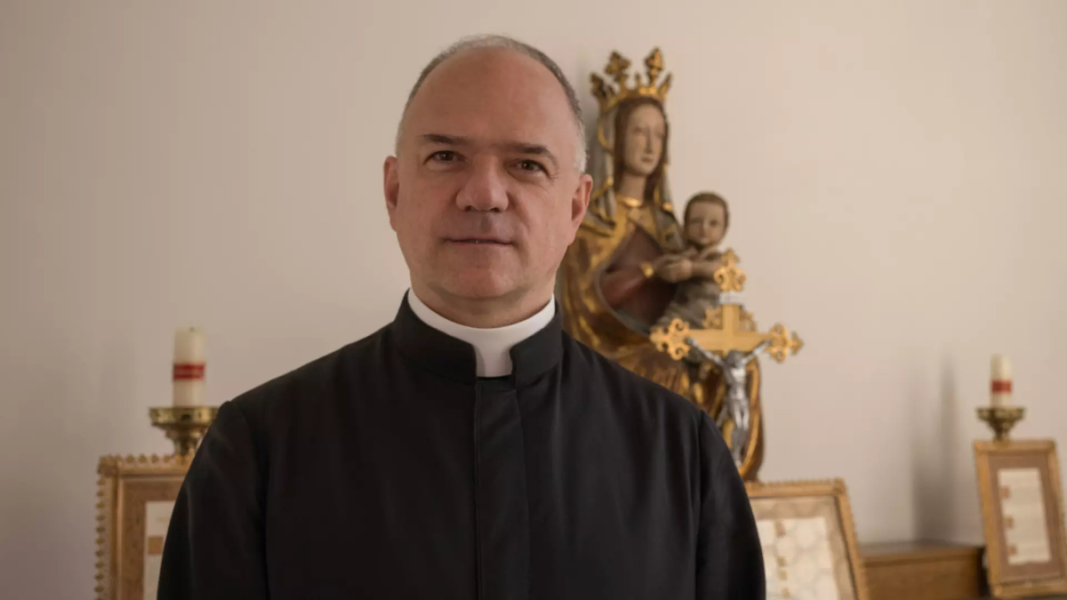
The publication of Mater Populi fidelis by the Dicastery for the Doctrine of the Faith has found one of its firmest responses in the Priestly Fraternity of Saint Pius X. Its Superior General, Don Davide Pagliarani, confesses that the text had a “great impact” on him. As he recounts, his first reaction was to offer a Mass of reparation in the face of what he considers a new attack, not only against the traditional teaching of the Church, but against the Most Holy Virgin Mary herself.
Pagliarani laments that the document does not limit itself to discouraging the Marian titles traditionally used—such as Co-Redemptrix or Mediatrix of All Graces—but alters their meaning until emptying them of content. That denaturalization, he explains, amounts to dethroning the Virgin from the unique place she occupies in the economy of salvation.
The traditional Magisterium ignored
The Superior General recalls the clarity with which Saint Pius X expounded these doctrines in the encyclical Ad diem illum, where the Pope describes Mary’s singular cooperation in Christ’s redemptive work and her role as mediator. He notes—it is striking—that the Dicastery’s note barely mentions this text, without quoting it, as if its Magisterium were inconvenient or incompatible with current theological categories.
For Pagliarani, explicitly denying these titles implies disregarding the homogeneous evolution of dogma and the “common theological conclusion” upheld for centuries by saints, doctors, and pontiffs.
The ecumenical background and the new notion of Redemption
The Superior General identifies two main causes behind this doctrinal shift.
On one hand, ecumenism. Co-redemption and universal mediation are unacceptable to Protestant theology, and their exclusion already occurred at the Second Vatican Council. According to Pagliarani, the will not to offend the Reformed world has ended up impoverishing the Catholic faith: what is not proclaimed clearly ends up weakening and being lost.
The second reason is deeper: the very concept of Redemption is being altered. There is less and less talk of expiatory sacrifice, of satisfaction offered to divine justice, or of reparation. Christ would no longer be the Redeemer who makes satisfaction for the sins of the world, but the expression of an unconditional love that forgives without demanding conversion. This doctrinal revision—Pagliarani warns—makes it impossible to understand the Virgin’s singular union with her Son’s redemptive work.
“A spiritual paranoia” toward Marian piety
The document constantly repeats that Mary does not compete with Christ nor detract anything from his unique mediation. For Pagliarani, this insistence reveals an unjustified distrust toward Marian piety. He even calls it a “spiritual paranoia,” because no instructed faithful runs the risk of placing the Virgin above her Son. Marian devotion, well-founded, always leads to the mystery of Christ and never supplants it.
Devastating pastoral consequences
Pagliarani warns of the pastoral impact this text will have. In a time of doctrinal confusion and moral crisis, the figure of the Most Holy Virgin should be presented as help and refuge, especially for the most needy faithful. However, the Dicastery chooses to warn against the titles that for centuries have nourished the interior life of simple Catholics.
He considers that this decision will impoverish spiritual life and deprive many souls of a support that the Church should never have allowed to weaken.
The contradiction with interreligious openness
The Superior General also laments the underlying contradiction: while Marian doctrine is restricted to avoid ambiguities, Rome enthusiastically celebrates the anniversary of Nostra Aetate, the document that opened the door to contemporary interreligious dialogue. According to Pagliarani, that dialogue has given rise to “the most regrettable interreligious meetings,” in open contradiction with the Church’s mission to proclaim that Christ is the only Mediator and Savior.
He recalls another traditional title now forgotten: that of Mary as “she who has crushed all heresies.” It is not a metaphor, he emphasizes, but a profound theological reality. Mary guards the truth because she is the Mother of Him who said: “I am the Truth.” Wherever Marian devotion weakens, faith runs the risk of being diluted.
A prayer for these times
The interview concludes with a prayer taken from the liturgy, which the Superior General considers especially necessary today:
«Dignare me laudare te, Virgo sacrata. Da mihi virtutem contra hostes tuos.»
—Allow me to praise you, sacred Virgin. Give me strength against your enemies.