


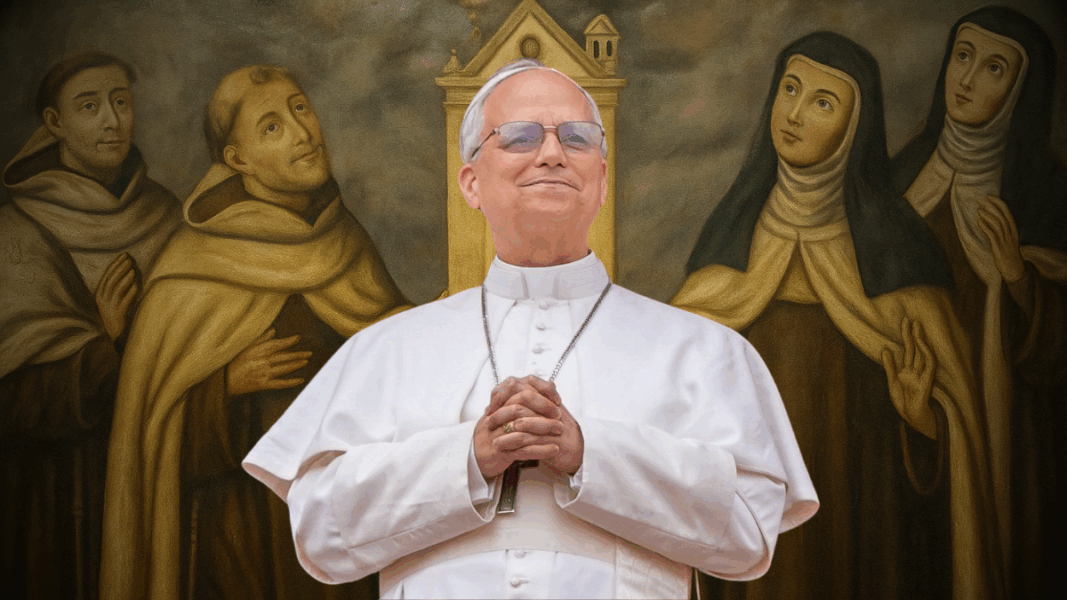
On November 13, 2025, in the Paul VI Hall of the Vatican, Pope Leo XIV received in audience the participants of the Congress organized by the Dicastery for the Causes of Saints, titled “Mysticism. Mystical Phenomena and Holiness”. In his discourse, the Holy Father addressed the nature of the mystical experience, the relationship between extraordinary phenomena and authentic Christian holiness, and the need for prudent and ecclesial discernment in the face of manifestations that can be confused with true spiritual gifts. He also recalled that the fundamental criterion for recognizing the holiness of a faithful is the constant conformity with the will of God, above any extraordinary sign.
Below is the complete discourse of Leo XIV:
Your Eminences, Excellencies,
dear Priests, Religious, Religious Sisters,
dear brothers and sisters,
I am pleased to welcome you at the end of the Congress promoted by the Dicastery for the Causes of Saints and dedicated to the relationship between mystical phenomena and holiness of life. It is one of the most beautiful dimensions of the experience of faith, and I thank you because with this study you have contributed to valuing it and also to shedding light on some aspects that require discernment.
Both through theological reflection and through preaching and catechesis, the Church has recognized for centuries that at the heart of mystical life is the consciousness of intimate union of love with God. This event of grace is manifested in the fruits it produces, according to the Lord’s word: “No good tree bears bad fruit, nor again does a bad tree bear good fruit; for each tree is known by its own fruit. For figs are not gathered from brambles, nor are grapes picked from a bramble bush” (Lk 6:43-44).
Mysticism is characterized, therefore, as an experience that surpasses mere rational knowledge not by merit of the one who lives it, but by a spiritual gift, which can manifest itself in various ways, even with completely opposite phenomena, such as luminous visions or dense darknesses, afflictions or ecstasies. In themselves, however, these exceptional facts remain something secondary and not essential in relation to mysticism and to holiness itself: they can be signs insofar as they are singular charisms, but the true goal is and remains always communion with God, who is “more intimate to me than I am to myself and higher than the highest part of me” (Saint Augustine, Confessions, III, 6, 11).
Consequently, the extraordinary phenomena that can characterize the mystical experience are not indispensable conditions for recognizing the holiness of a faithful: if they are present, they strengthen their virtues not as individual privileges, but insofar as they are oriented toward the edification of the entire Church, Mystical Body of Christ. What matters most and what must be emphasized most in the examination of candidates for holiness is their full and constant conformity with the will of God, revealed in the Scriptures and in the living apostolic Tradition. It is important, therefore, to maintain balance: just as the Causes of Canonization should not be promoted only in the presence of exceptional phenomena, care must also be taken not to penalize them if these same phenomena characterize the life of the Servants of God.
With constant commitment, the Magisterium, theology, and spiritual authors have also provided criteria for distinguishing authentic spiritual phenomena—which can occur in a climate of prayer and sincere seeking of God—from manifestations that can be deceptive. To avoid falling into superstitious illusion, it is necessary to evaluate such facts with prudence through a humble discernment in conformity with the teaching of the Church.
Almost summarizing this practice, Saint Teresa of Avila states: “It is clear that the highest perfection does not consist in interior sweetnesses, in great raptures, in visions, or in the spirit of prophecy, but in the perfect conformity of our will with that of God, so that we want, firmly, what we know to be His will, accepting with the same joy both the sweet and the bitter, as He wills.” [1] These words correspond to the experience of Saint John of the Cross, according to which the exercise of virtues is the sprout of passionate availability to God, so that His will and ours become “one single will in a prompt and free consent,” [2] until the transformation of the lover into the Beloved. [3]
At the center of the discernment about a faithful is the listening to his fame of holiness and the examination of his perfect virtues, as expressions of ecclesial communion and intimate union with God. In carrying out this valuable service, especially those among you who work in the field of the Causes of Canonization are called to imitate the saints and thus cultivate the vocation that unites us all as baptized, living members of the one People of God.
In the meantime, I encourage you to continue with confidence and wisdom on this path, and from the heart I impart the apostolic blessing to all of you.
Thank you!
[1] Saint Teresa of Jesus, Foundations 5, 10; cf. Id., Interior Castle, I, 2, 7; II, 1, 8.
[2] Saint John of the Cross, Living Flame of Love 3, 24.
[3] Cf. Id., Spiritual Canticle, 22, 3.