


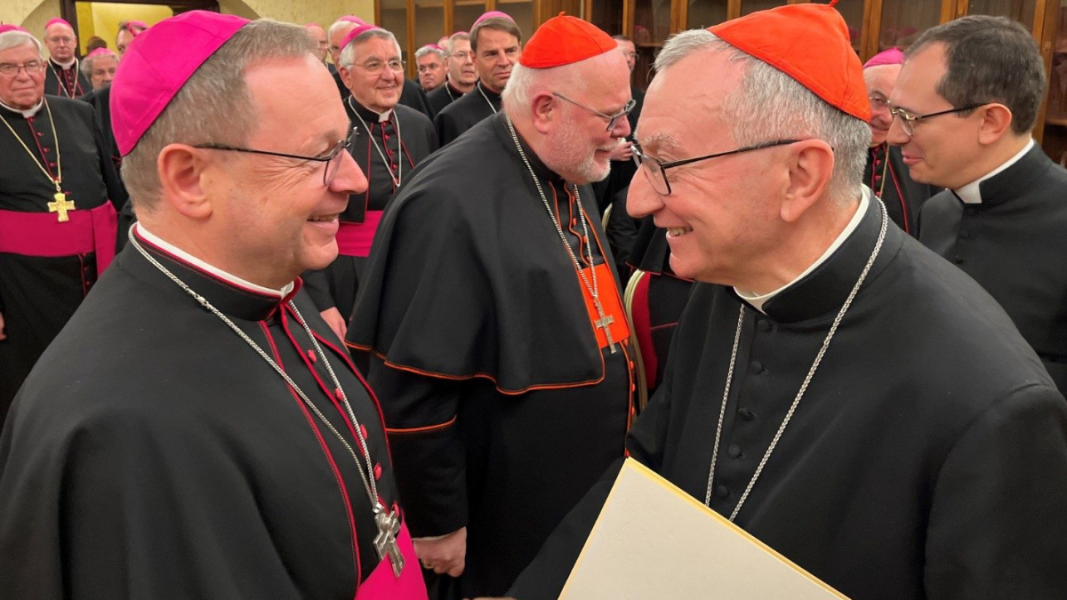
The Holy See and the German Episcopal Conference (CET) held a new meeting in Rome on November 12, as part of the dialogue process initiated following the ad limina visit of the German bishops in November 2022. This is the fourth formal meeting—after those on July 26, 2023, March 22, 2024, and June 28, 2024—aimed at addressing the future of the Church in Germany and, in particular, the possible creation of a new synodal body.
A meeting to define a «Synodal Conference»
According to the joint statement, the meeting was marked by a “sincere, open, and constructive” atmosphere. On the table was the draft statute for the synodal body planned in Germany, provisionally called “Synodal Conference”, a structure whose nature, composition, and competencies remain the subject of intense debate between Rome and the German bishops.
On behalf of the Roman Curia, the participants were:
-
Cardinal Víctor Manuel Fernández (Dicastery for the Doctrine of the Faith)
-
Cardinal Kurt Koch (Promotion of Christian Unity)
-
Cardinal Pietro Parolin (Secretariat of State)
-
Cardinal Arthur Roche (Divine Worship)
-
Archbishop Filippo Iannone, O.Carm. (Legislative Texts)
The German delegation was headed by:
-
Msgr. Georg Bätzing, president of the CET
-
Msgr. Stephan Ackermann
-
Msgr. Bertram Meier
-
Msgr. Franz-Josef Overbeck
-
Dr. Beate Gilles, secretary general
-
Dr. Matthias Kopp, CET spokesperson
As a guest—whose presence is noteworthy given his critical stance toward the synodal way—Msgr. Stefan Oster, Bishop of Passau, attended.
The key point: the future German “synodal body”
The statement confirms that Rome and the CET are negotiating the nature of the new body which, according to the German proposal, would integrate bishops and laity with decisive voice in doctrinal, pastoral, and disciplinary matters—a approach that has generated reservations in the Vatican due to its potential collision with Catholic ecclesiology, where doctrinal and disciplinary authority resides in the episcopal college in communion with the Pope.
The topics debated included:
-
the legal nature of the future “Synodal Conference,”
-
its exact composition (degree of participation and voting by laity),
-
and its real competencies vis-à-vis diocesan episcopal conferences and universal Church law.
However, the statement does not clarify what specific agreements were reached.
A process underway… and a direction set from Rome?
The diplomatic tone of the statement suggests that the negotiations continue without a break, but also without public clarity on the limits that Rome is willing to accept. The promoters of the German synodal way have defended impulses that directly affect moral doctrine and sacramental discipline (blessings of same-sex couples, re-reading of sexual morality, deliberative participation of laity in episcopal decisions, revision of Christian anthropology).
The Vatican, for its part, seems to opt for avoiding a frontal clash, betting on a prolonged process that limits, reformulates, or institutionally absorbs the German proposals without an open fracture. With the simultaneous presence of such divergent figures as Bätzing and Oster, the process can be interpreted both as an attempt at mediation and as a sign that doctrinal unity remains seriously threatened.
And here inevitably arises the question that the statement itself leaves hanging: Where is the Vatican directing the path of the Church in Germany?