


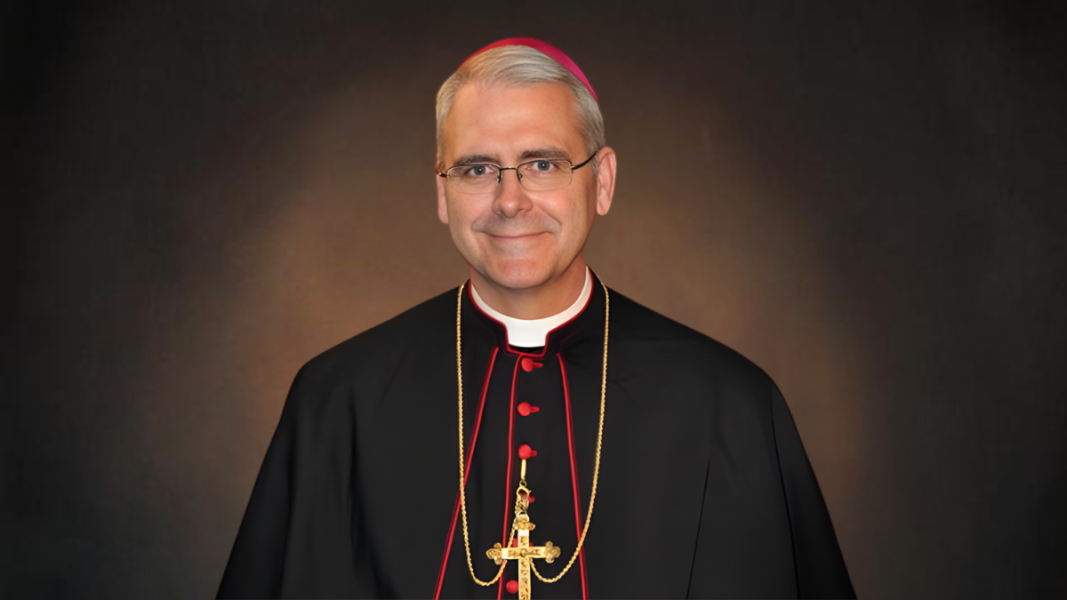
The election of Archbishop Paul Stagg Coakley as the new president of the United States Conference of Catholic Bishops (USCCB) marks a point of continuity in the doctrinal direction of the American episcopate and, at the same time, offers interesting insights into the liturgical and spiritual sensitivities of the prelate who will guide the American Church in the coming years.
Born in 1955 in Norfolk (Virginia) and ordained a priest in 1983 for the Diocese of Wichita, Paul S. Coakley developed his ministry in Kansas before being appointed bishop of Salina in 2004. In 2010, he was designated archbishop of Oklahoma City, an archdiocese he has led ever since. With years of work on USCCB committees, leadership in international charity initiatives, and a reputation for doctrinal prudence, Coakley has established himself as one of the most stable voices in the conservative American episcopate. His episcopal motto, Duc in altum, aptly summarizes his pastoral style: sober, focused on recovering fundamentals and avoiding unnecessary ruptures.
Coakley is known for his firm interventions on central issues of the Church’s Social Doctrine. In the area of defending life, he has repeatedly denounced abortion as an intrinsic evil, without ambiguous nuances. At the same time, he has emphasized that the application of the death penalty contributes to hardening society and has expressed a clear reservation toward its use without falling into strange equivalences. On immigration matters, he has warned of the dehumanizing effects of mass deportation policies and has recalled that the American tradition has been built thanks to generations of immigrants who arrived in the country seeking better living conditions. His public stance maintains a delicate balance between the defense of non-negotiable principles and pastoral care for vulnerable groups, without yielding to purely ideological polarizations.
In addition to what his official profiles reflect, Coakley possesses formative veins that rarely appear in mainstream media but help understand part of his spiritual sensitivity. Sources close to the prelate confirm that the archbishop was a disciple of John Senior, the renowned thinker who influenced several generations of American Catholics through his defense of tradition, classical culture, and the centrality of monastic life as the root of Christian civilization. Likewise, he had a brief period of monastic life at the Abbey of Fontgombault, one of the most influential Benedictine monasteries in the traditional liturgical renaissance of the 20th century. These details, not usually mentioned in his public biographies, explain the familiarity and naturalness with which he moves in environments where liturgical tradition is lived without ideological tension.
In relation to the traditional liturgy, Msgr. Coakley is described by those who know him as very friendly toward the traditional Mass. He is not a “traditionalist bishop” in the media sense of the term, but rather a prelate who does not identify the extraordinary form of the Roman Rite with divisions or “culture wars,” and who considers it a legitimate part of the Church’s liturgical richness. He celebrates it occasionally and maintains a close relationship with communities that live the liturgical tradition in full communion with the Church. Last year, during the well-known Clear Creek pilgrimage, Coakley attended the closing Mass celebrated by Msgr. Athanasius Schneider in the choir. His presence, silent, without prominence and without public announcement, was highly valued by the faithful, who interpreted it as a gesture of closeness to that spiritual world, devoid of any intent of instrumentalization.
The USCCB is experiencing complex years, marked by internal tensions over pastoral priorities, debates around the role of liturgical tradition, challenges in the fields of bioethics, Catholic education, and religious freedom, as well as delicate relations with Rome on doctrinal and disciplinary issues. Coakley’s election points to an episcopate that desires doctrinal stability and strategic serenity. He is neither an agitator nor a purely technocratic manager; above all, he is a pastor with clear convictions, a deep spiritual life, and sensitivity to understand that the renewal of the Church passes as much through mission as through tradition.
The new president of the American episcopate combines in a rare way doctrinal orthodoxy without stridency, intellectual seriousness with roots in classical tradition, and a real closeness to the traditional liturgy and monastic life. His leadership will be key in the coming years, especially in a country where the Church is at stake for much of its identity in the face of intense cultural and political pressures. Coakley’s discreet tone should not deceive: his formation and trajectory suggest that, under his presidency, the USCCB will seek clarity without confrontation and, perhaps, a renewed attention to the spiritual treasure of Catholic tradition attacked by Traditionis Custodes and a wave of prohibitions and persecution.