


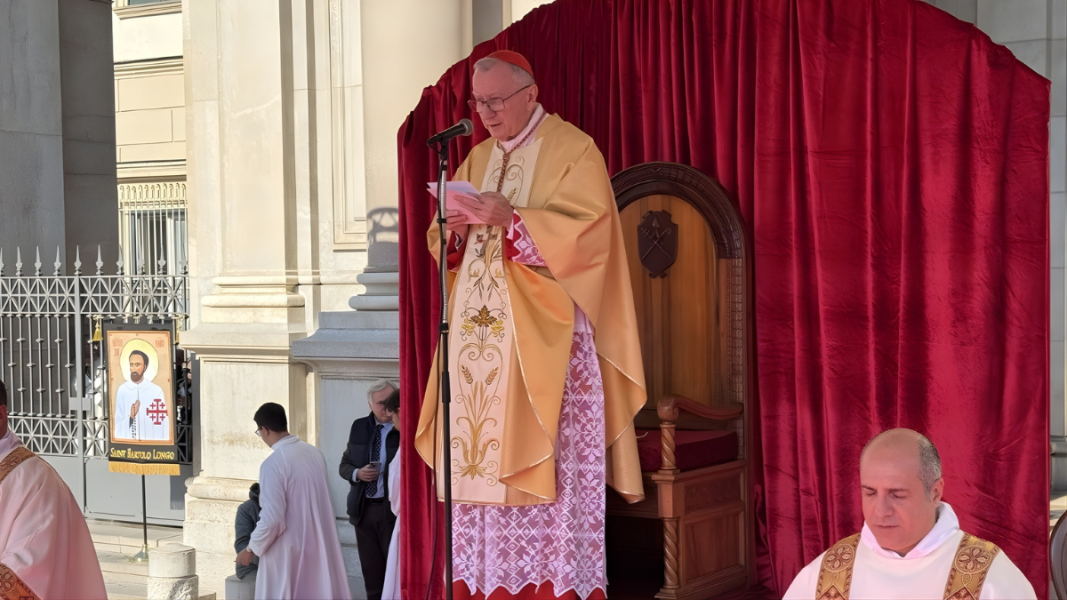
Cardinal Pietro Parolin, Secretary of State of the Vatican, presided over the Solemn Mass on November 13 for the 150th anniversary of the arrival of the image of Our Lady of the Rosary in Pompeii. As papal legate, Parolin highlighted the spiritual significance of this local jubilee, experienced in the midst of the celebration of the Holy Year of Hope, and conveyed the closeness of Pope Leo XIV to the thousands of faithful gathered in the Marian shrine.
A jubilee within the Jubilee
The Pompeii shrine is experiencing days of singular grace. Commemorating the 150 years since the arrival of the famous image of Our Lady of the Rosary, the celebration takes on a particularly significant character this year, as it unfolds in the full experience of the Holy Year of Hope. Parolin, who came as the Pope’s special envoy, recalled that this coincidence is not merely a chronological fact, but a reason to renew faith and deepen the evangelizing mission of the shrine founded by St. Bartolo Longo.
The day began with a moment of prayer before the relics of the saint, inside the shrine. There, the cardinal was accompanied by Archbishop Tommaso Caputo and a large group of bishops, priests, and civil and military authorities. The faithful, who came from all over Italy, crowded the esplanade to participate in the Mass. Parolin conveyed the greeting of Pope Leo XIV, assuring that the Pontiff «spiritually joins» the celebration and entrusts himself and his apostolic ministry to the protection of the Virgin.
A shrine that embraces with Mary’s tenderness
In his homily, Parolin emphasized the role of the Shrine of Our Lady of the Rosary as a place of consolation and prayer. There—he said—pilgrims experience something of the same tenderness that Mary poured out on the house of her cousin Elizabeth: a silent, close presence full of love.
The cardinal contrasted this tenderness with the dominant mentality of our time, marked by speed, productivity, and efficiency. Although these criteria can generate positive advances, they also produce a «distraction of the heart» that prevents us from looking at people and their real needs. In a hurried society, he noted, many run «so as not to think,» to avoid facing essential questions about the meaning of life.
The haste of the heart: an impulse born of the Gospel
In contrast to this empty and superficial haste, Parolin presented Mary’s attitude as a deeply Christian alternative. The Virgin’s visit to Elizabeth—he explained—was not the fruit of activism, but of an «inner haste» that springs from the desire to share God’s works and bring consolation to those who need it. This «haste of the soul» does not seek immediate results, but the good of the other, illuminating their path with the presence of Christ.
The cardinal invited all Christians to imitate this evangelical haste, which moves us to act out of love and not out of the anxiety of efficiency. It is a disposition of the heart that recognizes what is essential and gives priority to the mission of announcing hope and attending to the wounds of our neighbor.
Bartolo Longo, example of conversion, service, and boldness
In this context, Parolin presented the life of St. Bartolo Longo as a particularly timely testimony. After going through a profound inner crisis and seeking the truth without rest, Longo found in the Virgin Mary the sure path to God. From that experience came his peace, his conversion, and his urgent desire to share with others the joy of the Gospel.
That «haste of the heart» gave rise to the Marian city of Pompeii, a place that Longo wanted to be a symbol of hope, prayer, and mercy. In times marked by social violence and vulgarity—added the cardinal—the saint’s work reminds us that nothing is lost when we trust in God and in Mary’s intercession.
Mary, humble servant and Mother of hope
At the end of the homily, Parolin raised the traditional Supplication before the image of the Virgin, entrusting the entire Church to Mary. He emphasized that the ambition of the Mother of God is not to receive honors as if she were a divinity, but to serve the Son and lead Christians to understand the Gospel of tenderness, of gift, and of selfless love.
The cardinal described Mary as «mirror of the beauty of Christ,» «most tender Mother,» and «Mother of hope,» underscoring her central role in the spiritual life of the faithful and in the Church’s evangelizing mission.
Caputo recalls the humble origin of the Virgin’s image
At the beginning of the celebration, Archbishop Caputo welcomed Cardinal Parolin and recalled the history of the image of Our Lady of the Rosary, which arrived in Pompeii in a humble and almost improvised manner. Donated to Bartolo Longo and his wife Marianna Farnararo, the canvas was transported from Naples in a cart of manure. This episode—he emphasized—reflects God’s style, who knows how to make great works spring from small and despised realities.
Caputo also evoked how the valley of Pompeii, in a few years, was transformed into a place of faith, charity, and works of mercy thanks to Longo’s spiritual and social vision.
Renew the life of the Rosary
The archbishop concluded by highlighting the importance of promoting the prayer of the holy Rosary throughout the Church, deepening its Christological and contemplative dimension. He recalled that Leo XIV particularly insisted on this point in the letter sent to Parolin on November 8, inviting the entire ecclesial community to rediscover this prayer as a path of meditation on the mystery of Christ.