


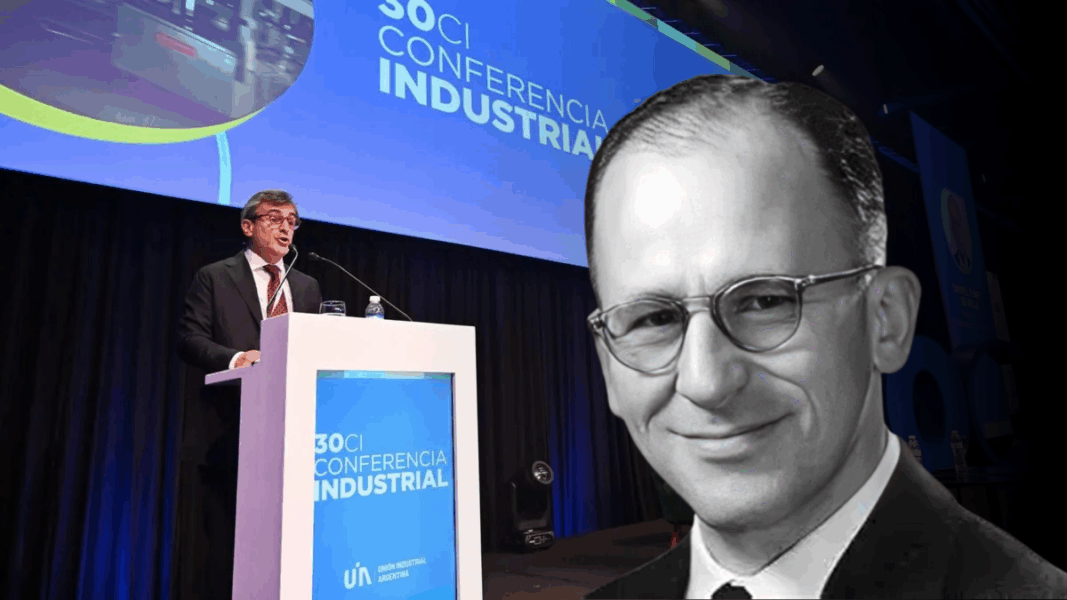
This Thursday, within the framework of the XXXI Argentine Industrial Conference held in Buenos Aires, Pope Leo XIV sent a message addressed to entrepreneurs, leaders, and representatives of the country’s productive sector. In his address, the Pontiff framed the reflection within the Jubilee of Hope, recalling the centrality of the common good, social justice, and the dignity of the worker according to the Church’s Social Doctrine.
The Holy Father took up the fundamental principles of Rerum Novarum and highlighted the figure of the Servant of God Enrique Shaw as an example of a Christian entrepreneur capable of integrating faith, ethics, and responsible management. He invited a renewal of entrepreneurial commitment that promotes human development, social cohesion, and care for creation.
We leave below the complete message from Leo XIV:
I cordially greet the participants in the 31st Argentine Industrial Conference, which is being held in Buenos Aires on November 13, 2025. I thank the organizers of this meeting for the kind invitation to address all of you. This space offers us, within the framework of the Jubilee of Hope, a heartfelt opportunity to recognize that the economy and business, when oriented toward the common good, can and must be engines of the future, inclusion, and justice.
In continuity with other interventions of the Magisterium, in 1891, Rerum Novarum constituted the foundational act of the Church’s Social Doctrine in its current form. There, the unjust conditions of many workers were denounced, and it was strongly affirmed «that neither justice nor humanity tolerates the demand for such performance that the spirit is dulled by excess work and at the same time the body succumbs to fatigue» (n.31). Likewise, the right to a just wage, to form associations, and to live with dignity was emphasized. These teachings, born in a time of profound industrial transformations, continue to have surprising relevance in the globalized world we inhabit, where the dignity of the worker is still often violated.
The Church reminds us that the economy is not an end in itself, but an essential yet partial aspect of the social fabric, in which God’s project of love for each human being develops. The common good requires that production and profit not be pursued in isolation, but oriented toward the integral promotion of every man and every woman. For this reason, my predecessor Leo XIII recalled that if workers receive a just wage, it allows them not only to support their families, but also to aspire to a small property and to love more the land worked by their own hands, from which they expect sustenance and dignity, and thus open themselves to higher aspirations for their life and that of their loved ones (cf. n. 33).
In the same vein, he also warned that those who enjoy material abundance must carefully avoid harming in the slightest the sustenance of the less favored, which—though modest—must be considered sacred, precisely because it constitutes the indispensable support of their existence (cf. n. 15). These words resonate as a constant challenge, because they invite us not to measure the success of the business solely in economic terms, but also in its capacity to generate human development, social cohesion, and care for creation.
In Argentina, this vision finds a luminous and close example in the venerable Servant of God Enrique Shaw, an entrepreneur who understood that industry was not only a productive gear nor a means of capital accumulation, but a true community of persons called to grow together. His leadership was distinguished by transparency, by the capacity to listen, and by the commitment to ensure that every worker could feel part of a shared project. In him, faith and business management were united harmoniously, demonstrating that the Social Doctrine is not an abstract theory nor an unrealizable utopia, but a possible path that transforms the lives of people and institutions by placing Christ at the center of all human activity.
Enrique promoted just wages, drove training programs, cared for the health of the workers, and accompanied their families in their most concrete needs. He did not conceive profitability as an absolute, but as an important aspect to sustain a human, just, and supportive business. In his writings and decisions, the inspiration of Rerum Novarum is clearly perceived, which asked entrepreneurs «not to consider workers as slaves; to respect in them, as is just, the dignity of the person, especially ennobled by what is called the Christian character» (n.15).
But the coherence of the Servant of God was not limited to the exercise of his profession. He also knew misunderstanding and persecution prophesied by Christ for those who work for justice (cf. Mt 5,10). He was imprisoned in times of political tensions and accepted that experience with peace and serenity. Later he faced illness, but never stopped working or encouraging his own. He offered suffering to God as an act of love and, even in the midst of pain, remained close to his workers.
His suffering for love of justice and fidelity to the principles of service, progress, and human advancement that he proposed as duties of the business leader in his work “…and subdue the earth”, make Enrique Shaw a current model for all those who make up the world of work. His life shows that one can be an entrepreneur and a saint, that economic efficiency and fidelity to the Gospel are not mutually exclusive, and that charity can penetrate even into industrial and financial structures.
Dear friends: Holiness must flourish precisely where decisions are made that affect the lives of thousands of families. The world urgently needs entrepreneurs and leaders who, out of love for God and neighbor, work for an economy at the service of the common good. May this Industrial Conference be a space to renew the commitment to an innovative, competitive, and above all human industry, capable of sustaining the development of our peoples without leaving anyone behind. I commend you to the intercession of Saint Joseph the Worker and with all my heart I impart the requested Apostolic Blessing.
Vatican, September 8, 2025, feast of the Nativity of the Most Holy Virgin Mary.
LEÓN PP. XIV