


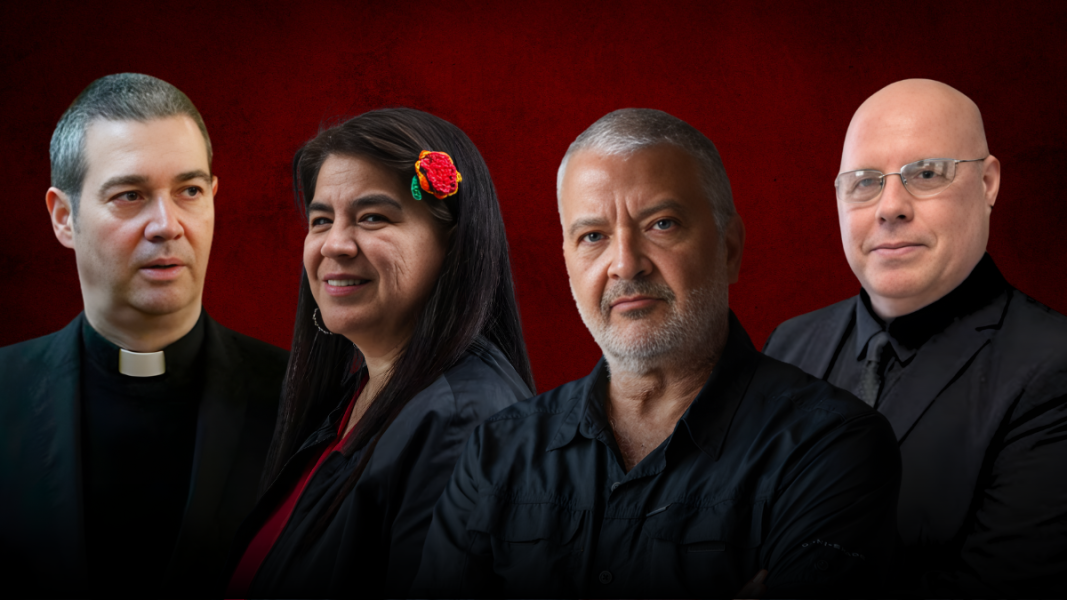
They say that the devil disguises himself as an angel of light. But sometimes he doesn’t even bother. He presents himself as he is, with a crooked clerical collar, a journalist’s notebook, and an open letter under his arm. And the most worrying thing is not his appearance, but his pretension: they seem convinced that they can lead the Pope to the abyss if they set their minds to it.
A month has already passed since the frustrated attempt at diplomatic manipulation that had the mayor of Lima as its protagonist (or victim). But far from moderating, the hard core of the “Sodalicio lobby” —Pedro Salinas, Paola Ugaz, Jordi Bertomeu and, of course, José Enrique Escardó— has intensified its pressure. They no longer settle for conditioning greetings. Now they mark appointments, celebrate sanctions, dictate doctrine and even allow themselves to revictimize the very victims they claim to defend.
The recent decision by Pope Leo XIV to appoint three deputy commissioners to collaborate with Bertomeu in the liquidation of the Sodalicio has been presented as a victory for the good guys. And yet, everything in that staging smells like a headlong flight. A desperate move to maintain the narrative that the Pope follows the instructions of the “skull trio” without question.
The same old actors —Ugaz, Salinas, Escardó— repeat insistently: that they know the Pope, that they have spoken with him, that they trust Bertomeu, that they have “everything documented.” That if what they say is not done, there will be no justice. What if they are not seeking justice, but control?
Because while they shower praise on the Pope for “following the process closely,” they expose him publicly as if he were just another piece on their board. And if any tribunal —like the one in Toledo— dares to dissent or question their narratives, they accuse it of revictimizing and demand its immediate correction. This is not how justice is built. This is how an ideological hegemony is imposed, not the truth of the facts.
Escardó, whose story undoubtedly deserves to be heard and compassion, has gone from being a symbol of denunciation to an untouchable totem of a narrative that is increasingly toxic. Any nuance, any doubt, any attempt to objectify his testimony is considered institutional heresy.
And that, far from helping him, turns him into a hostage of a cause that no longer seeks justice but revenge, visibility, and power. His words are used as a battering ram. His pain, as armor. His story, as a threat. And it all boils down to a terrible phrase: “If the Pope does not do what we want, he too will be guilty”.
Prevost must free himself from this yoke
Pope Leo XIV, who inherited the Sodalicio case and knows it better than anyone, would do well to definitively close the Chiclayo chapter and distance himself from those who have made this case their platform of power. The best thing Cardinal Prevost can do is free himself as soon as possible from this mediocre web of manipulation, before they end up dragging his pontificate —and the entire Church— into total disrepute.
Because one thing is to attend to the victims with respect and justice. And another, very different, is to allow the Church to be held hostage by a clique that has made emotional blackmail its only political tool.
If we truly want a free, clean, and strong Church, the first step is to cut the chain of favors, fears, and pressures that some have built on the pain of others. And if that means saying enough to Salinas, Ugaz, Bertomeu and company, better to do it today than regret it tomorrow.