


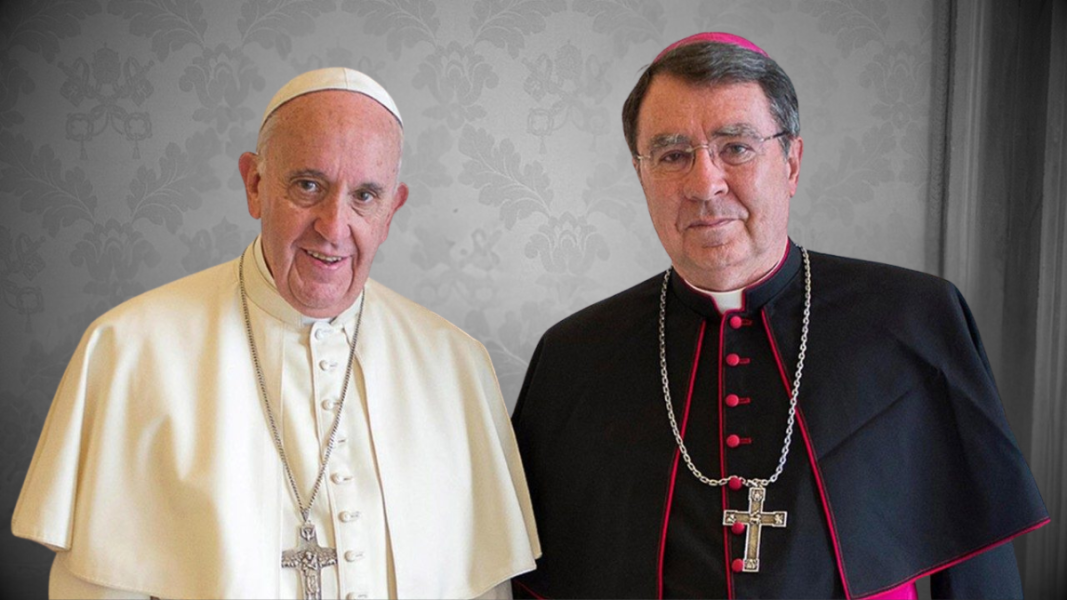
During the fall plenary assembly of the United States Conference of Catholic Bishops (USCCB) in Baltimore, Cardinal Christophe Pierre, apostolic nuncio and about to turn 80 years old, delivered a speech before the country’s bishops.
In his address, the pontifical representative called on the prelates to maintain fidelity to the pastoral path of Francis and to the “vision of the Second Vatican Council”, insisting that the future of the Church must advance along the path marked by those two references.
“Although some may lean toward a path that diverges from Francis’s pastoral vision, we know that the way to advance in the Church is not to stray from that vision”, affirmed Pierre.
“The Council is the map of the future”
The nuncio emphasized that the documents of the Second Vatican Council constitute “the map for the journey ahead”, and quoted words from Francis: “It is not yet time for a Vatican III, because we have not yet finished implementing Vatican II.”
“The vision of the Council was prophetic, an orientation toward the future”, said Pierre.
He asked the bishops to “resist polarization” and “adopt the synodal style of communion and discernment” as a way to make unity concrete.
In his speech, he also referred to Pope Leo XIV, stating that his first gestures and writings are “a maturation of Francis’s legacy”, and that both pontificates share “fidelity to the spirit of the Second Vatican Council”.
A Church that did not begin in 1962
However, the problem is deeper.
The nuncio’s speech —reported by The Pillar— once again presents the Second Vatican Council as the starting point and destination of the contemporary Church, as if Christianity had begun just six decades ago.
This vision seems to ignore that the Church was not born in 1962 nor with Francis, but with Jesus Christ, who founded it upon Peter more than two thousand years ago and has guided it through centuries of faith, magisterium, saints, martyrs, and councils, and even before that, God was already preparing the way for the coming of his Son into the world.
Ecclesial fidelity does not consist in indefinitely reinterpreting a recent council nor in enthroning Francis as the prophet of the synodal and ecological Church that they now seek to impose, but rather in remaining in the living Tradition that dates back to the Gospel itself:
“I am the Way, the Truth, and the Life” (Jn 14:6).
The risk of a Church without memory
Cardinal Pierre appealed to “follow the path of Francis” and to “delve deeper into the Council”, but without mentioning the doctrinal continuity that must unite each era of the Church with its apostolic root. That is the danger of conciliar rhetoric without dogmatic content: a Church that looks at itself, but forgets Christ.
True renewal does not consist in “advancing” toward the unknown, but in returning to the source, to the Gospel and to the Tradition that the Fathers and Doctors of the Church transmitted with fidelity. As Benedict XVI recalled, authentic ecclesial development occurs only in the “hermeneutic of continuity”, not in rupture.