


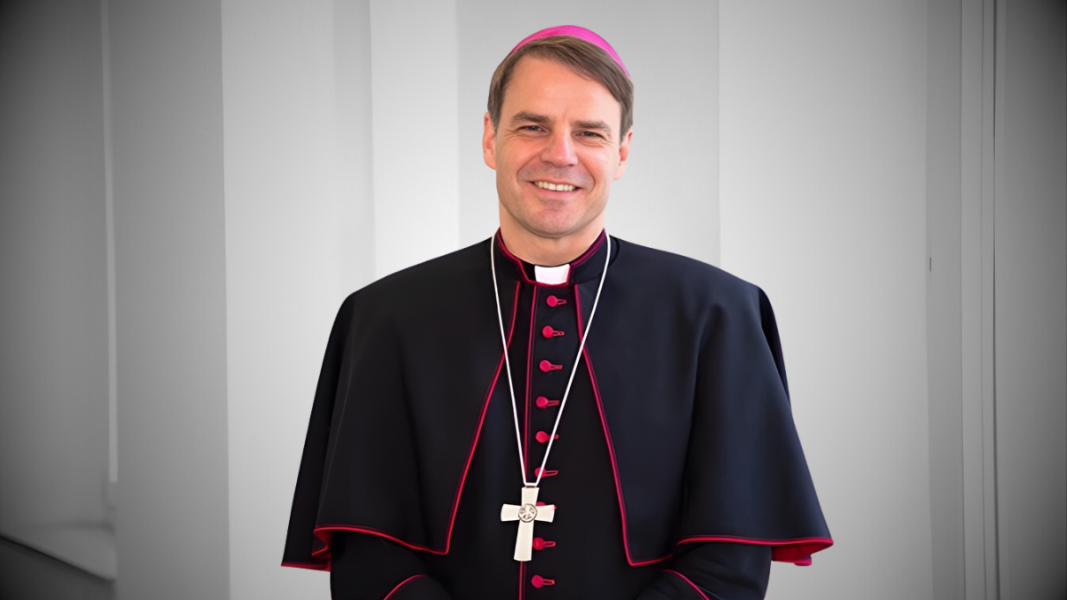
The bishop Stefan Oster, of Passau (Bavaria), has publicly distanced himself from the document issued by the German Bishops’ Conference on “the diversity of sexual identities in Catholic schools”, considering that the text contradicts the foundations of Christian anthropology and lacks any reference to redemption in Christ.
The Salesian prelate published on November 10 an extensive analysis titled “Do We Still Believe What We Believe?”, in which he questions the theological orientation of the episcopal document, titled “Created, Redeemed and Loved – Visibility and Recognition of the Diversity of Sexual Identities in Schools”.
“Although the cover of the brochure says ‘The German bishops’, this text does not speak for me”, affirmed Oster.
The document, of 48 pages, was published on October 31 by the education and schools commission of the German Bishops’ Conference, after intense internal debates. It aims to offer pastoral guidelines on how to address sexual diversity in Catholic schools, and includes terms such as “heteronormativity”, “rainbow families” or “sexual self-determination”.
Read also: The German bishops promote the recognition of “sexual diversity” in Catholic schools
“A Desacralized View of the Human Being”
In his analysis, Oster warns that the text reflects a paradigm shift in anthropology that undermines the sacramental vision of man.
“The document is on its way toward a desacralized understanding of the human being”, he wrote.
The bishop emphasized that the text reduces redemption to a naturalist concept:
“It is taken for granted that all, in their diversity, are already redeemed. There is no mention at any point of the task of human self-realization in Christ and through Christ”.
He also criticized the document for citing studies from the human sciences without any reference to faith, grace, or sin:
“The human sciences observe man in his concrete existence, but by their method they lack access to the Christian vision of the human being: his need for redemption, his vocation to holiness, his relationship with God.”
Concern for Gender Ideology and Childhood
Oster also expressed his concern over the uncritical affirmation of transgender identity in young people.
According to the bishop, the text “presents transsexuality as a natural phenomenon of adolescent development, without warning of the risks of affirming it hastily”.
He recalled that countries such as the United Kingdom, Norway, Finland, Sweden, and Denmark have restricted hormonal and surgical therapies in minors, and warned that “vulnerable young people need protection, not indoctrination”.
The Root of the Conflict: A New Anthropology
For Oster, the underlying problem is not pedagogical but theological.
“We live in a time when the most decisive controversies revolve around the doctrine of man”, he wrote.
“A different anthropology inevitably leads to a different doctrine of revelation, of the sacraments, of salvation and, ultimately, of God Himself.”
The bishop of Passau, who had already openly criticized the German Synodal Way, insisted that the doctrinal limits on women’s priesthood or blessings of irregular unions “are not negotiable or gradually modifiable”.
“Crossing those boundaries would mean building another Church”, he warned.
Other Voices Within the German Episcopate
The auxiliary bishop Thomas Maria Renz (Rottenburg-Stuttgart) also commented on the document, pointing out that its objective should be limited to avoiding discrimination, but without falling into naive acceptance of every form of sexual identity.
“It is essential to distinguish between the Christian welcome of people and the approval of any passing feeling typical of adolescence”, emphasized Renz.
Both prelates represent a minority within the German episcopate that seeks to maintain doctrinal continuity in the face of ideological pressures arising from the Synodal Way, which seeks to revise Catholic sexual morality, priestly celibacy, and the hierarchical structure of the Church.
A Bishop Faithful to the Truth
Stefan Oster’s stance —one of the youngest and most theologically steadfast bishops in Germany— marks a moral and doctrinal boundary within an increasingly divided episcopate.
While some prelates bet on adapting Catholic teaching to the categories of the contemporary world, Oster reminds that the Church’s mission is not to accommodate the Gospel to fashions, but to convert hearts to Christ.
His question, “Do We Still Believe What We Believe?”, summarizes the dilemma of the German Church: either it remains in the revealed truth or it becomes just another sociological institution, without faith or mission.