


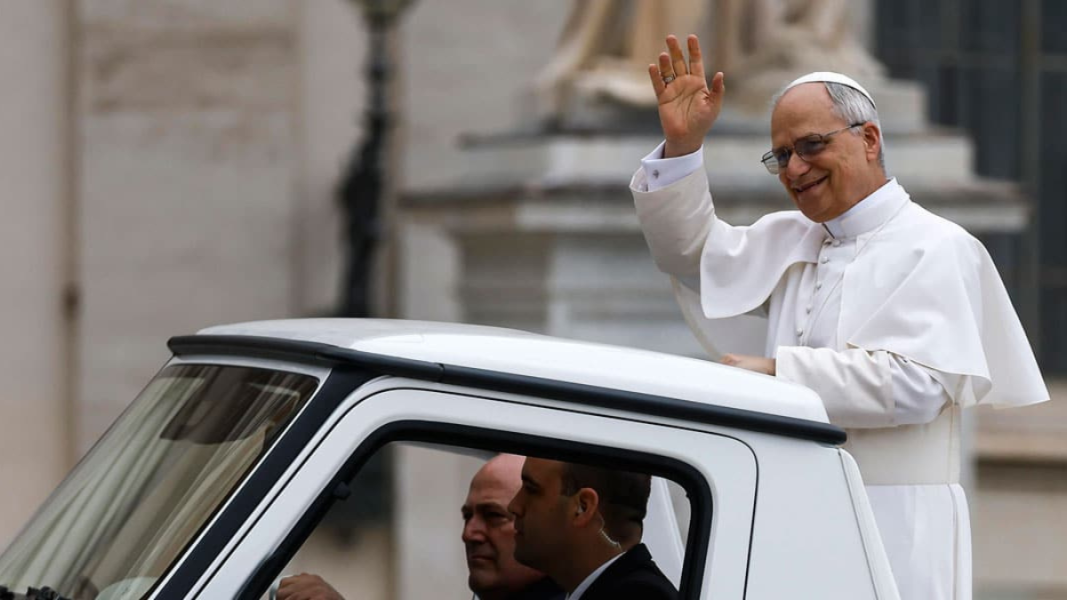
This morning in St. Peter’s Square, Pope Leo XIV continued the cycle of catecheses for the 2025 Jubilee Year, centered on the theme “Jesus Christ, our hope.” On this occasion, he dedicated his meditation to “The Resurrection of Christ and the Challenges of the Present World,” highlighting that Paschal spirituality is a source of hope and authentic fraternity.
Before thousands of faithful and pilgrims from all over the world, the Holy Father recalled that faith in the Risen Christ “frees us from selfishness and returns us to our original vocation to love and give ourselves,” emphasizing that fraternity is not an illusion, but a reality that finds its strength in the Lord’s love.
The audience concluded with the recitation of the Our Father and the Apostolic Blessing.
Below we provide the words of the Holy Father:
Dear brothers and sisters, good morning and welcome!
Believing in the death and resurrection of Christ and living the Paschal spirituality instills hope in life and encourages us to invest in the good. In particular, it helps us to love and nurture fraternity, which is undoubtedly one of the great challenges for contemporary humanity, as Pope Francis clearly saw.
Fraternity arises from a deeply human fact. We are capable of relating and, if we wish, we know how to build authentic bonds among ourselves. Without relationships, which sustain and enrich us from the beginning of our lives, we could not survive, grow, or learn. These are multiple, different in modality and depth. But it is true that our humanity is better realized when we are and live together, when we are capable of experiencing authentic, not formal, bonds with the people we have beside us. If we shut ourselves up in ourselves, we run the risk of falling ill with loneliness and even a narcissism that cares about others only out of self-interest. The other is then reduced to someone from whom to take, without ever being truly willing to give, to surrender ourselves.
We know well that even today fraternity is neither immediate nor something that can be taken for granted. On the contrary, many conflicts, so many wars scattered around the world, social tensions, and feelings of hatred would seem to demonstrate the opposite. However, fraternity is not a beautiful impossible dream, nor is it the desire of a few dreamers. But to overcome the shadows that threaten it, we must go to the sources and, above all, draw light and strength from Him who alone frees us from the poison of enmity.
The word “brother” derives from a very ancient root, which means to care for, to worry about, to support and sustain. Applied to every human person, it becomes a call, an invitation. We often think that the role of brother, of sister, refers to kinship, to the fact of being blood relatives, of belonging to the same family. In reality, we know well that disagreements, fractures, and sometimes hatred can devastate relationships between relatives as well, not only between strangers.
This demonstrates the need, more urgent than ever today, to reconsider the greeting with which St. Francis of Assisi addressed everyone, regardless of their geographical and cultural, religious or doctrinal origin: omnes fratres was the inclusive way in which St. Francis placed all human beings on the same level, precisely because he recognized in them the common destiny of dignity, dialogue, welcome, and salvation. Pope Francis took up this approach of the Poor Man of Assisi, giving value to its relevance after 800 years, in the Encyclical Fratelli tutti.
That “tutti” (all) which for St. Francis meant the welcoming sign of a universal fraternity expresses an essential trait of Christianity, which from the beginning was the proclamation of the Good News destined for the salvation of all, never in an exclusive or private way. This fraternity is based on Jesus’ commandment, which is once again, as fulfilled by Him Himself, an overflowing fulfillment of the Father’s will: thanks to Him, who loved us and gave Himself for us, we can in turn love each other and give our lives for others, as children of the one Father and true brothers in Jesus Christ.
Jesus loved us to the end, says the Gospel of John (cf. 13:1). As the Passion approaches, the Master knows well that His historical time is about to end. He fears what is about to happen, experiences the most terrible torment and abandonment. His Resurrection, on the third day, is the beginning of a new history. And the disciples become fully brothers, after so much time of life in common, not only when they live the pain of Jesus’ death, but above all when they recognize Him as the Risen One, receive the gift of the Spirit, and become witnesses.
Brothers and sisters who support each other in trials do not turn their backs on those in need: they weep and rejoice together in the laborious perspective of unity, trust, mutual giving. The dynamic is the one that Jesus Himself gives us: “Love one another as I have loved you” (cf. Jn 15:12). The fraternity that Christ, dead and risen, offers us frees us from the negative logics of selfishness, divisions, arrogances, and returns us to our original vocation, in the name of a love and a hope that are renewed every day. The Risen One has shown us the path to travel together with Him, to feel and to be “fratelli tutti” (brothers all).