


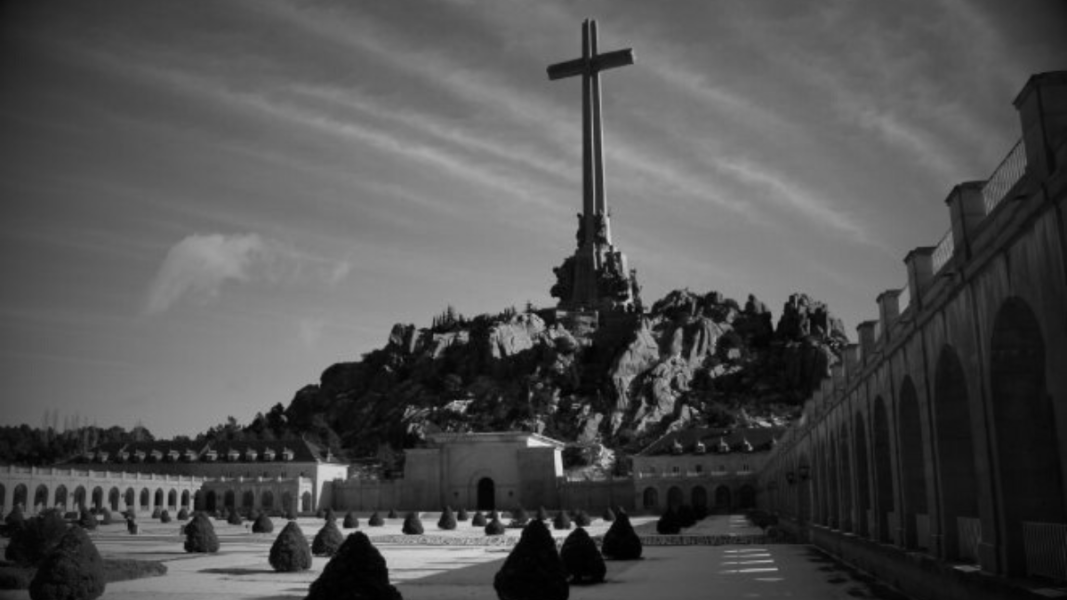
The COPE network, the official media outlet of the Spanish Episcopal Conference, has published a news item about the “resignification” project for the Valley of the Fallen. In its note titled “The project for the resignification of the Valley of the Fallen will respect, in principle, the agreements reached between the Church and the Government”, the media outlet merely celebrates that the chapels and religious symbols “will be maintained,” and that “the interventions inside will be minimal”.
Apparently, it would suffice for the Government to allow the preservation of some external signs of worship for the institutional Church to consider itself satisfied, even though the whole ensemble—in its soul, its symbolism, and its meaning—is emptied and turned into a museum of “democratic memory”.
From formal respect to passive complicity
COPE reports in a reassuring tone that “the basilica will have a direct and independent access for activities related to worship.” But that “independent access” is not a guarantee: it is a confinement.
It means that the temple, formerly the heart of the ensemble, will become an isolated space, tolerated within a political narrative that denies its origin and sacred purpose.
Accepting this as good news is equivalent to celebrating that they leave us a chapel inside a theme park. It is, in essence, confusing aesthetic preservation with spiritual fidelity.
What agreements?
According to various sources, the Government and the Holy See announced an agreement on March 4, 2025 regarding the future of the Valley of the Fallen. However, the full text has never been published.
The Official State Gazette itself mentions its existence in the Resolution of May 5, 2025, where it specifies that the ideas competition for the resignification “will respect the terms established in the agreement signed on March 4, 2025, between representatives of the Catholic Church and the Government of Spain” —Parolin and Bolaños—. But the document is neither attached nor has been disseminated by either party.
Therefore, there is no public version of the agreement to date with the conditions, signatories, or specific clauses.
The media have only reported partial versions—speaking of the permanence of the monks, the continuity of worship, and the replacement of the prior—, but without documentary evidence or official transparency and with variables that seem not to be written on paper.
A question that forces us to ask: what was really agreed, who signed it, and with what moral or canonical authority?
While the Government advances in the resignification of the monument, the Church remains silent about a pact that—if authentic—will mark a historical precedent and will demand names, dates, and responsibilities.
The trap of resignification
The Government has announced that it will invest 30 million euros in this operation, presenting it as a “triple artistic, architectural, and landscape perspective”.
COPE repeats that description without warning that that triple perspective excludes the essential: faith.
What the State calls “transforming” is desacralizing; what it calls “memory” is revisionism; and what it proclaims as “reconciliation” is a narrative without Christ.
That a Catholic media outlet adopts that language without nuances or criticism reveals a worrying assimilation to secular discourse, a comfortable silence that, in practice, becomes complicity and normalizes profanation.