


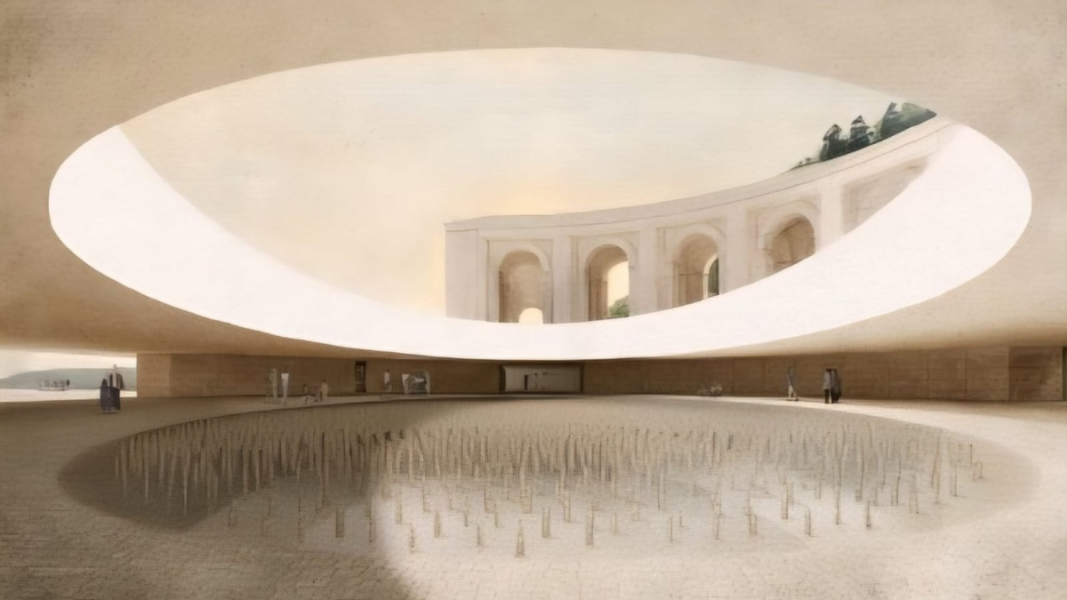
The winning project for the “reinterpretation” of the Valley of the Fallen is already on the Government’s table. The proposal, titled La base y la cruz and signed by Pereda Pérez Arquitectos and Lignum S.L., promises —according to elDiario.es— to transform the monumental access to the basilica into a “welcoming space” with a circular patio open to the sky, a “democratic horizontal shadow in front of the authoritarian vertical axis”.
The language is not casual: it seeks to replace the transcendent verticality of Christianity —man looking toward God— with an ideological horizontality, a symbol of a humanity that suffices unto itself. What for faith was spiritual elevation, for postmodern politics has become a gesture of submission to the narrative of the State.
From temple to “welcoming space”
The project plans to eliminate the grand staircase leading to the basilica, replacing it with a buried structure featuring a circular patio forty meters in diameter. There, an interpretation center and a “museographic” area will be located to explain the monument’s origin, its historical context, and the use of Republican labor in its construction.
The intervention is described as “an act of reconciliation with what was lived,” but in reality it seems to seek something deeper: erasing the sacrality of the ensemble, its vocation as a temple, and its orientation toward the eternal.
The document itself speaks of “deactivating the symbolic centrality of the basilica” and replacing the “authoritarian axis” with a “democratic horizontal shadow.” In other words, replacing the sacred with the symbolic, faith with political ideology, and the cross with state memory.
“The stone, symbol of immutable power”
One of the most revealing passages of the project refers to the treatment of materials:
“The stone, previously a symbol of immutable power, becomes a material of reencounter”,
explain the authors.
thus they propose recycling the granite from the “elements of lesser interest” —such as sculptures or removed fragments— to use it as decoration.
In the name of “unity,” what is projected is physically crushing the Christian signs that gave meaning to the place —such as La Piedad by Juan de Ávalos— and turning their remains into decorative gravel. It is hard to imagine a more eloquent metaphor: from the rock of faith to the ideologically chipped stone of relativism.
The symbolic emptying
The Valley of the Fallen was not conceived as a political mausoleum, but as a monument to reconciliation and an expiatory basilica. Its center was not Franco, but the Cross. And its original meaning, that of praying for all the dead —without distinction of side— in a gesture that the contemporary world, so accustomed to revenge, seems incapable of understanding.
Read also: Hostages of their sins
The so-called “reinterpretation” is not a mere aesthetic reform: it is an attempt to rewrite Spain’s spiritual history, reinterpreting its memory under the logic of “diversity” and “democratic memory.” It is no longer about praying, but about “reflecting.” Not about elevating the soul, but about descending to a circular patio that replaces the Cross with a “welcoming shadow.”
Art profaned
When a State decides to crush sculptures like La Piedad —the work of a Republican artist who found in sacred art a bridge of reconciliation— and turn them into decorative stone, it is not reinterpreting the past: it is profaning it.
Faith is replaced by ideology; liturgy, by “pedagogical tours”; the cross, by an empty circle.
Thus, under the amiable language of “democratic memory,” the moral demolition of a Christian symbol is consummated. The Valley of the Fallen is stripped of its soul to become a space for visits, but not for prayer.