


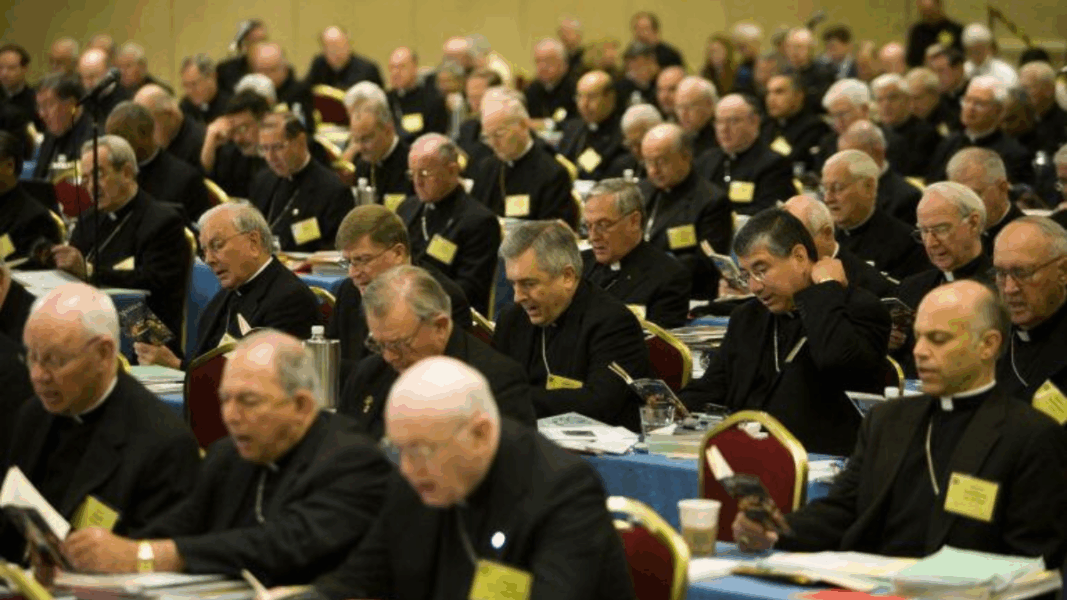
The United States Conference of Catholic Bishops (USCCB) began this Monday, November 10, its Fall Plenary Assembly in Baltimore, where the prelates will elect their new president and vice president for the next three years, replacing Archbishop Timothy P. Broglio—military ordinary and current president—and Archbishop William E. Lori, outgoing vice president and Archbishop of Baltimore.
Ten candidates to lead the episcopal conference
The USCCB has released the list of ten candidates proposed by the bishops themselves, from whom the new president and vice president will be chosen:
-
Bishop Robert E. Barron, Diocese of Winona-Rochester
-
Bishop Paul S. Coakley, Archdiocese of Oklahoma City
-
Bishop Daniel E. Flores, Diocese of Brownsville
-
Bishop Richard G. Henning, Archdiocese of Boston
-
Bishop David J. Malloy, Diocese of Rockford
-
Bishop Nelson J. Pérez, Archdiocese of Philadelphia
-
Bishop Kevin C. Rhoades, Diocese of Fort Wayne-South Bend
-
Bishop Alexander K. Sample, Archdiocese of Portland (Oregon)
-
Bishop Charles C. Thompson, Archdiocese of Indianapolis
-
Bishop Edward J. Weisenburger, Archdiocese of Detroit
The election will be held by absolute majority among voting members. If no candidate obtains more than 50% in the first round, a second vote will be held, and if the tie persists, a third between the two with the highest number of votes. The president will be elected first, and subsequently the vice president from the remaining nine.
Renewal in the episcopal commissions
In addition to the presidency, the bishops must elect new leaders for six commissions of the conference:
-
Canonical Affairs and Church Governance
-
Ecumenism and Interreligious Relations
-
Evangelization and Catechesis
-
International Justice and Peace
-
Protection of Children and Young People
-
Religious Liberty
The elected prelates will serve one year as presidents-elect and assume their three-year term at the end of the 2026 assembly.
The outcome of the elections could mark the pastoral direction of the U.S. Church in the coming years, between those seeking to reaffirm Catholic identity in the face of ideological pressure and those proposing a more dialogical line with the dominant culture.
Estados Unidos: los obispos preparan nueva cúpula eclesial con 10 posibles candidatos