


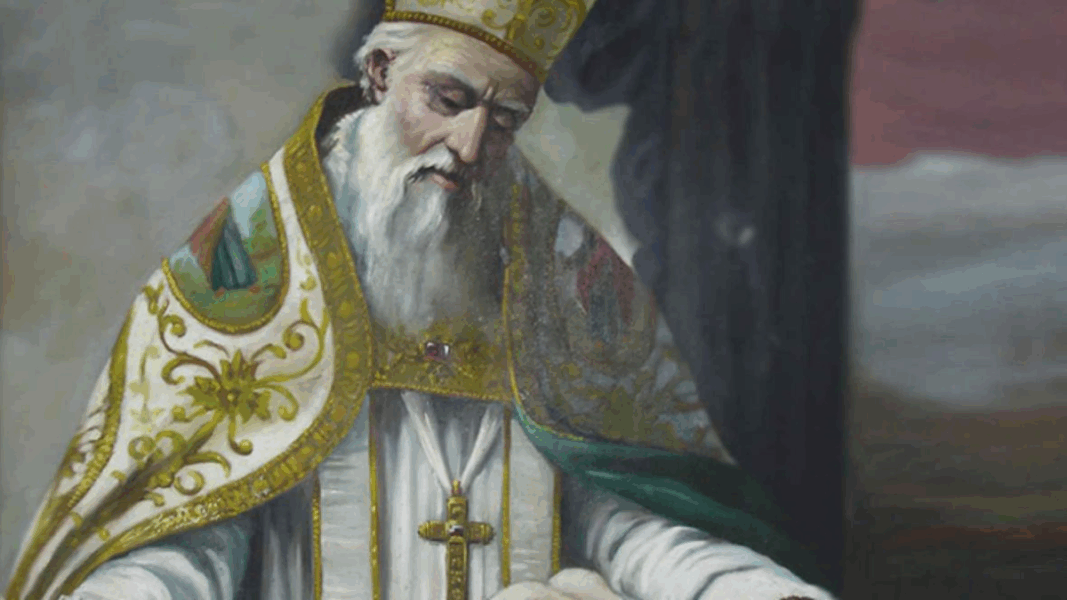
The “Tomus ad Flavianum”: cornerstone of Christological dogma
Leo the Great was a theologian of extraordinary precision and depth. His famous doctrinal letter to Patriarch Flavian of Constantinople—known as the Tomus ad Flavianum—clearly defined the Catholic doctrine on the two natures of Christ: divine and human, united in a single Person. This document was read at the Council of Chalcedon (451) before hundreds of bishops who, upon hearing it, exclaimed: “Peter has spoken through the mouth of Leo.”
With that expression, the universal Church recognized the primacy of the Roman See and the continuity between the Apostle Peter and his successors. In times when imperial power sought to subject doctrine to political control, Leo reclaimed that the authority of the Pope does not depend on Caesar or councils, but on Christ himself, who promised: “You are Peter, and on this rock I will build my Church.”
Thanks to his intervention, the Council of Chalcedon became a milestone of Christological orthodoxy and a testimony to the primacy of the Roman Pontiff. Pope Leo did not impose his authority with force, but with truth; not out of human ambition, but out of fidelity to the deposit received.
The Pope who stopped Attila
In the year 452, the threat of the Huns reached the gates of Italy. Attila, called “the scourge of God,” had devastated central Europe and was advancing toward Rome. Without an army or weapons, Leo decided to meet the invader accompanied only by a few clerics. The encounter on the Mincio River, near Mantua, became one of the most awe-inspiring episodes in history.
Tradition recounts that Attila, upon seeing the Pope, was overwhelmed by a supernatural force and decided to withdraw. Some ancient chroniclers say that the leader saw Saints Peter and Paul behind Leo wielding swords. Whatever the cause, the historical fact is indisputable: the Pope, alone with his moral authority, saved Rome from certain destruction.
Three years later, in 455, Leo intervened again before the Vandal Genseric, who, although he sacked the city, agreed not to burn it or kill its inhabitants. In an era of barbarism and despair, the Pope became a defender of human dignity and the emerging Christian civilization.
A shepherd of souls and doctor of the faith
Beyond historical events, the spiritual legacy of Leo the Great is found in his Sermons and Letters, texts that combine theological rigor, rhetorical beauty, and pastoral depth. His homilies on the Incarnation and Easter are true jewels of Christian thought. In them resonates a theology that does not separate doctrine from life, nor faith from charity.
He was also an ecclesial reformer: he disciplined the clergy, combated abuses, promoted monastic life, and strengthened episcopal authority. He instituted the solemnity of the Nativity of the Lord in Rome and consolidated the Roman liturgy, which later spread throughout Christendom. In a time when chaos threatened to dissolve institutions, Leo showed that the true reform of the Church begins with the holiness of its pastors.
From his spirituality flows a perennial teaching: the Christian cannot allow himself to be swept away by fear or the confusion of the world. As he wrote in one of his most famous homilies:
“Recognize, Christian, your dignity. And, since you have been made a partaker of the divine nature, do not return to your former vileness with unworthy conduct.”
In those words is summarized his entire vision: faith is not an idea, but a transformation of the person; a real participation in the life of Christ.
The Doctor who illuminated centuries
Leo the Great died on November 10, 461. He was buried in the Basilica of Saint Peter and proclaimed Doctor of the Church in the 18th century by Pope Benedict XIV. His doctrinal influence extended for centuries and shaped Christian thought on the priesthood, papal authority, and the theology of the Incarnation.
His magisterium is distinguished by its balance: doctrinal clarity without rigidity, pastoral charity without weakness. He knew that fidelity to the truth does not oppose mercy, but rather grounds it. In the face of errors and deviations, he did not hesitate to correct with energy, but always seeking the conversion of the soul, not the humiliation of the adversary.
Leo the Great and the Church of today
The figure of Leo the Great acquires an unsettling relevance today. In an era of doctrinal confusion, loss of the supernatural sense, and crisis of authority within the Church itself, his example reminds us that true reform does not consist in adapting to the world, but in converting it with the power of truth.
As in the 5th century, the modern world finds itself facing the collapse of its certainties. Post-Christian culture has destroyed the moral foundations on which Europe was built. In this panorama, the Church needs shepherds with the spirit of Leo: men of prayer, doctrine, and courage, who confirm the faithful in the faith and do not fear the judgment of the world.
Leo the Great understood that papal authority does not consist in pleasing, but in teaching; not in compromising with error, but in safeguarding the truth. In his sermons and letters resonates the conviction that the Church is the pillar of truth, not one current among others in the river of history.
His pontificate teaches us that when everything seems to be collapsing, the remedy is not in compromises or concessions, but in radical fidelity to Christ. Holiness, doctrine, and pastoral charity are the only weapons with which the Pope stopped Attila and the same ones with which today he can stop the spiritual barbarism of the modern world.