


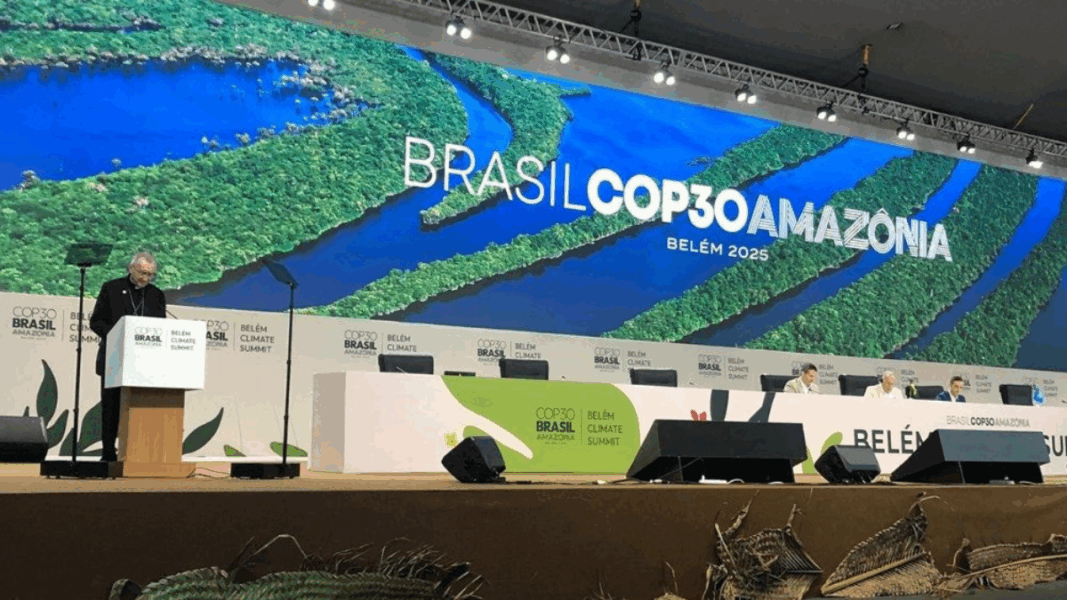
Today, the COP30 climate summit begins in Brazil and, just a few days earlier, the Vatican Secretary of State, Cardinal Pietro Parolin, granted an interview in which he emphasized the need to “give concreteness to the commitments assumed” on environmental matters, warning that “time has become short.” His statements, disseminated by Vatican News, anticipate the Vatican’s stance at the summit and confirm its alignment with the global ecological agenda promoted by the United Nations.
The Church and the Climate: A Discourse That Becomes Politicized
Parolin acknowledged that the phenomenon of climate change “involves a growing number of people, especially the most vulnerable,” and recalled recent meetings with authorities from Pacific islands, threatened—as he said—by “disappearance” due to rising sea levels.
The cardinal highlighted that the Church “has committed” from the Holy See to this cause, citing Pope Francis’s encyclicals Laudato si’ and Laudate Deum, and stated that local Churches “have also aligned” with this line. In his view, the Church’s role is not to offer technical solutions, but to “raise the level of awareness” and provide an “ethical response” to the climate problem.
“I believe that the fundamental contribution of the Holy See and the local Churches must be to raise the level of awareness and offer an ethical response to the problem of climate change,” said Parolin.
Nothing new under the sun. The insistence on ecological discourse and “multilateralism” has become habitual in Vatican circles—but no less concerning for that. Is this still an evangelizing action or rather a complacent dialogue with global structures that promote an anthropocentric and secularized vision of creation?
The cardinal even quoted St. Paul: “Time has become short.” An expression that, in the apostle’s mouth, alluded to the urgency of conversion and not to the implementation of the Paris Agreement. But this confusion of planes—between the spiritual and the climatic—has become almost the norm: today faith seems to be measured by the carbon level.
Between Environmental Ethics and Globalist Rhetoric
Parolin argued that COP30 should focus less on new speeches and more on fulfilling already signed commitments: reducing carbon emissions, helping the most vulnerable countries, and creating resilience to natural disasters. “Grand proclamations are not needed, but determination and execution,” he affirmed.
The cardinal added that the conference represents “an opportunity to relaunch multilateralism,” a system that—he said—“has suffered an enormous crisis in recent years.” His vision coincides with that of the late Pope Francis, who insisted on the role of international cooperation in the face of the so-called “climate crisis.”
However, that constant appeal to multilateralism and “ecological urgency” displaces the center of the Church’s mission. There is no longer as much talk of the salvation of souls as of the political administration of planetary problems. And when the Gospel is diluted in the rhetoric of summits, there is a risk of substituting Christian hope with trust in international forums.
Ecological Education: When Faith Becomes Activism
In the days prior to COP30, Parolin visited the Marituba hospital in Brazil, founded by Bishop Aristide Pirovano, and the Fasentina da Esperanza project, where children from vulnerable areas learn ecological practices such as growing vegetable gardens or producing biogas. The cardinal highlighted these initiatives as examples of a “more just and supportive world,” stating that “we can start with the children.”
The gesture is praiseworthy, without a doubt. But the insistence on “ecological education” as a path to human redemption poses an evident theological risk: that of reducing Christian faith to an environmentalist ethic, centered on sustainability and the common good, but without reference to Christ, the true Redeemer of man and creation.
Because, in the end, the world will not be saved by multilateral agreements or solar panels, but by the conversion of hearts. And that—though it seems to be forgotten in these forums—remains the Church’s task.