


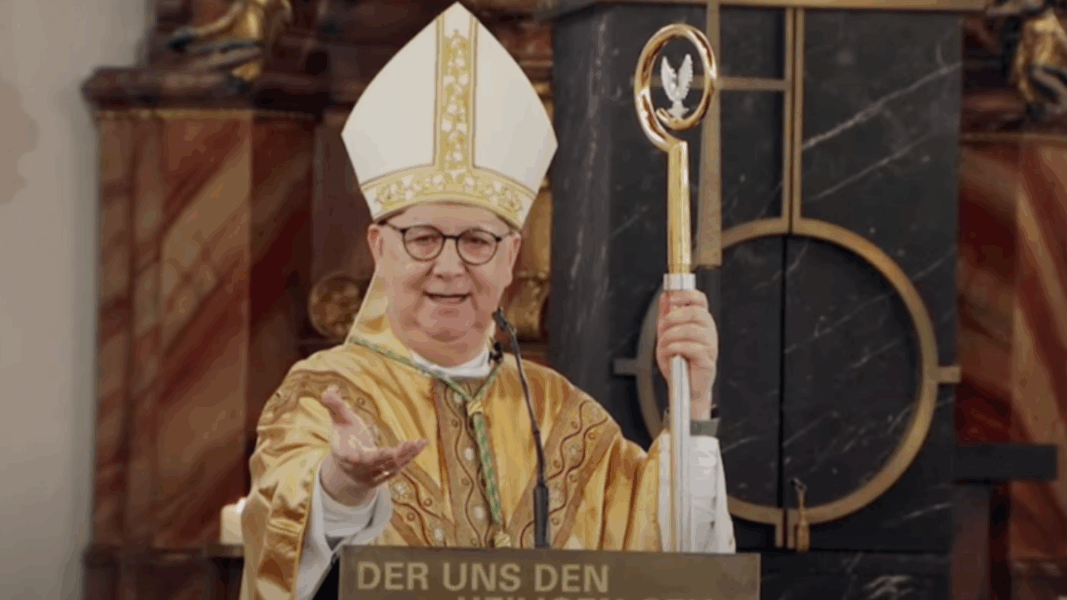
In a homily delivered during the solemn Requiem for the Day of the Faithful Departed, the Swiss emeritus bishop Marian Eleganti offered a profound reflection on death, eternity, and Christian holiness. With the clarity and firmness that characterize him, he denounced the loss of the transcendent sense of life and the denial of divine judgment in contemporary culture. He invited the faithful to live with the awareness of the end, “as those who die every day,” exhorting them to conversion, to ardent love for God, and to preparation for the definitive encounter with Him. A meditation that returns to Catholics the supernatural realism of the faith and the universal call to holiness.
We provide below the full and translated text of the homily:
Before his death, St. Louis Gonzaga wrote in his farewell letter (1591) to his mother: “Illustrious lady, always be vigilant and take care not to offend this infinite love of God. You would do so if you mourned me as dead, when I live before the face of God and can help you even more than in this life with my intercession for your concerns.”
While in the past people expressed their confident faith in the return to the “eternal home” with God, today many speak of their “dissolution into the universe”: “I said goodbye today; the solution is in space” (reads an obituary). Apparently, the definitive end is not accepted: “I have moved. My new address is: Cimitero Acattolico, Via Gaia Cestio 6, Rome. I look forward to your visits” (inscription on a tomb in the so-called atheist cemetery of Rome).
When we attend funerals today, almost all assume that the deceased is already at peace. The texts and prayers are positive. Rarely is prayer offered for the forgiveness of the deceased’s sins. In times past, death was brief and usually quick. What was important was a good death, pleasing to God. Sudden and unexpected death was feared. Today, people live longer and die slowly and painfully. For that reason, many desire a sudden, unexpected, quick, and painless death. But all forget to prepare for it.
“Live as those who die every day,” says the desert father St. Anthony to his brothers before dying. Faith in Jesus Christ and his confident surrender into the hands of the Father allow us to overcome the fear of death. “Why fear death?” says the blind monk of the Grande Chartreuse in the movie The Great Silence. “The closer you get to God, the happier you are. That is the fullness of our life.”
In general, each one dies as he has lived. It is said of St. Martin that his face, at death, seemed that of an angel. Francis dies naked on the floor of the Porziuncola. Benedict dies praying, standing, supported by two brothers.
Many die without preparation, without repentance, and without faith. This reveals a serious deficiency in the proclamation of the Gospel since the Second Vatican Council. “People want to hear good news, not threatening messages,” say the pastors. For that reason, priests no longer warn against sin. There is no talk of purgatory or hell. People are not concerned about being lost eternally. They think that after death, everything will be fine or that there will be nothing afterward. They do not reckon with the fact that every life will have to give an account before the eternal Judge. The Last Judgment of the Sistine Chapel seems like something from the past, not the future, and has nothing to do with me. What a deception!
All pastors proclaim God’s mercy, but omit the Gospel passages where Jesus speaks clearly of judgment and the consequences of a life without repentance. People lull themselves into a false security, even when they take their own life through assisted suicide. Do they really believe that God approves everything they think and do? The parable of the guest who arrives at the banquet without a wedding garment teaches that whoever presents himself with stained garments will be excluded from eternal life, and that this will be painful, in contrast to those who have washed their robes in the blood of the Lamb and, following the parable of the rich man and the poor Lazarus, rest in the bosom of Abraham.
St. John of the Cross uses the image of the log of wood. When it is damp and thrown into the fire, it suffers, sighs, and smokes noisily. It must sweat out all its moisture before igniting and then burning quietly and happily in the fire, having become fire itself. It is a very eloquent image for understanding the transformation that must take place in purgatory before we unite with the fire that is God Himself and are eternally blessed in Him. We are called to become fire ourselves. But first, all moisture—all sin—must be eliminated. Fire harms no one: it only consumes those who do not share its nature.
Let us therefore give thanks that already in this life we are purified and that we are “sweating” our moisture, so that when we encounter the divine fire, we do not smoke or lament, but burn and shine happily. Let us pray for the dead, that they may receive consolation, and let us not categorically reject the idea of judgment. “Only there will I be truly human!” wrote St. Ignatius of Antioch to the Romans before his martyrdom. Within himself he heard the murmur of the living waters calling him: “Come to the FATHER!”. Not all men are “God-bearers” like him, who gave himself that name: Theophoros. How many die accompanied by demons or bound to evil. We must pray for them. “This is the will of God: your sanctification” (1 Thess 4:3). “Be holy, for I, the Lord your God, am holy” (Lev 19:2). Paul says that we were chosen “before the creation of the world” to be “holy and blameless before God… for the praise of his glorious grace” (Eph 1:4-6). Each person must strive not to lose this end, accepting with patience the trials of life to purify their nature, so that it shines in all its purity and, at the hour of death, unites with God: for the praise of his glorious grace. Amen.
According to the teaching of the Council (LG 39), all the baptized are called to holiness, as St. Paul writes: “This is the will of God: your sanctification” (1 Thess 4:3; cf. Eph 1:4). “For in him he chose us before the creation of the world, that we should be holy and blameless before him.”
Romano Guardini describes where the difficulty lies: “Let us be more precise: within us live a false self and a true self. The false self is the constant ‘I, me, mine,’ which refers everything to its own importance and well-being, which wants to enjoy, impose itself, and dominate. This self obscures the real self, the truth of the person. When the first disappears, the second is freed. The more one moves away from oneself in surrender, the more one grows in one’s essential (true) self. The saint is the one in whom the first self has been completely overcome and the second has been set free. Then the person simply is, without emphasizing itself. It is strong without effort. It no longer has desires or fears. It radiates. Around it, things attain their truth and order. In summary: the person has opened up to God.”
This process lasts a lifetime, because love never stops. And each one is guided by God in a personal way. Comparisons with others must be avoided. But there is one rule for all: RB Prol. 13: “Run while you have the light of life, lest the shadows of death surprise you.” In this sense, time—each day—is a blessing. God has placed eternity in the fleeting moment. Much is at stake!
St. Teresa of Ávila says that one must seek to grow in virtue every day, “otherwise, one will always remain a dwarf… Whoever does not grow, decreases. I consider it impossible for love to be content with remaining always in the same place.”
In love there is never “enough”: unlike the economy, there are no “limits to growth.”
St. Benedict speaks frequently of the “zeal” that must be shown. We must let ourselves be guided by pure intention and zeal for God. St. Benedict calls this “the zeal of love” (RB 66:4), the so-called “good zeal,” to which he dedicates an entire chapter of his Rule (RB 72).
“Just as there is a bitter and bad zeal that separates from God and leads to hell, so also there is a good zeal that removes from sin and leads to God and to eternal life. Monks must practice this zeal with fervent love.” (RB 72:1-3).
Let us remember: Jesus came to bring fire to the earth. He abhors lukewarmness. Lk 12:49: “I have come to bring fire to the earth, and how I wish it were already burning!” Lk 3:16: “He will baptize you with the Holy Spirit and fire.”
Rev 3:14-22: To the Church in Laodicea, the risen Lord says: “I know your works: you are neither cold nor hot. Would that you were cold or hot! But because you are lukewarm, neither cold nor hot, I will spit you out of my mouth. For you say, ‘I am rich, I have prospered, and I need nothing,’ not realizing that you are wretched, pitiable, poor, blind, and naked. I counsel you to buy from me gold refined by fire, so that you may be rich, and white garments so that you may clothe yourself and the shame of your nakedness may not be seen, and salve to anoint your eyes, so that you may see. Those whom I love, I reprove and discipline, so be zealous and repent. Behold, I stand at the door and knock. If anyone hears my voice and opens the door, I will come in to him and eat with him, and he with me. The one who conquers, I will grant him to sit with me on my throne, as I also conquered and sat down with my Father on his throne. He who has an ear, let him hear what the Spirit says to the churches.”
So, please: no lukewarmness! The love of Christ urges us on (2 Cor 5:14).
RB 4:1: “Above all: love the Lord your God with all your heart, with all your soul, and with all your strength” (Dt 6:5).
Do not live in a dying fire. St. John of the Cross advises a sister:
“He told me to see if anything separates me from God, if anything distracts me from his presence and from the relationship that one should have with His Majesty.
And he told me to pay attention to that toward which I feel most inclined.”
This is very useful advice. Let us live in such a way that we have nothing to regret, as St. Augustine lamented:
“Late have I loved you, O beauty ever ancient, ever new, late have I loved you. You were within me, but I was outside… You were with me, but I was not with you” (Confessions X,27,38).
Living interiorly means praying. In this way we are inspired in our daily life. Without prayer we cannot recognize what helps us advance. Tauler says that in every sincere prayer there is a new inspiration of the Holy Spirit, whenever it may be:
“Man receives new gifts and graces every time he turns to Him and examines his actions and ways to see if there is anything in them that does not belong to God… The only thing he must do is let the Holy Spirit work in him and not hinder his action: then He will fill him completely.”
In this way, all become saints. But holiness has a different face in each person.