


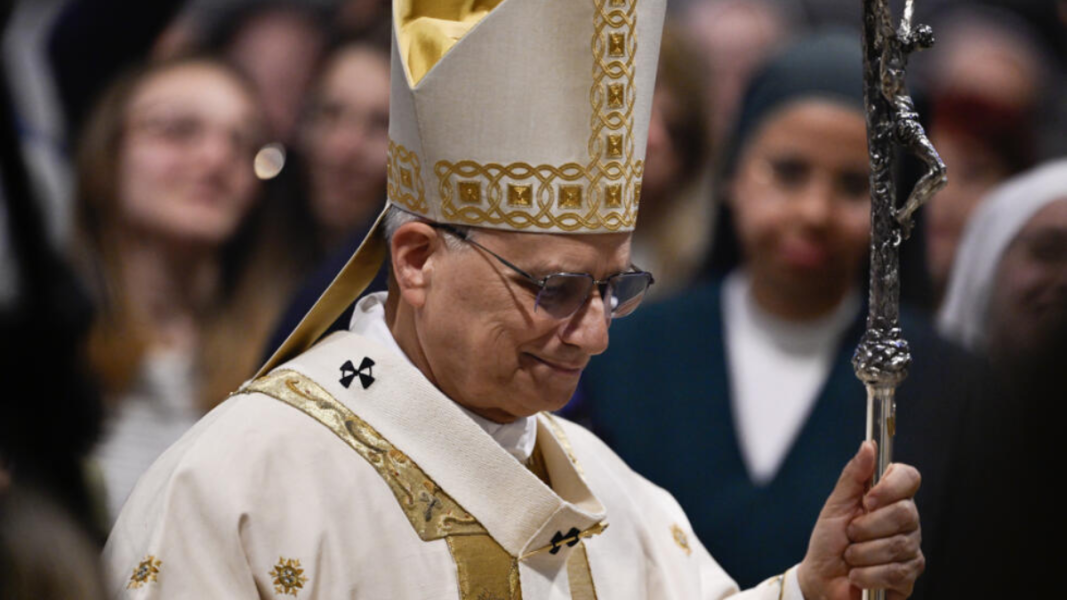
On the morning of November 9, 2025, Pope Leo XIV presided over Holy Mass in the Basilica of Saint John Lateran on the occasion of the Solemnity of the Dedication of the Lateran Basilica, the cathedral of Rome and mother of all the churches of the world. In this celebration, the Holy Father recalled the spiritual meaning of this temple, erected in the 4th century at the desire of Emperor Constantine and consecrated by Pope Saint Sylvester I, emphasizing that beyond its historical value, the basilica is a living symbol of the Church built with “living stones” in Christ.
The homily, centered on the need to foundation Christian life on the firm rock of Christ and on the call to build solid, humble, and faithful communities, combines a profound theological reflection with a pastoral exhortation to the people of God.
Below we provide the complete homily of Leo XIV:
Dear brothers and sisters:
Today we celebrate the Solemnity of the Dedication of the Lateran Basilica ―of this Basilica, cathedral of Rome―, which took place in the 4th century, the work of Pope Sylvester I. The construction was carried out by the will of Emperor Constantine, after, in the year 313, he granted Christians the freedom to profess their faith and practice worship.
We remember this event to this day: why? Certainly, to recall with joy and gratitude a very important historical fact for the life of the Church, but not only that. In fact, this Basilica ―Mother of all the Churches―, is much more than a monument and a historical memory, it is “a sign of the living Church, built with chosen and precious stones in Christ Jesus, the cornerstone (cf.1 P 2,4-5)” (Conf. Ep. Italiana, Premises to the Rite for the Blessing of the Oils and Dedication of Churches and Altars) and as such it reminds us that we too “in this world serve, as living stones, to build it (cf. 1 P 2,5)” (Dogmatic Const. Lumen gentium, 6). For this reason, as Saint Paul VI noted, in the Christian community the custom arose very early of applying “the name of Church, which means the assembly of the faithful, to the temple that welcomes them” (Angelus, November 9, 1969). It is the ecclesial community, “the Church, society of believers, [that] testifies in Lateran its most solid and evident external structure” (ibid.). Therefore, with the help of the Word of God, let us reflect, looking at this building, on our being Church.
First of all, we might think about its foundations. Their importance is evident, to such an extent that, in a certain way, it is unsettling. If those who built it had not dug deeply to find a sufficiently solid base on which to erect everything else, the entire construction would have collapsed long ago or would run the risk of collapsing at any moment, so that we, being here, would also be in grave danger. Fortunately, those who preceded us provided our cathedral with solid foundations, digging deeply, with effort, before beginning to raise the walls that welcome us, and this makes us feel much more at ease today.
But it also helps us to reflect. In fact, we too, workers of the living Church, before we can erect imposing structures, must dig within ourselves and around us to remove all unstable material that may prevent us from reaching the bare rock of Christ (cf. Mt 7,24-27). Saint Paul tells us this explicitly in the second reading, when he states that “the only valid foundation is Jesus Christ and no one can lay another one different” (3,11). And this means constantly returning to Him and to his Gospel, docile to the action of the Holy Spirit. Otherwise, we would run the risk of overburdening with heavy structures a building with weak foundations.
Therefore, dear brothers and sisters, in working with all our effort in the service of the Kingdom of God, let us not hurry or be superficial: let us dig deeply, free from the criteria of the world, which all too often demands immediate results because it does not know the wisdom of waiting. The millennial history of the Church teaches us that only with humility and patience can one build, with God’s help, a true community of faith, capable of spreading charity, of fostering the mission, of proclaiming, celebrating, and serving that apostolic Magisterium of which this temple is the first seat (cf. S. Paul VI, Angelus, November 9, 1969).
In this regard, the scene presented to us by the proclaimed Gospel (Lk 19,1-10) is enlightening: Zacchaeus, a rich and powerful man, feels the need to meet Jesus. However, he realizes that he is too short to see him, so he climbs a tree, with an unusual and inappropriate gesture for a person of his rank, accustomed to receiving what he wants served on a platter, in the tax office, as a tribute due to him. Here, on the other hand, the path is longer and, for Zacchaeus, climbing the branches means recognizing his own limits and overcoming the inhibitory brakes of pride. In this way, he can meet Jesus, who tells him: “Today I must stay at your house” (v. 5). From then on, starting from this encounter, a new life begins for him (cf. v. 8).
Jesus transforms us, and calls us to work on God’s great construction work, wisely modeling us according to his designs of salvation. In recent years, the image of the “work in progress” has frequently been used to describe our ecclesial journey. It is a beautiful image that speaks of activity, creativity, commitment, but also of effort, problems to solve, sometimes complex ones. It expresses the real and tangible effort with which our communities grow every day, sharing charisms and under the guidance of pastors. The Church of Rome, in particular, bears witness to this in this phase of the implementation of the Synod, in which what has matured in years of work demands to be submitted to confrontation and verification “on the ground.” This implies an arduous path, but we must not be discouraged. Instead, it is good to continue working with confidence, to grow together.
In the history of this majestic building in which we find ourselves, there have not been lacking critical moments, pauses, corrections of projects in the development phase. However, thanks to the tenacity of those who preceded us, we can gather in this wonderful place. In Rome, even with so much effort, there is a great good that grows. Let us not allow fatigue to prevent us from recognizing and celebrating it, to nourish and renew our momentum. Moreover, lived charity also shapes our face as Church, so that it becomes increasingly evident to all that she is “mother,” “mother of all the Churches,” or even “mom,” as Saint John Paul II said when speaking with children on this same day (cf. Discourse on the occasion of the feast of the Dedication of the Basilica of Saint John Lateran, November 9, 1986).
Finally, I would like to mention an essential aspect of the mission of a cathedral: the liturgy. It is the “summit toward which the activity of the Church tends and […] the source from which all her power flows” (Dogmatic Const. Sacrosanctum concilium, 10). In it we find all the themes we have mentioned: we are built as a temple of God, as his dwelling in the Spirit, and we receive strength to preach Christ in the world (cf. ibid., 2). The care of the liturgy, in the place of the See of Peter, must therefore be such that it can be proposed as an example for the entire people of God, respecting the norms, paying attention to the different sensitivities of those who participate, according to the principle of wise inculturation (cf. ibid., 37-38) and at the same time in fidelity to that style of solemn sobriety typical of the Roman tradition, which can do so much good to the souls of those who participate actively (cf. ibid., 14). The utmost attention must be paid so that here the simple beauty of the rites can express the value of worship for the harmonious growth of the entire Body of the Lord. Saint Augustine said that “beauty is nothing other than love, and love is life” (cf. Sermon 365, 1). The liturgy is a sphere in which this truth is realized in an eminent way; and I desire that whoever approaches the altar of the cathedral of Rome may leave filled with that grace with which the Lord desires to flood the world (cf. Ez 47,1-2.8-9.12).