


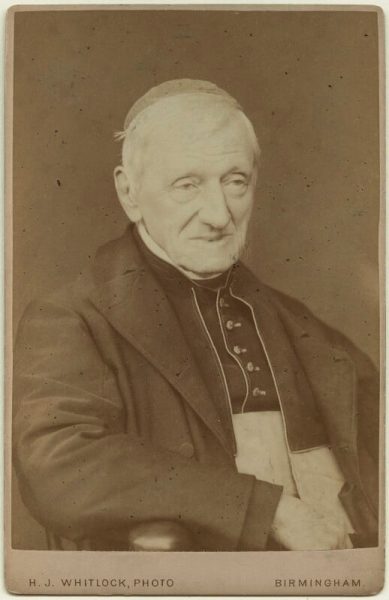
By Fr. Peter M. J. Stravinskas
At fifteen years old, Saint John Henry Newman embarked on a spiritual journey that would last decades: according to his motto, ex imaginibus et umbris in veritatem (“From images and shadows to the truth”). For many years of his theological pilgrimage, Newman remained faithful to the 39 Articles of Religion of the Anglican Communion, including the one that described Purgatory as a “pernicious” doctrine. However, with much prayer, a deep study of Sacred Scripture, and the convincing teaching of the Church Fathers, he ended up writing one of the most beautiful and profound works on Purgatory, The Dream of Gerontius (The Dream of Gerontius), which rivals in spiritual depth with Dante’s vision in the Divine Comedy. Perhaps this work is best known for the beautiful hymn “Praise to the Holiest”, quoted by Benedict XVI in his homily during Newman’s beatification.
In the poem, a dying soul tries to understand its final moments, assisted by its Guardian Angel. The dying man does not understand why he has found such calm before death, previously feared. The angel explains that the prayers of the priest and his friends have given him confidence and that “the calm and joy that well up in your soul are the first fruit of your reward, the Heaven that begins.”
The man feels his senses fading little by little and fears losing consciousness; the angel consoles him: “Until the Beatific Vision, you will be blind; for even your Purgatory, which comes as fire, is fire without light.”
Comforted by this truth, the soul surrenders to God’s will, asking only to see the divine Face for an instant before beginning its purification. The angel promises that he will see God “in the twinkling of an eye,” but warns him: “That vision of the Most Beautiful will gladden you, but it will also pierce you.”
The soul learns that “the flame of Eternal Love burns before transforming”. It thus prepares for God’s judgment, whose vision “will kindle in your heart tender, reverent, and grateful thoughts.”
And what are those thoughts? Let us let Newman’s own poetry speak, who knew well that cor ad cor loquitur (“the heart speaks to the heart”):
You will sicken with love, and yearn for Him,
and feel compassion for that so sweet One,
who wished to place Himself at such a disadvantage,
to be used by a creature so vile.
There is a plea in His thoughtful eyes
that will wound you to the soul and trouble you.
And you will hate yourself, and loathe yourself, for,
though already sinless, you will feel that you have sinned
as never before; and you will want to flee,
hide from His gaze;
and yet, you will desire to remain
in the beauty of His countenance.
And these two pains, so opposite and sharp—
the longing for Him when you do not see Him,
the shame of yourself when you think of seeing Him—
will be your truest, most burning Purgatory.
When the soul approaches the divine tribunal, it is astonished to hear earthly voices: they are those of the priest and friends praying the Subvenite (“Come to his aid, saints of God”). These supplications bring the Angel of the Agony, the one who strengthened Christ in Gethsemane, to accompany this soul toward eternity as well.
Once there, the soul—already in love with God— “flies to the dear feet of Emmanuel”, but does not fully arrive, for the holiness of the Most High burns and leaves it passive before “the terrible Throne.” And yet, the angel exclaims: “Oh happy soul in suffering! For you are safe, consumed and vivified by the gaze of God.”
The soul agrees: it is “happy in my pain” and desires to depart immediately, not out of fear, but to hasten the day when it can return and fully enjoy God. It runs, then, toward what the angel calls “the golden prison” of Purgatory. The soul exclaims with hope:
“There I will sing to my absent Lord and Love:
take me, that I may rise sooner
and see Him in the truth of the eternal day.”
The angel fulfills its holy desires. Thus Newman concludes his magnificent work, at once theological and imaginative, realistic and poetic, giving the last word to the messenger of God:
Gently and tenderly, soul redeemed with love,
in my arms I clasp you lovingly;
and, over the penal waters that roll,
I support you, lower you, and guard you.And carefully I immerse you in the lake,
and you, without a sob or resistance,
cross the swift torrent,
sinking deeper and deeper into the gloom.The angels, to whom this holy task belongs,
will care for you and lull you as you lie;
and the Masses on earth and the prayers of Heaven
will assist you before the Throne of the Most High.Farewell, but not forever, dear brother,
be brave and patient in your bed of pain;
soon your night of trial will pass,
and I will return to awaken you at dawn.
The Day of the Faithful Departed gathers in itself the great themes of Christian theology: divine justice and mercy, human responsibility and dignity, solidarity in prayer and suffering, and present life seen from eternity. In the Church and the Lord, who incorporate us into His Mystical Body, the bonds are not broken by death, but are strengthened in the Communion of Saints.
Who, then, could not feel hopeful and joyful before such consoling truths? The liturgical sobriety of the day reflects that moment of Purgatory, a perfect prelude to the eternal glory of the Love that possesses us and to which we belong forever.
Yes, Lord: we pray today for all who love and yearn for your purifying love; make them—and us— be cum sanctis tuis in aeternum, quia pius es (“with your saints forever, because you are merciful”).
Let us let Cardinal Newman have the last word with two of his most beautiful prayers:
May He support us all the day long,
until the shadows lengthen and the evening comes,
and the busy world is hushed,
and the fever of life is over, and our work is done.
Then in His mercy,
may He give us a safe lodging, a holy rest, and peace at the last.
And this other one:
Oh, my Lord and Savior,
support me in that hour in the strong arms of Your Sacraments
and with the fresh perfume of Your consolations.
May the words of absolution be spoken over me,
may the holy oil anoint me,
may Your Body be my food and Your Blood my sprinkling.
May my sweet Mother, Mary, breathe upon me,
and my Angel whisper peace to me,
and my glorious Saints smile upon me;
that in them and through them I may receive the gift of perseverance
and die as I desire to live: in Your faith, in Your Church, in Your service, and in Your love. Amen.
About the author
Fr. Peter M. J. Stravinskas holds doctorates in school administration and theology. He is the founder and editor of The Catholic Response and editor of Newman House Press. He recently launched a graduate program in Catholic school administration through Pontifex University.