


By Daniel B. Gallagher
When I retired after a decade of service in the Holy See, things were not going well. That was in 2016. To tell the truth, they were already going badly even under Benedict XVI. The Roman Curia is a bureaucratic disaster.
But magisterial disasters are even worse, and one enormous one occurred four years after my departure.
It was not a spontaneous comment during an impromptu press conference. It was not an ambiguous statement on topics like marriage, LGBTQ rights, or the death penalty. It was an entire theological vision. Or, rather, the absence of one.
This October marks five years since the greatest stumble of Francis’s pontificate. Unfortunately, it is closely related to the very name that Jorge Bergoglio chose upon being elected to the See of Peter. Interpreting Saint Francis of Assisi, his legacy, and the charism he bequeathed to the Church has always been difficult. Fratelli Tutti greatly increased that difficulty.
Most criticisms of the 2020 encyclical focus on one or another topic from the long list that Francis presents as crucial for our time: racism, immigration, interreligious dialogue, the dignity of women, the death penalty, and others. But I have seen very few criticisms of the document’s foundational principle.
Although Francis himself described the encyclical as a mixture of previous homilies, speeches, and catecheses, at its core lies a highly dubious and risky undertaking: separating Christ from Christianity in an attempt to dialogue with the world about the meaning of “fraternity and social friendship.”
“I elaborated this encyclical letter from my Christian convictions, which inspire and sustain me, but I have sought for this reflection to be an invitation to dialogue among all people of good will” (n. 6).
The “but” is crucial here. Francis implies that convictions about fraternity and social friendship derived from his Christian faith can be transmitted independently of that faith, as if they could equally arise from other religions or simply from the unevangelized human condition.
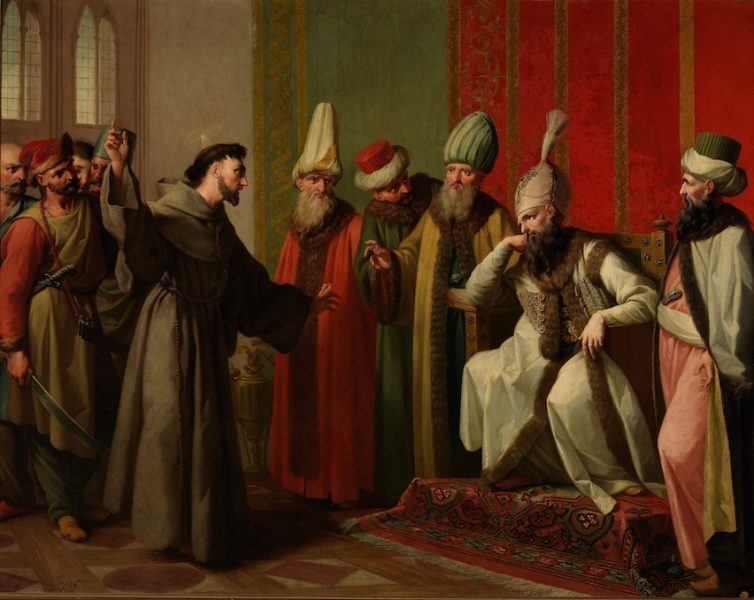
Francis justified his approach by appealing to Saint Francis’s encounter with the Sultan of Egypt, Al-Malik al-Kamil, in 1219:
“Without worrying about the difficulties and dangers involved, [Saint] Francis went to meet the Sultan with the same attitude that he inculcated in his disciples: if they found themselves ‘among Saracens and other non-believers,’ without renouncing their identity, they should not ‘engage in disputes or controversies, but be subject to every human creature out of love for God.’”
But Saint Francis forbade disputes and controversies not to omit Christ’s mandate to proclaim the Gospel, but as a means of fulfilling it. His intention was to convert the Sultan, not simply to share with him a Christian vision of fraternity without Christ.
Without a Christocentric principle at its base, Fratelli Tutti quickly falls into almost laughable commonplaces:
“Let us dream, then, as a single human family, as fellow travelers sharing the same flesh, as children of the same earth which is our common home, each with the richness of his or her beliefs and convictions, each with his or her own voice, all brothers and sisters.” (n. 8)
The idea is that Christianity models the kind of community that human beings would be capable of building on their own. But the early Christians knew well that the koinonía they enjoyed was a gift, not a human achievement. It was the fruit of divine action, not of a political paradigm. It was realized in the Mystical Body of Christ, not in a social ideal. The baptized were moved not only to preach what Christ preached, but to preach Christ himself.
That was the foundational principle of Saint John Paul II‘s first encyclical, Redemptor Hominis (1979). The main focus of Christian discipleship must be on the community of grace into which we have been incorporated, not on the worldly community to which we try to contribute something.
John Paul II wrote that there is a “profound ‘personal’ aspect and dimension” in the community of disciples, “which, despite all the deficiencies of their communal life—in the human sense of the word—is a community precisely because all its members form it together with Christ himself, at least because they bear in their souls the indelible mark of being Christians.” (n. 21)
The Church—and its Magisterium—longs to return to this Christocentric approach. John Paul II reminded us again and again that the only truly distinctive thing that Christians can offer the world is not a humanitarian program, nor a recipe for moral perfection, nor a political model of coexistence, but Christ himself.
In a Christ-centered approach, there is no “but”: there is no reason to remove him from the equation. If Saint Francis avoided arguing with the Saracens, it was not because he feared they would not understand Christ, but because he considered it the best way to communicate him. His encounter with the Sultan fostered mutual understanding and promoted peaceful relations between Christians and Muslims, but his ultimate purpose was to preach Christ.
The first of the Admonitions of Saint Francis, from which the Pope took the encyclical’s title, is not dedicated to “social friendship”, but to the Most Holy Eucharist:
“All those who see the Sacrament of the Body of Christ, which is consecrated by the words of the Lord on the altar by the hands of the priest in the form of bread and wine, and do not see and believe according to the Spirit and Divinity that it is truly the Most Holy Body and Blood of our Lord Jesus Christ, are condemned.”
The absence of a similar Eucharistic foundation in Fratelli Tutti dooms it to failure. I hope that this is corrected before another five years pass.
About the author
Daniel B. Gallagher teaches philosophy and literature at Ralston College. Previously, he was the Latin secretary to Popes Benedict XVI and Francis.