


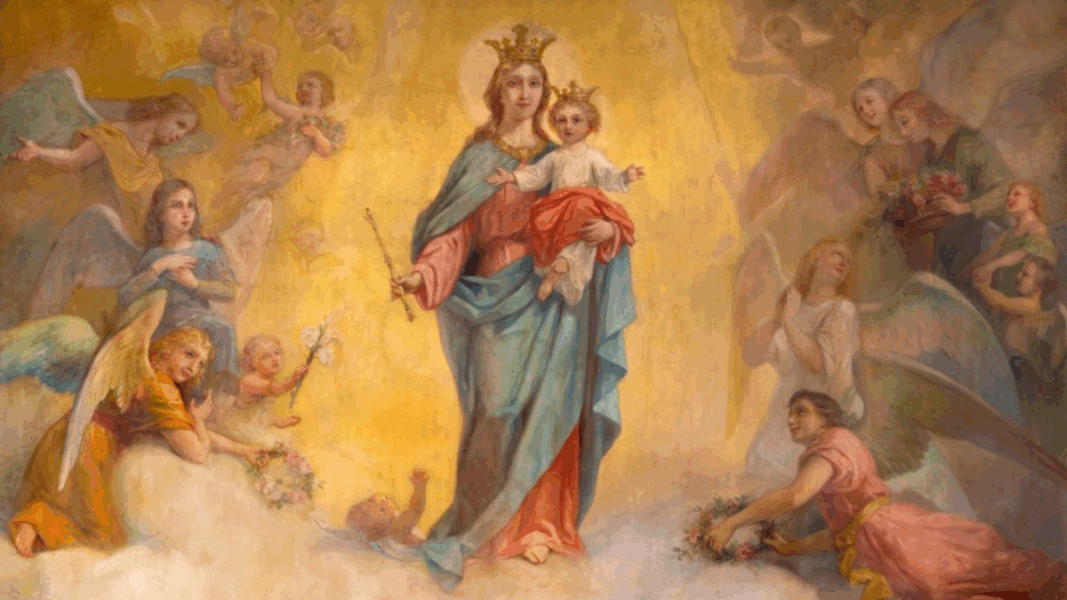
It causes deep bewilderment and pain that, in the name of a supposed pastoral prudence, the greatness of the Mother in the work of Salvation is publicly minimized. How can the author of the Nota doctrinal look the Son in the eyes when the most singular role of Her whom He Himself gave us as Mother at the foot of the Cross is avoided in proclamation? Defending the truth about Mary is not a secondary matter: it is honoring the will of the Redeemer and safeguarding the beauty of the divine plan. Every attempt to reduce her mission inevitably resonates as a wound inflicted on the Heart of Christ, who wanted her inseparably united to Him for our salvation.
Is there not here a very concrete spiritual temptation: acedia? That inability to rejoice in divine goods, described by tradition as sadness in the face of the holy. When Mary’s greatness becomes bothersome, a subtle malice toward heavenly goods then appears, a veiled rejection of what God has chosen to honor. There are those who, without openly denying her, seem uncomfortable with the glory that God has granted to his Mary, as if her light eclipsed Christ, when in truth it reflects and magnifies Him. That sadness in the face of God’s work in Mary does not come from the Spirit, but from human resistance—or worse still, from the enemy—before the splendor of the divine plan.
Throughout the history of the Church—as the Nota doctrinal explicitly recognizes—the figure of Mary has always been understood in profound relation to the mystery of Jesus Christ. Piety, theology, Tradition, and the Magisterium have venerated her not only as Mother of the Lord, but also as the intimate and subordinate associate in His redemptive work. From this living tradition arise titles such as Mediatrix of All Graces and Co-Redemptrix, used by popes, saints, and doctors to express Mary’s singular participation in the economy of salvation.
In recent times, in the name of what some call “ecumenical sensitivity” and “fear of possible misunderstandings,” certain progressive sectors—now installed in the highest hierarchical levels of the Church—have preferred to limit or omit the public use of these titles. They do not deny the doctrine that underpins them (as the Note from the CDF itself recognizes), but it is considered that their formulation might “obscure” Christ’s unique mediation.
Our purpose here is to show that the problem does not lie in the theological truth—abundantly grounded in the document—but in its pastoral interpretation and expression, used as a Trojan horse to gradually reduce doctrinal clarity. It is necessary to warn of the risk that these “linguistic options” end up weakening the very content of the faith.
Is the problem theological or hermeneutical?
The reservations of the Note toward the title Co-Redemptrix do not question its content, but the way it can be understood today.
The first confusion arises: the prefix co- means with, not equal to.
Subordinate cooperation, never parallel or competitive; it does not indicate equality with Christ, but cooperation: “With Christ and always subordinate to Christ.”
Christ is the unique Redeemer, the primary cause and absolute source of all grace. Mary is the associated instrument, fully dependent on Him.
This teaching is not accessory or merely devotional: it is sure doctrine, rooted in Tradition and supported by numerous pontiffs.
If we pay attention, the argument put forward is another: the “risk of confusion”—that some believers might interpret Mary as a “second redeemer” parallel to Christ. Even granting that such a misunderstanding might occur—which I do not believe possible—the decisive point is that the debate is not dogmatic, but hermeneutical (interpretation), linguistic (terminological clarity), and pastoral (cultural and ecumenical reception).
Here opens the decisive question: Can “pastoral prudence” become a norm that attenuates what the Church has taught for centuries?
When pastoral becomes the normative criterion
If a true title is stopped being used “to avoid confusions,” the real effect is: the weakening of catechesis, along with an impoverishment of the people’s faith and the dimming of Mary’s unique place in the Redemption.
As Tradition teaches: lex orandi, lex credendi. What ceases to be proclaimed ceases to be believed.
The problem is not the truth of the title, but the risk that pastoral ends up norming theology by omission, as if truth depended on the changing sensitivities of the era. We already know this dynamic: first it is affirmed that the doctrine remains intact, but then pastoral application alters the real perception of that doctrine among the Christian people.
The recent case of Fiducia supplicans is paradigmatic: it was assured that the Magisterium on marriage and sexuality did not change, and yet, under the argument of a “pastoral of benevolence,” the blessing of homosexual unions was introduced, provoking in the common conscience the impression of a doctrinal change that is officially denied.
This is how this drift works: what is pastorally tolerated ends up being interpreted as normative in the faith, even if theology asserts otherwise. In the same way, if Mary ceases to be proclaimed as Co-Redemptrix—though it is said that the doctrine remains—the practical result will be that the people of God will stop believing in what is no longer expressed.
A pastoral of this kind, which silences the truth, ceases to be pastoral: it becomes betrayal.
Manipulation of terms
The document does not err in its theological intention, but in its linguistic premise and argumentative logic.
The correct premise would be: “If there is a risk of misunderstanding the prefix co-, let us explain its subordination to Christ with clarity.”
But the reasoning suggested by the Note is: “Since it might be misunderstood, let us not use the term.”
Thus, the possibility of confusion is turned into a sufficient argument to discard a legitimate expression used for centuries by the Church.
This criterion is unsustainable: if applied coherently, most theological language should be eliminated (Transubstantiation, Person, Nature, Sacrifice, etc.), for all require explanation. Faith is taught: it is not reduced to what needs no clarification.
The doctrinal effect of silencing a true title
The abuse of pastoral language ends up producing a displacement of the sensus fidei: what ceases to be named ceases to exist in the consciousness of the Christian people. Even without formally condemning it, it is enough to avoid it for generations to erode its truth on the ecclesial plane: pastoral becomes a negative norm: “This is not said,” though it remains true. Time will take care of making it disappear.
López Quintás describes this mechanism of symbolic manipulation in four steps:
- A traditional name is labeled as “confusing”;
- Its public use is avoided;
- The people conclude that it is erroneous;
- The truth is marginalized without touching it.
What is no longer named ceases to exist for the consciousness.
In defense of the legitimacy of the term Co-Redemptrix
The assertion that the title Co-Redemptrix would be “inopportune” because it requires constant explanations cannot be accepted as a sufficient criterion. Every profound truth of the faith demands explanation: the Trinity, the Incarnation, Transubstantiation, the uniqueness of Christ as Mediator… Each of these expressions could “generate confusion” without proper catechesis. The Catholic solution never consisted in suppressing profound terms, but in purifying and explaining them faithfully.
Far from obscuring the unique Redemption, the title Co-Redemptrix illuminates it with greater force: Christ’s work is so perfect that it incorporates, not out of necessity but out of love, the free cooperation of a creature.
Everything in Mary is of Christ and leads to Christ. Her word at Cana—“Do whatever He tells you” (Jn 2:5)—is the hermeneutical light of her mission.
Therefore, the use of the title is theologically fruitful and precisely expresses a truth taught by the Church; a truth that cannot be dimmed or relegated in the name of pastoral, but on the contrary, must nourish and sustain all evangelizing action, for where Mary is welcomed and proclaimed, Christ is more fully recognized and loved.
Conclusion
The Church, or better, Card. Fernández, can nuance its language without modifying the doctrine; but history shows that when pastoral conditions the way of expressing the faith, it ends up shaping its understanding as well. If, out of misunderstood prudence, what is true is silenced, truth loses its illuminating force.
Safeguarding the Marian title of Co-Redemptrix—taught correctly and in full subordination to Christ—is not an exaggeration or a devotional concession, but an act of fidelity to the mystery as it has been contemplated and proclaimed by the Church. Defending this name is defending the integrity of the salvific plan: where Mary’s mission shines, the glory of the unique Savior is revealed with greater clarity.
Co-Redemptrix Mother and Mediatrix of All Graces!
PRAY FOR US!
You cooperated in the mystery of our salvation,
O Mother of the Savior,
and you were for us a bridge to God.
Note: Articles published as Tribuna express exclusively the opinion of their authors and do not necessarily represent the editorial line of Infovaticana, which offers this space as a forum for reflection and dialogue.