


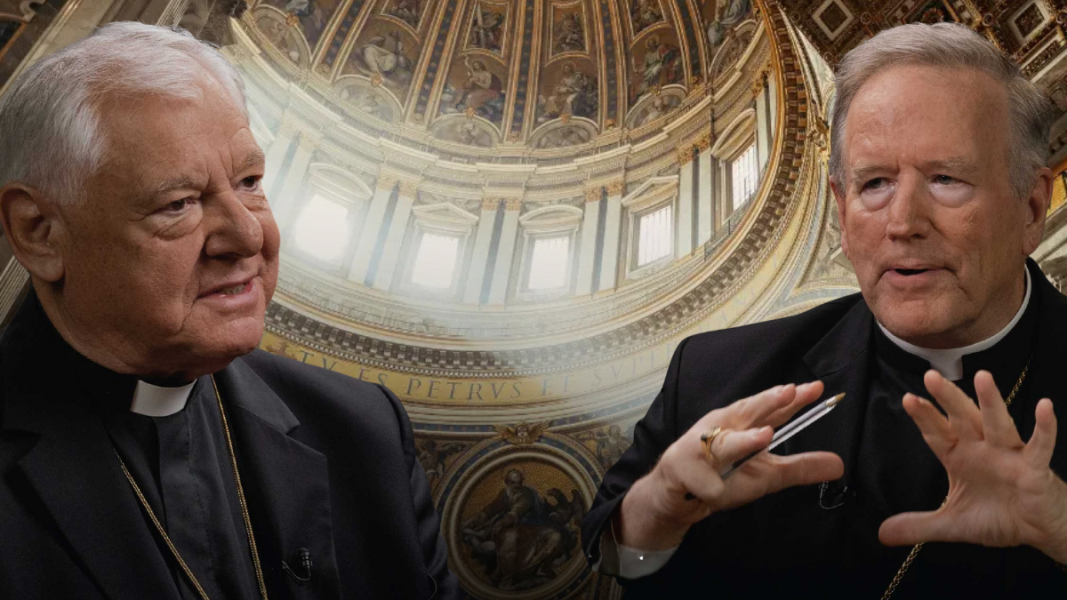
On November 6th, Bishop Robert Barron published on his YouTube channel an extensive interview with Cardinal Gerhard Ludwig Müller, former prefect of the Congregation for the Doctrine of the Faith under Benedict XVI and Francis. For nearly two hours, both reflected lucidly on the great intellectual and spiritual challenges of our time: modern gnosticism, Nietzsche’s nihilism, the role of reason in Catholic faith, Vatican II, and the fate of the Church in Europe.
Christianity in the face of the new gnosticism
One of the most striking moments of the conversation was when Müller warned about the return of an old heresy: gnosticism. “Pope Francis asked me to write a book on modern gnosticism, because it is the greatest challenge facing contemporary Christianity”, the cardinal recalled. For him, both gender ideology and contemporary relativism are expressions of that ancient temptation to separate the soul from the body and deny the incarnation.
“The body —he explained— belongs to me. It is not an instrument that I can manipulate; it is part of my identity. God became flesh, assumed our reality. That is why our body also participates in salvation and the resurrection”. In the face of a culture that dissociates the self from human nature, Müller emphasized that Christian faith affirms precisely the opposite: the unity of the person.
Nietzsche’s nihilism and the need to recover meaning
Another axis of the interview revolved around the influence of the philosopher Friedrich Nietzsche, whom Barron described as an omnipresent presence in the modern mentality. Müller agreed: “Nietzsche is the symbol of our time, a time marked by latent nihilism”.
The cardinal described his thought as “a suicidal philosophy”, born from the desperate attempt to fill the void left by the death of God. “When man eliminates God —he warned—, he denies himself. Then he seeks to replace that absence with drugs, sex, or ideologies. But he who listens to the voice of God needs no substitutes: he has a dignity that no ideology can give him”.
Reason and faith: Benedict XVI and the defense of the Logos
Recalling his closeness to the emeritus Pope Benedict XVI, Müller evoked the famous Regensburg lecture: “The act of faith must be free; faith and reason can never be separated or opposed”. For the cardinal, the great danger of Western thought has been “voluntarism”, that is, the supremacy of the will over intelligence. “When the will becomes arbitrary —he explained—, it opens the way to ideologies that seek to remake reality, even the human body, according to one’s own desire”.
Barron emphasized that in the Enlightenment era, the Church was accused of opposing reason, when in reality “the great defenders of reason have been the popes: John Paul II and Benedict XVI”. Müller agreed: “We are the religion of the Logos, of reason. Christian thought was what gave rise to the true age of reason, because faith presupposes intelligence”.
Vatican II and doctrinal continuity
Asked about the reception of Vatican II, Müller was categorical: “The doctrine of the Council is nothing other than the doctrine of the Church from the beginning. There is no rupture, but continuity”. He criticized both progressives who want to reinvent the Church and traditionalists who dream of an idealized past. “The problem —he said— is not choosing between Vatican I or Vatican III, but being faithful to the Gospel and the thought revealed in Jesus Christ”.
The cardinal insisted that ideological divisions within the Church reflect the fragmentation of Western thought since the Enlightenment. In the face of this, the Catholic mission is to unite revealed truth with modern culture, without betraying the faith or shutting itself up in ghettos.
Liberation and justice: the true social theology
In the final part of the interview, Barron mentioned Müller’s friendship with the Peruvian theologian Gustavo Gutiérrez. The cardinal explained that their relationship was theological, not political: “Gutiérrez wanted to overcome Marxism, not adapt it. Marxism does not liberate, it destroys”. In his view, authentic liberation theology does not seek to eliminate social classes, but to overcome hatred between them. “The Christian —he added— does not defeat his enemy by destroying him, but by turning him into a brother”.
Europe, faith, and mission
On the spiritual crisis of the Old Continent, Müller was forthright: “Christianity is the soul of our culture. If Europe renounces its Greek, Latin, and Christian roots, it will fall into a chaotic anthropology”. He criticized the fear of many bishops to be unpopular or attacked by the media, and reminded them of their mission: “A good shepherd lays down his life for his sheep, no matter what the wolves say”.
To conclude, the cardinal offered a reflection of great evangelical force:
“No philosopher nor any politician can save me in the hour of my death. Only Jesus Christ, the Son of God made man, can do it. He is the only Savior of the world”.
A dialogue that reaffirms the faith
The interview between Bishop Barron and Cardinal Müller was not just another academic disquisition, but a testimony of fidelity to Catholic truth in the face of the chaos of modern ideas. Between intellectual lucidity and pastoral firmness, both recalled the essential: Christianity is not a theory, but a real encounter with a Person —God made flesh— that gives meaning, reason, and hope to history.