


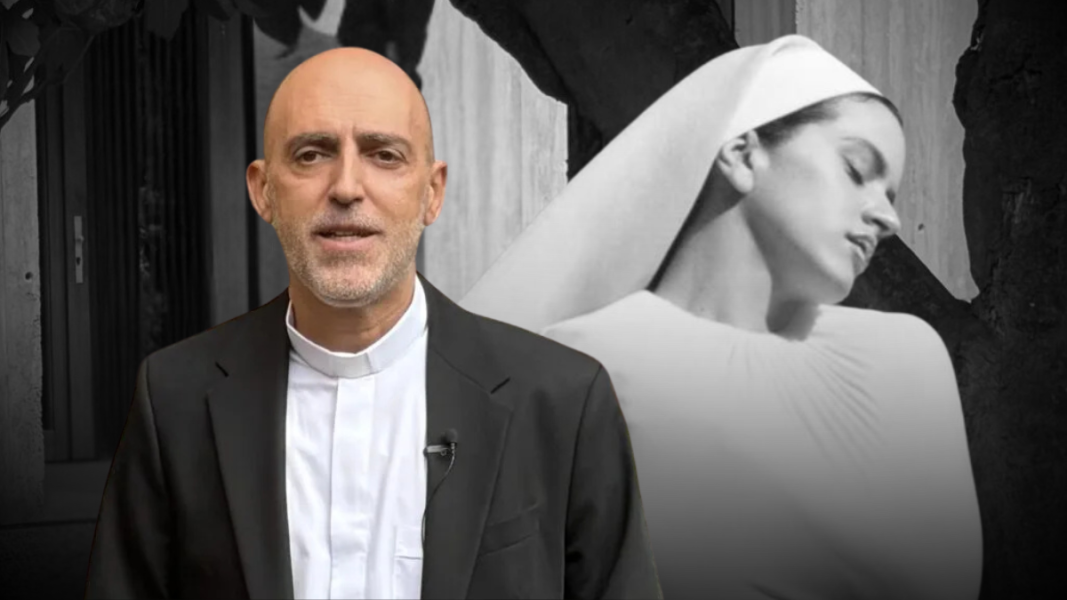
In an open letter published in the diocesan magazine Full dominical, Bishop Xabier Gómez García addresses Rosalía with a text loaded with questions about her work, her inner world, and her spiritual search. The prelate points out how the artist manifests a «thirst» that «the world cannot quench, that only God can fill», and describes her as if her art were «a spiritual journey, where creation is a form of pilgrimage toward what transcends».
The bishop writes to her:
«We are so far away… I write to you from this cover as one who throws a message into the sea inside a bottle; who knows if it can reach you. (…) Your lyrics unsettle me, but they also open me to the possibility of a dialogue about the complexity of the human experience. (…)»
With this letter, Mons. Gómez García transcends a mere cultural greeting to pose a challenge: can Rosalía’s art—which is public, media-driven, stylized—also lead to a search for true meaning, inner fullness, beyond the spectacle?
Rosalía’s Artistic Turn: Praises and Criticisms
The bishop’s message is inserted into a moment of artistic transformation for Rosalía. The Catalan, who rose to fame by fusing flamenco with pop and urban music, is experiencing a new phase. As various publications point out: her latest album—titled Lux—is described as a total turn in her career, moving her away from urban pop toward a more ambitious and transcendent work.
On the other hand, it is noted that her staging embraces mysticism and spirituality, facets that until now had been latent, but that now acquire conscious visibility.
An Intersection Between Faith, Art, and Market?
The bishop’s letter precisely raises what other analysts point out in the cultural world: the tension between art that seeks the transcendent and the industry that demands visibility, immediate success, and permanent renewal. In Rosalía’s case, the ecclesial invitation (to seek inner peace, to face silence) overlaps with the media discourse (to reinvent oneself, produce, stand out).
For the Church—and this is evident in the letter—the true art has a spiritual dimension, not just aesthetic or commercial. And in that sense, Rosalía’s work becomes a terrain of dialogue or conflict. Can an artist who operates on a large scale also assume that inner journey? Or is the risk that the spectacle replaces the mystery, and the “thirst” remains unsatisfied?
The bishop expresses it clearly: «If you don’t loosen the moorings, it won’t be easy to reach the port you long for». And this is no minor metaphor in the ecclesial world: it speaks of conversion, detachment, tension between the ephemeral and the eternal.
Religious Inspiration
Rosalía has explained the symbolic meaning of the cover of her new album, LUX, in which she appears covered with a veil similar to the habit of nuns. In an interview in Mexico City, she referred to the creative process and the inspiration she had, “I think that image was the one that best represented the project. It reflects that spiritual search and that sense of commitment. The habit, that piece that nuns wear on their heads, represents a dedication to a chosen cause, something to which life has been devoted”, the artist declared. “In my case, I feel very devoted to music. I dedicate my life to it with deep devotion. It is a different form, but also a commitment from respect and admiration toward them, not from provocation”.
Rosalía added that many women were her inspiration for LUX: “They were saints, many of them nuns who were also artists, women who lived in a very unconventional way”. She especially mentioned Saint Hildegard of Bingen, 12th-century Benedictine abbess, mystic, and composer: “She was an incredible polymath nun. She had visions and created in a way that, even today, still makes sense and continues to be deeply inspiring”.
Beauty as a Sign of the Eternal
The dialogue between art and faith that emerges from the artist’s new work and Mons. Gómez García’s letter finds a deep echo in the thought of Léon Bloy, the French writer who denounced the banalization of beauty and art detached from their divine root. For Bloy, true aesthetics could not be reduced to taste or success, but had to be a reflection of the Absolute. “There is only one sadness—he wrote—the one of not being saints” in the conclusion of his book «La mujer pobre». In his vision, authentic beauty is a call to conversion, not an end in itself.
Bloy saw in the artist a kind of prophet of Beauty, whose mission is to reveal the invisible through the visible. That is why he warned that art without faith becomes artifice: a mirror that no longer reflects the sky, but only man. “Beauty—he said—is not an adornment of the world, but its sacrament”.
In that key, the letter from the Bishop of Sant Feliu can be read as an invitation for Rosalía’s art not to remain on the aesthetic surface, but to delve into the thirst for the infinite that beats in every truly beautiful work. The figure of Saint Hildegard, mentioned by the artist herself, precisely represents that synthesis between contemplation and creation, where beauty does not distract from the mystery, but leads toward it.
Mons. Gómez García concludes his letter with an invitation to reflect on the inner search and surrender upon recognizing the mystery hidden in silence:
«There are silences that speak more than a thousand songs. I wonder if, when everything falls silent, you find peace or only more noise. Perhaps the answer is not outside, but inside you.»
We leave below the complete letter from Mons. Gómez García:
We are so far away… I write to you from this cover as one who throws a message into the sea inside a bottle; who knows if it can reach you.
I can’t manage to understand you, but I would like to. Your art, hypnotically eclectic and performative, and you yourself, generate questions in me. Perhaps it is not necessary to understand it. But I wonder what is in you, in your inner world in this stage or cycle of your life as a woman and artist.
When you speak of a «thirst» that the world cannot satisfy, that only God can fill that void, the search for meaning that runs through the film Andrei Rublev, by Tarkovsky comes to mind. The Russian painter, in the midst of darkness and violence, seeks light, beauty, faith, despite not finding easy answers. Like him, you seem to live art as a spiritual journey, where creation is a form of pilgrimage toward what transcends. But, you don’t quite do it… and without loosening the moorings it won’t be easy to reach the port you long for. If you wanted to arrive.
Your lyrics unsettle me, but they also open me to the possibility of a dialogue about the complexity of the human experience. You understand love as a force that can be painful, liberating, even divine. Your art is a space where vulnerability and strength coexist, where desire and faith can meet.
There are silences that speak more than a thousand songs. I wonder if, when everything falls silent, you find peace or only more noise. Perhaps the answer is not outside, but inside you.