


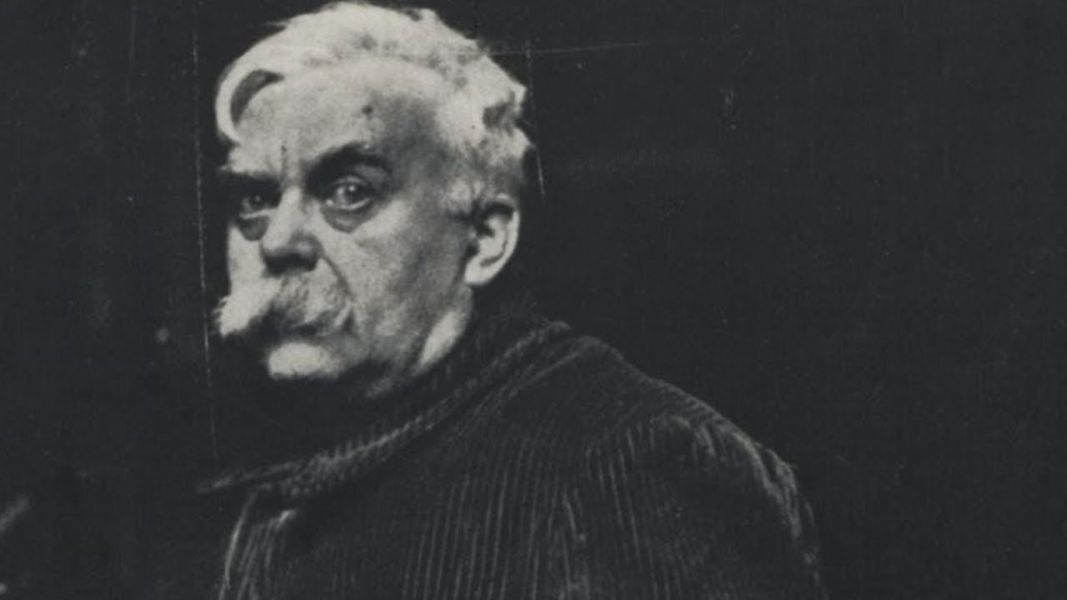
Among the Catholic writers of the late nineteenth century, few have left such a deep mark as León Bloy (1846–1917). His life was marked by material poverty and a scorching faith that permeated all his work. Friend of Charles Péguy and spiritual master of Jacques and Raïssa Maritain, Bloy was a man who wrote with a heart aflame and a pen soaked in prayer. For him, literature was not entertainment, but mission: a way to seek truth and make God visible through words.
He lived in a time when art was becoming increasingly aesthetic and less spiritual. In the face of positivism and religious indifference, Bloy denounced a world that had lost the sense of mystery and suffering. “The modern world has lost the sense of the tear”, he wrote, lamenting the frivolity of a society that no longer knew how to cry or contemplate. In that context, his voice rose like that of a prophet reminding artists of their sacred responsibility: not to entertain, but to illuminate.
Beauty as a Reflection of God
León Bloy understood beauty as a visible sign of God’s presence in the world. “Beauty is not a luxury, it is a necessity of the soul”, he affirmed with conviction. For him, any truly beautiful work had to arise from contemplation, not from ambition or ego. The artist, he said, does not create from nothing: he humbly participates in the divine creative work. In that sense, authentic art is always a form of prayer.
His thought is supported by classical theology: beauty, truth, and goodness are inseparable because they all point to the Creator. When one is separated from the others, it becomes perverted. Therefore, art detached from truth becomes a lie, and beauty without goodness turns into artifice. Bloy saw in that rupture the great drama of modernity: a culture fascinated by form, but empty of content.
“There is only one sadness: that of not being saints”
Bloy’s famous phrase summarizes his spirituality and his vision of art. For him, sanctity is the supreme measure of beauty. The soul that seeks perfection in love becomes a mirror of the divine, and from that inner purity springs true inspiration. “Only saints are perfect poets”, he wrote, convinced that grace does not suppress creativity, but elevates and purifies it.
In his diaries, the French author describes the artist’s life as an inner struggle, a pilgrimage toward the light. His aesthetic is not one of pleasure, but of sacrifice. “There is no beauty without the cross”, he repeated. The cross, for Bloy, is the supreme form of beauty, because in it love reaches its fullness. That is why he wrote harshly against empty aesthetes, those who confuse the beautiful with the flashy, forgetting that “art is a prayer when it stops speaking of itself”.
A Timely Voice Against Superficial Art
More than a century later, León Bloy’s voice continues to challenge the world of culture and believers themselves. In a society saturated with images, instant fame, and soulless stimuli, his thought invites us to look higher. It reminds us that beauty is not made for consumption, but for conversion; that it does not lull to sleep, but awakens; that it does not adorn faith, but announces it.
In a time when aesthetics dominates over ethics, Bloy’s testimony is a reminder that art cannot replace God, but lead toward Him. His austere and combative life shows that poverty and beauty are not opposed, because both are born from love that gives itself. In his radical language, Bloy sought to restore to art its prophetic dimension: to reveal the invisible amid the noise of the world.
Beauty as a Path to Truth
León Bloy’s teaching, more than an aesthetic theory, is a call to the conversion of the heart. Beauty, when it is true, does not exhaust itself: it points the way to Truth. “Everything that does not lead to God is vain”, he wrote. And in a century that seemed to have forgotten God, he strove to remind that art—when born from a soul wounded by grace—can still be a testimony of eternity.
His thought poses a question that remains current and necessary: Can contemporary art, amid the noise, success, and transience, once again look upward and recognize itself, once more, as a path to Truth?