


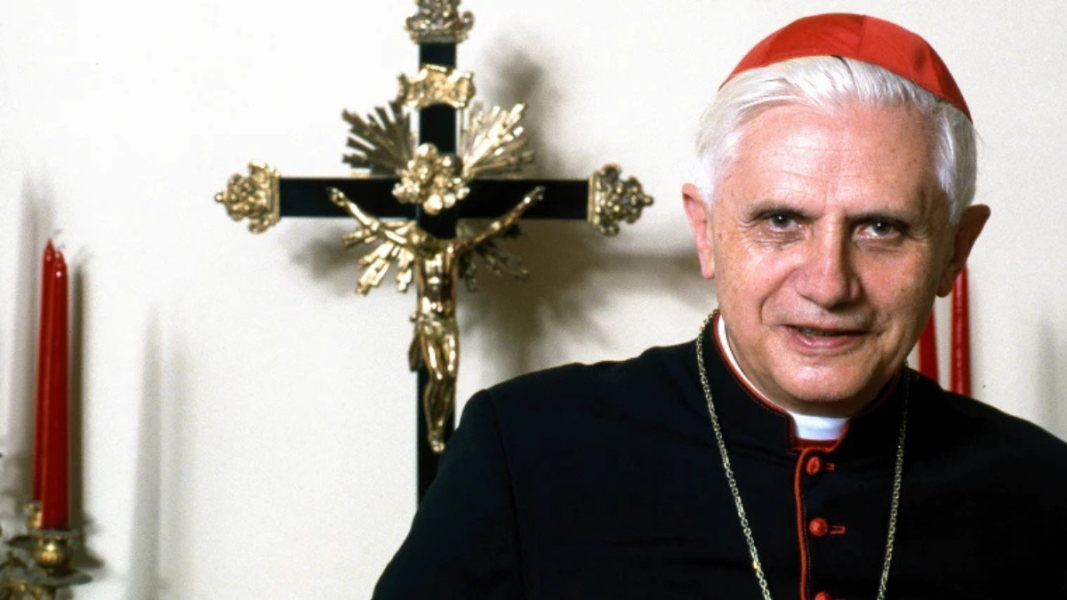
On April 18, 2005, Cardinal Joseph Ratzinger, then Dean of the College of Cardinals, presided over the Mass Pro eligendo Pontifice in St. Peter’s Basilica, prior to the conclave that would elect the successor to St. John Paul II. His homily, remembered for its theological clarity and prophetic tone, focused on the call to fidelity to Christ and the need for a mature faith in the face of the challenges of the modern world.
Ratzinger began his preaching with a reflection on God’s mercy and justice, drawing from the day’s readings. “Jesus Christ is divine mercy in person: to encounter Christ means to encounter God’s mercy,” he affirmed, emphasizing that Christ’s love does not trivialize evil but transforms it in the fire of his redemptive love.
“Christ’s mercy is not a cheap grace; it does not imply trivializing evil. Christ bears in his body and soul the full weight of evil, all its destructive force,” he expressed.
Mature faith in the face of the “dictatorship of relativism”
The most quoted part of his homily was the one referring to the risks of modern thought detached from revealed truth. Drawing from the letter to the Ephesians, Ratzinger warned against the “winds of doctrine” that carry away many Christians and defended the need for an “adult” faith, rooted in friendship with Christ.
“How many winds of doctrine have we known in the last decades! From Marxism to liberalism, from atheism to a vague mysticism… Whoever has a clear faith is labeled a fundamentalist, while relativism presents itself as the only adequate attitude. A dictatorship of relativism is being established that recognizes nothing as definitive and leaves as the ultimate measure only one’s own ego and its whims,” warned the then cardinal.
These words, spoken just hours before the start of the conclave, set the tone for a reflection that transcended the liturgical moment. For Ratzinger, the true maturity of faith does not consist in adapting to fashions but in maintaining fidelity to Christ as the measure of true humanism.
Friendship with Christ, measure of freedom
In another central passage, the cardinal explained the meaning of Jesus’ words in the Gospel of St. John: “I no longer call you servants, but friends.” From them, he presented a profound vision of Christian life as a communion of wills between God and man.
“Friendship with Christ coincides with what the Our Father expresses: ‘Thy will be done.’ In Gethsemane, Jesus transformed our rebellious will into a will united with the Father’s. Thus he gave us true freedom,” he said.
Ratzinger added that this friendship with Christ implies responsibility: the disciple is called to bear fruit that remains, to sow in souls “love, knowledge, and the word that opens the heart to the joy of the Lord.”
“We ask for a shepherd according to God’s heart”
In the final stretch of his homily, Cardinal Ratzinger asked the faithful to pray for the future Pope, after the long pontificate of St. John Paul II.
“Let us pray insistently to the Lord so that, after the great gift of Pope John Paul II, he may give us again a shepherd according to his heart, a shepherd who guides us to the knowledge of Christ, to his love and to true joy.”
The next day, Ratzinger himself would be elected Supreme Pontiff, taking the name Benedict XVI. Over time, that 2005 homily has become one of the most representative texts of his theological and pastoral thought, for its lucid diagnosis of contemporary culture and its call to the firmness of faith.
We leave below the full homily of Cardinal Joseph Ratzinger:
In this hour of great responsibility, let us listen with particular attention to what the Lord tells us with his own words. From the three readings, I would like to choose only some passages that concern us directly in a moment like this.
The first reading presents a prophetic portrait of the figure of the Messiah, a portrait that receives its full meaning from the moment Jesus reads this text in the synagogue of Nazareth, when he says: “This Scripture has been fulfilled today” (Lk 4:21). At the center of the prophetic text is a word that, at least at first glance, seems contradictory. The Messiah, speaking of himself, says that he has been sent “to proclaim the year of the Lord’s favor, a day of vengeance for our God” (Is 61:2). We hear, with joy, the announcement of the year of mercy: divine mercy sets a limit to evil, the Holy Father told us. Jesus Christ is divine mercy in person: to encounter Christ means to encounter God’s mercy. Christ’s mandate has become our mandate through priestly anointing; we are called to proclaim, not only with words but also with life, and with the effective signs of the sacraments, “the year of the Lord’s favor.” But what does Isaiah mean when he announces the “day of vengeance of the Lord”? Jesus, in Nazareth, in his reading of the prophetic text, did not pronounce these words; he concluded by announcing the year of mercy. Was this, perhaps, the reason for the scandal that occurred after his preaching? We do not know. In any case, the Lord gave his authentic commentary on these words with his death on the cross. “He himself bore our sins in his body on the tree…,” says St. Peter (1 Pt 2:24). And St. Paul writes to the Galatians: “Christ redeemed us from the curse of the law by becoming a curse for us—for it is written, ‘Cursed is everyone who hangs on a tree’—in order that in Christ Jesus the blessing of Abraham might come to the Gentiles, so that we might receive the promise of the Spirit through faith” (Gal 3:13-14).
Christ’s mercy is not a cheap grace; it does not imply trivializing evil. Christ bears in his body and soul the full weight of evil, all its destructive force. He burns and transforms evil in suffering, in the fire of his suffering love. The day of vengeance and the year of mercy coincide in the Paschal mystery, in Christ dead and risen. This is God’s vengeance: he himself, in the person of his Son, suffers for us. The more we are touched by the Lord’s mercy, the more we are in solidarity with his suffering, the more we are willing to complete in our flesh “what is lacking in Christ’s afflictions” (Col 1:24).
Let us move to the second reading, to the letter to the Ephesians. Here it is essentially about three things: first, the ministries and charisms in the Church, as gifts of the Lord risen and exalted to heaven; then, the maturing of faith and knowledge of the Son of God, as the condition and content of the unity of Christ’s body; and finally, the common participation in the growth of Christ’s body, that is, the transformation of the world into communion with the Lord.
Let us pause only on two points. The first is the path toward “the maturity of Christ”; thus says, simplifying a bit, the Italian text. According to the Greek text, we should speak more precisely of the “measure of the fullness of Christ,” to which we are called to attain to be truly adults in faith. We should not remain children in faith, minors. What does it mean to be children in faith? St. Paul answers: it means being “tossed to and fro and carried about with every wind of doctrine…” (Eph 4:14). A very current description!
How many winds of doctrine have we known in these last decades, how many ideological currents, how many fashions of thought!… The little boat of the thought of many Christians has often been tossed about by these waves, carried from one extreme to the other: from Marxism to liberalism, even to libertinism; from collectivism to radical individualism; from atheism to a vague religious mysticism; from agnosticism to syncretism, etc. Every day new sects are born, and what St. Paul says about the deceit of men is fulfilled, about the cunning that tends to lead into error (cf. Eph 4:14). Whoever has a clear faith, according to the Church’s Creed, is often labeled a fundamentalist. Whereas relativism, that is, letting oneself “be tossed to and fro by every wind of doctrine,” seems to be the only attitude appropriate in our times. A dictatorship of relativism is being established that recognizes nothing as definitive and leaves as the ultimate measure only one’s own ego and its whims.
We, on the other hand, have another measure: the Son of God, the true man. He is the measure of true humanism. An adult faith is not one that follows the waves of fashion and the latest novelty; adult and mature is a faith deeply rooted in friendship with Christ. This friendship opens us to everything that is good and gives us the criterion to discern between the true and the false, between deception and truth. We must mature this adult faith; we must lead Christ’s flock to this faith. This faith—only faith—creates unity and is realized in charity. On this point, St. Paul, in contrast to the continual wanderings of those who are like children tossed by the waves, offers us these beautiful words: “speaking the truth in love,” as the fundamental formula of Christian existence. In Christ, truth and charity coincide. In the measure that we approach Christ, also in our life, truth and charity are fused. Charity without truth would be blind; truth without charity would be like “a resounding gong” (1 Cor 13:1).
Now let us go to the Gospel, from whose richness I would like to extract only two small observations. The Lord addresses these admirable words to us: “I no longer call you servants…, but I have called you friends” (Jn 15:15). Often we feel—and it is the truth—only useless servants (cf. Lk 17:10). And yet, the Lord calls us friends, makes us his friends, gives us his friendship. The Lord defines friendship in two ways. There are no secrets between friends: Christ tells us everything he hears from the Father; he gives us all his confidence and, with confidence, also knowledge. He reveals his face, his heart to us. He shows us his tenderness for us, his passionate love that goes to the folly of the cross. He trusts in us, gives us the power to speak with his I: “This is my body…”, “I absolve you…”. He entrusts his body, the Church, to us. He entrusts to our weak minds, to our weak hands, his truth, the mystery of God the Father, Son, and Holy Spirit; the mystery of God who “so loved the world that he gave his only Son” (cf. Jn 3:16). He has made us his friends, and we, how do we respond?
The second way Jesus defines friendship is the communion of wills. “Idem velle, idem nolle,” was also for the Romans the definition of friendship. “You are my friends if you do what I command you” (Jn 15:14). Friendship with Christ coincides with what the third petition of the Our Father expresses: “Thy will be done on earth as it is in heaven.” In the hour of Gethsemane, Jesus transformed our human will, rebellious, into a will conformed and united with the divine will. He suffered the whole drama of our autonomy and, precisely by placing our will in God’s hands, gives us true freedom: “Not as I will, but as you will” (Mt 26:39). In this communion of wills our redemption is accomplished: to be friends of Jesus, to become friends of Jesus. The more we love Jesus, the more we know him, the more our true freedom grows, the joy of being redeemed grows. Thank you, Jesus, for your friendship!
The other aspect of the Gospel to which I wanted to allude is Jesus’ discourse on bearing fruit: “I have destined you to go and bear fruit and that your fruit should remain” (Jn 15:16). Here appears the dynamism of the Christian’s existence, of the apostle: I have destined you to go… We must be driven by a holy restlessness: the restlessness to bring the gift of faith, of friendship with Christ, to all. In truth, God’s love, God’s friendship has been given to us so that it may reach others as well. We have received faith to transmit it to others; we are priests to serve others. And we must bear fruit that remains. All men want to leave a mark that remains. But what remains? Money, no. Nor buildings; books, no. After a certain time, more or less long, all these things disappear. The only thing that remains eternally is the human soul, the man created by God for eternity. Therefore, the fruit that remains is everything we have sown in human souls: love, knowledge; the gesture capable of touching the heart; the word that opens the soul to the joy of the Lord. So let us go and ask the Lord to help us bear fruit, a fruit that remains. Only thus is the earth transformed from a valley of tears into God’s garden.
Finally, let us return once more to the letter to the Ephesians. The letter says, with the words of Psalm 68, that Christ, as he ascended to heaven, “gave gifts to men” (Eph 4:8). The victor gives gifts. These gifts are: apostles, prophets, evangelists, pastors, and teachers. Our ministry is a gift from Christ to men, to build his body, the new world. Let us live our ministry in this way, as a gift from Christ to men! But in this hour, above all, let us pray insistently to the Lord so that, after the great gift of Pope John Paul II, he may give us again a shepherd according to his heart, a shepherd who guides us to the knowledge of Christ, to his love, to true joy. Amen.