


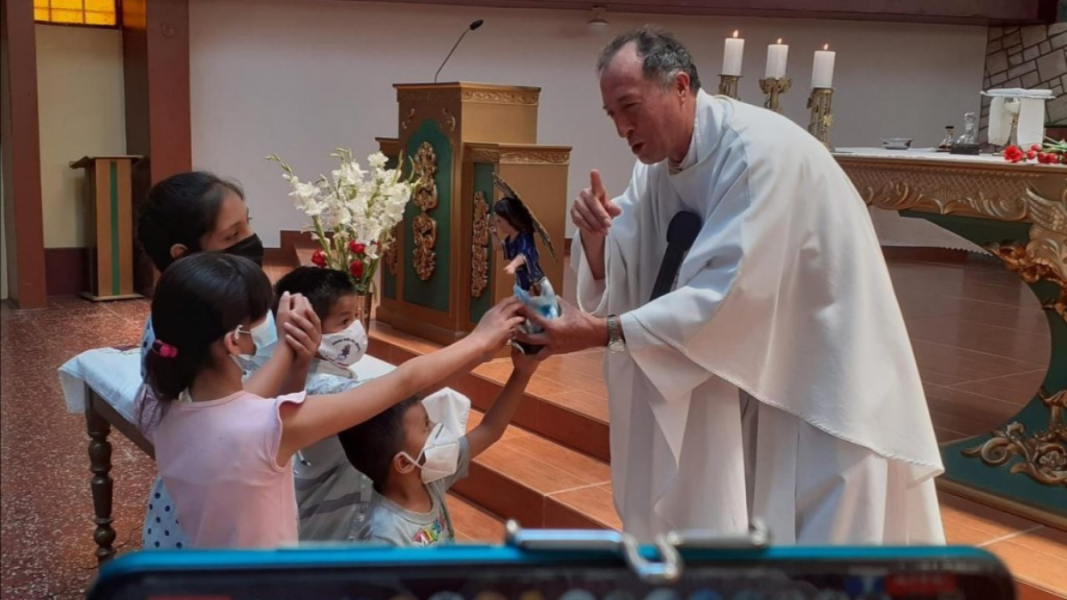
The recordings and testimonies from the ecclesiastical investigation into the priest Eleuterio Vásquez González, known as Father Lute, show an indisputable fact that adds to the accumulation of blunders that Infovaticana has been reporting: the aggressor admitted the abuses he committed against minors in Chiclayo, but does not consider them a crime because, in his view, there was no “complete sexual act”.
The explicit recognition
The delegate of the Diocese for the case, Giampiero Gambaro, explained it clearly to the victims on April 23, 2025 in a conversation in which he tried to convince them to accept that the case not be judged and that Lute avoid justice through the acceptance of a dispensation from the clerical state:
“The problem is that Father Eleuterio does not consider those facts a crime. He does not consider them a crime. And that’s why they say there is no proof, that there is no… he doesn’t consider it. It may be that he considered it a sin, this in his internal forum we are not interested in. But he does not consider it a crime, because the objective facts themselves, for him, are not a crime. Sexual abuse for this type of mind, a bit macho, a bit narcissistic, etc., is only the complete sexual act. So, what am I guilty of? Of nothing. There is no crime”.
In those words there is a doubly grave admission. On one hand, the delegate himself acknowledges that the priest admits to having committed acts of sexual abuse against the girls—in the most serious cases, of 9 and 11 years old—. On the other, he confirms that the abuser does not perceive them as a crime. It is, therefore, an explicit recognition of the facts, accompanied by a moral minimization that blurs the boundary between sin and crime.
Gambaro even reflects on the mind of the aggressor, as if his perception partially justified the situation:
“This is serious, it’s serious because of the type of training he has. That priests have… because here it’s a somewhat bigger issue, but it’s the training of the priests who are in Chiclayo… and for a person like that, with this profile, the fact of not being able to celebrate Mass, of not being the leader of the community, of being acclaimed as the genius of the devotion to the Eucharistic miracle… not being part of that thing that appears on social media… well, it’s not easy, right?”.
The tone, which pretends to be analytical, ends up conveying empathy toward the victimizer. Instead of placing the focus on the victims, it describes with compassion the priest’s suffering for not being able to celebrate Mass, as if that ministerial loss were comparable to the trauma of the abuses.
A hierarchy of pain
In November 2023, the priest Julio Ramírez, delegate of the Diocese of Chiclayo appointed by Robert Prevost to communicate with the victims, had already conveyed this same argument of minimization to the victims due to the absence of penetration in the abuses.
“in the case of the Church, the testimony has been taken, it has been sent there, but nothing more has been done. We know that the Pope does not archive cases of sexual violence, but… I don’t want it to sound bad, nor are we defending it, but since it hasn’t reached a situation… I know it’s traumatic what they’ve experienced, but they haven’t reached a situation of a proper violation, as if priority has been given to other cases that do have a strong complication. So that’s what I know and that’s what Monsignor told me… it seems that Rome has given priority to cases with stronger situations”.
These statements constitute a testimony of ecclesiastical negligence unworthy of a Church that in 2022 and 2025 should have learned the lesson. It is unworthy to officially convey to the victims that their case “does not deserve priority” because “there was no proper violation.” From a legal and moral perspective, this amounts to a banalization of sexual abuse and a denial of its intrinsic gravity.
Negligence cloaked in pastoral language
The discourse of both ecclesiastical representatives, Gambaro and Ramírez, reveals the same pattern: admitting the facts but downplaying their penal and moral weight. Instead of recognizing that any forced, coercive, or abusive sexual contact constitutes a serious crime and that the Church must pursue it to the last consequences, a scale of “gravity” is introduced that would grant more attention to cases with penetration, and they are proposed to be satisfied with opaque files and dispensations in fraud of law.
That approach contradicts both civil law and canon law. According to canon 1398 § 1, any cleric who “attempts against the sixth commandment of the Decalogue with a minor” commits a crime, without requiring penetration or consummation. And from a moral perspective, Catholic theology recognizes that sexual abuse is a violation of human dignity that does not depend on the type of physical act.
What these words show, beyond the intention, is an institutional structure of tolerance: the abuse is accepted as having existed, the abuser is humanized, the harm is relativized, and justice is postponed.
A recognition that obliges action
Father Lute’s case is no longer a matter of presumption: there is recognition of the abuses before the Church representatives investigating the case. The words of Gambaro and Ramírez are, in themselves, a moral and pastoral proof that the Church has full knowledge of the facts.
What is missing, and what the victims demand, is justice: not empathy with the abuser, nor technicalities about penetration, but comprehensive reparation and a firm condemnation. Because when an institution recognizes a crime and, at the same time, relativizes it, it ceases to be a judge to become an accomplice.