


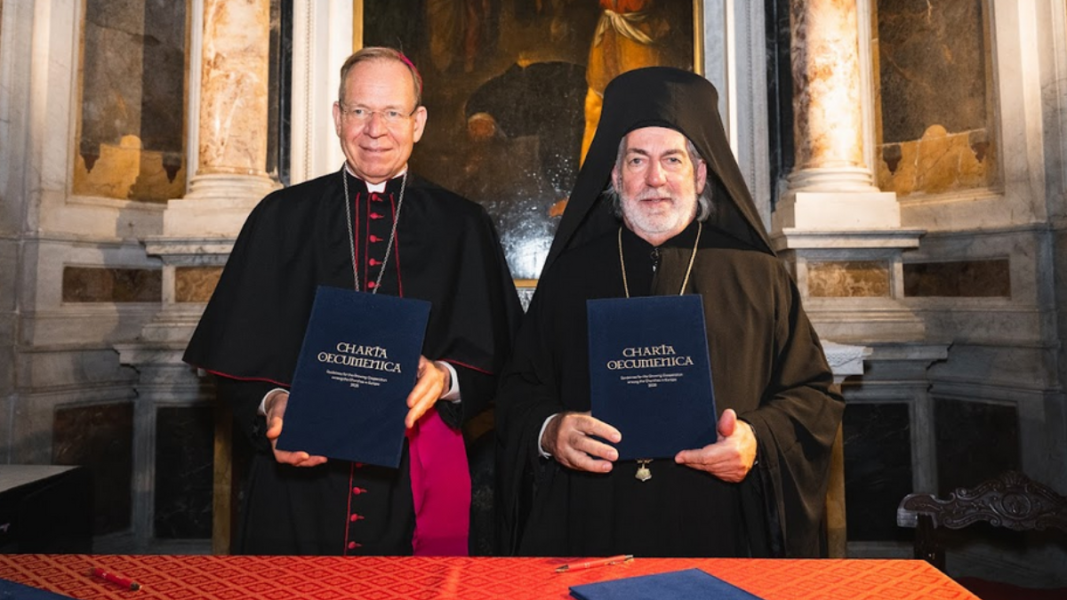
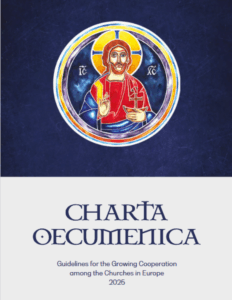
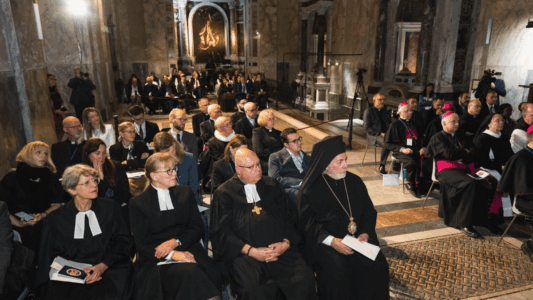
With a gesture for dialogue between Christian Churches, the Conference of European Churches (CEC) and the Council of European Bishops’ Conferences (CCEE) signed on November 5 in Rome the updated version of the Charta Oecumenica, a joint document that renews the commitment of the Churches of Europe to unity, collaboration, and the common witness of faith.
A Step Towards «Christian Unity»
The new Charta Oecumenica was signed by Archbishop Nikitas of Thyateira and Great Britain, president of the CEC, and Archbishop Gintaras Grušas of Vilnius, president of the CCEE. Both highlighted that the document represents a call for cooperation and the common witness of faith. “Our commitment as Churches is not abstract: it is rooted in a shared faith, lived amid pain, division, and hope,” stated Archbishop Nikitas. “We must proclaim the Gospel together, defend human dignity, and work for justice, peace, and the care of creation.”
For his part, Archbishop Grušas emphasized that the new charter arrives “at a crucial moment for Europe,” by offering tools to respond united “to the wounds of war, the drama of migrants, and the ethical challenges of new technologies.” He also insisted on the need to involve young people in building Christian unity and to create spaces for reconciliation and dialogue.
A Christian Vision for Current Challenges
Originally signed in 2001, the Charta Oecumenica has since been a reference text for the ecumenical movement in Europe. The updated version, published in the year commemorating the 1700th anniversary of the Council of Nicaea, responds to a transforming social, cultural, and religious context. The document reaffirms the Churches’ commitment to peace and reconciliation, the welcome of migrants and refugees, the protection of creation, and dialogue with Jewish and Muslim communities. Additionally, it addresses the ethical implications of emerging technologies and gives a prominent role to young people as protagonists of ecumenism.
A Horizontal Ecumenism and a Church in Dialogue
The content of the new Charter reflects a growing trend: that of a practical ecumenism of cooperation rather than doctrinal conversion. There is insistent talk of “visible unity,” “dialogue,” and “reconciled diversity,” but the text avoids any explicit reference to the primacy of Peter, to the Eucharist as the center of communion, or to the Church as the “visible and hierarchical Body of Christ”.
This type of ecumenism—presented as an extension of the current synodal path—relies on the horizontality of consensus and the language of cooperation, leaving the theological and sacramental dimension in the background. The Church, in its legitimate desire to promote unity, cannot dilute its identity in diplomatic negotiations nor hide its apostolic essence behind ambiguous agreements. Charity demands dialogue; but truth demands clarity.
True ecumenism does not consist in downplaying differences to coexist better, but in calling all the baptized to the fullness of faith and ecclesial communion. When the Church forgets this horizon, it runs the risk of becoming just another social actor, losing its missionary force and apostolic zeal.